




The numbers tell a story that India’s HR community has been slow to fully absorb. While the country’s white-collar hiring index slipped 5 per cent in March, moving from 404 in February to 385, the more consequential figure sits elsewhere entirely. India’s white-collar gig workforce crossed 8.23 million jobs in FY26, up 21 per cent from 6.8 million the year before, and is on a trajectory to breach 10.2 million by FY27. The permanent hiring index wobbled.
The gig market barely noticed. This decoupling is the real story.

The numbers that matter
For years, India’s flexible workforce was understood as a safety valve: something workers turned to when permanent jobs were scarce, and something companies tolerated rather than planned around. That characterisation no longer holds. Project-based hiring grew 33 per cent in FY26 and now accounts for a third of all gig hiring. By FY27, the foundit Insights Tracker projects it will become the dominant format. What was once an alternative employment structure is becoming the primary one.
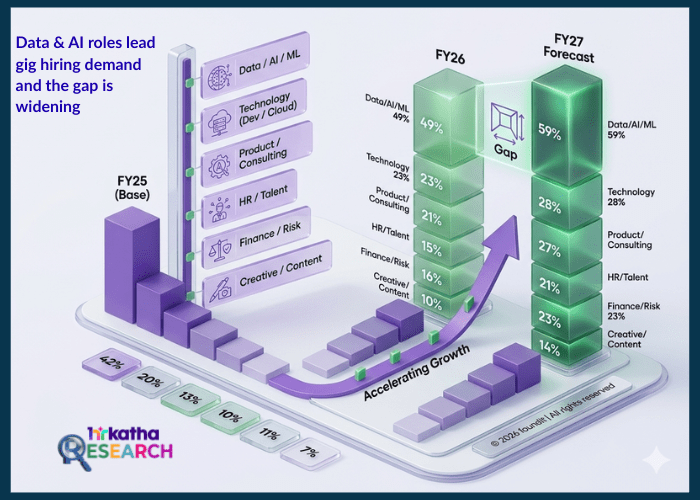
The composition of demand has shifted just as dramatically as the volume. Data, artificial intelligence, and machine learning roles commanded 49 per cent of all gig hiring in FY26, up from 42 per cent in FY25. By FY27, that figure is forecast to reach 59 per cent. No other function comes close to this pace of growth. Technology development and cloud roles follow at 28 per cent, with product and consulting functions at 27 per cent. The message from the market is unambiguous: organisations are not simply outsourcing routine tasks through flexible arrangements. They are executing their most strategically critical work through them.
There is a structural logic to this. Artificial intelligence projects, cloud migrations, and compliance mandates tend to be outcome-defined and time-bound. They suit gig structures naturally. A company building a credit-risk model for its lending platform does not necessarily need a permanent machine-learning engineer on staff for three years. It needs one for nine months, performing at the highest level, accountable to a specific deliverable. The gig market has become the mechanism through which organisations access exactly this kind of concentrated, expert capacity.
Experience commands a premium, and the gap is widening
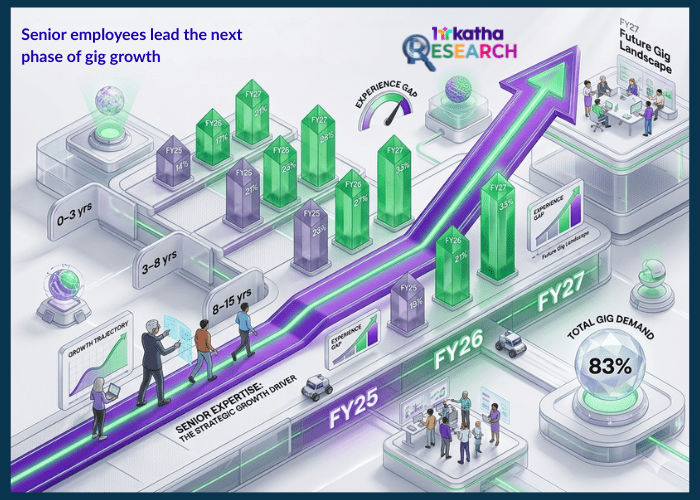
Perhaps the most telling signal in the data concerns seniority. Senior gig talent, professionals with 15 or more years of experience, is the fastest-scaling cohort in the market. Growth in this segment is forecast to reach 35 per cent by FY27, up from 15 per cent in FY25. Mid-senior professionals with 8 to 15 years of experience follow, with a 33 per cent forecast. Entry-level gig talent is growing too, but at roughly half the pace of senior cohorts.
The gap between the youngest and most experienced cohorts was a single percentage point in FY25. By FY27, the tracker projects it will reach 14 points.
This is a remarkable inversion of how the gig economy is popularly imagined. The dominant cultural narrative still tends to associate flexible work with young freelancers and fresh graduates piecing together income between more stable arrangements. The actual demand structure increasingly resembles something closer to a premium market for seasoned expertise. Organisations navigating GCC expansion, BFSI regulatory complexity, and digital transformation prefer a proven senior hire on defined terms over a permanent appointment that locks in both cost and strategic direction.
For younger professionals, this creates a more nuanced career calculation than simply choosing between stability and flexibility.
Where the growth is happening
Sectoral and geographic patterns add further texture. Manufacturing and GCCs are set to overtake both IT/Tech and BFSI as the highest-growth gig segment by FY27, with a 29 per cent forecast share. Industrial capacity expansion and the acceleration of capability centre buildouts are doing the work here, generating demand for specialised talent on defined timelines that permanent hiring pipelines struggle to serve.
Geographically, the story is quietly subversive. Tier-2 cities, taken together, are growing faster than any metro, with a 39 per cent forecast for FY27. Bengaluru and the Tier-1 cluster of Hyderabad, Pune, and Chennai follow, but the trajectory of gig talent growth runs increasingly outside India’s traditional hiring hubs. Cities such as Coimbatore, which has seen 40-plus per cent spikes in earlier periods driven by IT services and analytics, and Vadodara, benefiting from GCC-linked manufacturing roles, are no longer peripheral to this story.
Remote work is accelerating the shift. Fully remote gig roles accounted for 39 per cent of all flexible positions in FY26, up from 34 per cent the year before, and are forecast to reach 45 per cent by FY27. When geography no longer constrains access to talent, Tier-2 cities stop being second-tier alternatives. They become competitive talent pools.
The wrong question
Much of the popular commentary on India’s gig expansion reaches too quickly for the same conclusion: that flexible work is eroding traditional employment, and that this erosion is either a catastrophe or a liberation, depending on the commentator’s priors. Both framings miss the more accurate picture.
Permanent employment is not retreating. It is evolving alongside a parallel structure that is scaling independently. The white-collar hiring index held at plus 1 per cent year-on-year in March, with the six-month reading at plus 7 per cent. Organisations have not abandoned permanent headcount. They have become more precise about which roles warrant it. Functions aligned to domestic consumption, operational continuity, and regulatory compliance continue to see sustained permanent hiring demand. What the gig market is absorbing is a specific and growing category of work: specialised, project-defined, and often requiring expertise that is too scarce and too expensive to retain permanently.
For professionals, particularly younger ones still building their foundations, the smarter framing may be additive rather than binary. A permanent role provides the mentorship, credentialing, and institutional exposure that early careers require. Gig work, increasingly accessible even from smaller cities, offers a mechanism to diversify income, accelerate experience, and build a portfolio of demonstrated outcomes. Many professionals are already navigating both simultaneously.
The market, in any case, is not waiting for the debate to resolve. With 10.2 million white-collar gig jobs projected by FY27 and data/AI/ML roles alone forecast to represent 59 per cent of gig demand, India’s flexible talent market has moved well past the point where it requires anyone’s philosophical endorsement. It is simply growing, on its own logic, at its own pace.