


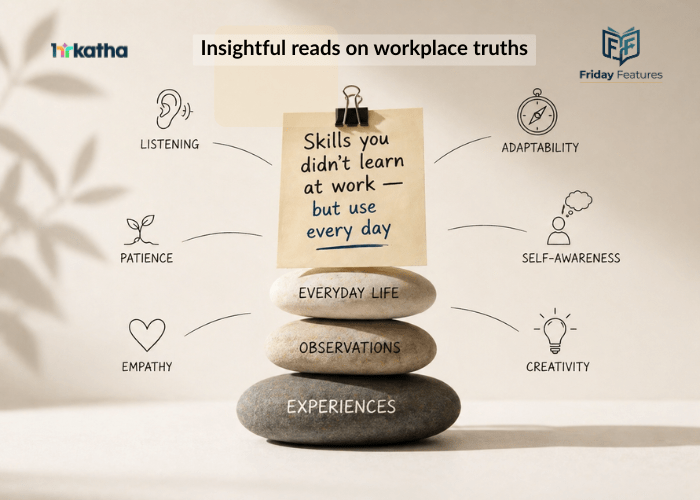
Most people can trace at least one work habit back to something that had nothing to do with work.
The calm you hold in a tense meeting. The way you listen when someone is struggling. The instinct to pause, read the room, and not react immediately. None of this came from a training deck. Most of it came from life – from a parent you observed, a difficult phase you navigated, or a hobby that had no outcome attached.
And yet, these are often the very things people notice most at work.
The skill of truly listening didn’t come from a workshop
Atul Mathur, EVP-HR, Aditya Birla Capital
For Atul Mathur, the most valuable workplace skill came from watching his father speak to people.
There was no hierarchy in those conversations. No impatience. No divided attention. Just complete presence, whether the person across the table was important or not.

The lesson was simple. When someone feels heard, half the problem is already solved.
He explains it in a way most people will recognise. Think of a doctor’s appointment. When the doctor listens properly, you leave reassured even before the medicine works. When they don’t, the doubt lingers.
The same dynamic plays out at work. People can sense the difference between listening to respond and listening to understand.
The lesson deepened when he became a parent. Raising a child builds a kind of patience that no formal programme can replicate. A crying child teaches you something fundamental. Behaviour always has a reason. The task is not to react, but to understand.
That shift is where leadership quietly begins.
The real skill is knowing when to dial it up or down
Shaleen Manik, CHRO, Transsion India
Shaleen Manik agrees that life builds powerful skills. Resilience, patience, empathy, decision-making under pressure.
But he focuses on a question most people overlook. What happens when these skills travel to the wrong context?
“The real capability lies in how you adapt these skills across situations,” he says.

It sounds obvious, but it isn’t. Many people are patient at home and impatient at work. Warm in personal spaces, but uncomfortable having difficult conversations professionally.
The skill exists. The calibration does not.
He adds another layer. Every strength carries a shadow. A competitive background can build drive, but also aggression. A nurturing personality can build trust, but also hesitation in pushing back.
The experiences people value can quietly become blind spots if left unexamined.
His conclusion is clear. Self-awareness matters more than the skill itself. Two people can go through the same experience and take away entirely different lessons.
And perhaps the most underrated ability of all is the willingness to unlearn. What made you effective once can, over time, start holding you back.
The canvas doesn’t rush—and neither does good leadership
Arunima Mohanty, CHRO, Metalman Auto
For Arunima Mohanty, CHRO, Metalman Auto, the most enduring lessons in leadership didn’t come from boardrooms—they came from a canvas.

What began as a childhood hobby—playing with colours, textures, and blank spaces—quietly shaped how she approaches both work and life today. Painting, she says, taught her something most workplaces struggle to reinforce: patience. A canvas doesn’t come together in one perfect stroke. It evolves, layer by layer, with corrections, pauses, and perspective.
That way of thinking now shows up in how she leads. Building teams, shaping culture, and making decisions—none of it is instant. It requires stepping back, observing, and allowing things to unfold without rushing to fix everything at once.
“Painting taught me that not every stroke needs to be perfect—but every stroke adds to the outcome. That perspective has helped me stay composed in high-pressure situations and respond thoughtfully rather than react instantly,” she shares.
The influence runs deeper. As a single parent, this same mindset helps her navigate parenting with empathy rather than control. Just like no two canvases are the same, no two individuals are either—each requiring a different balance of guidance and freedom. The ability to “see beyond the surface,” something art naturally builds, has shaped how she connects both with her daughter and with people at work.
Interestingly, painting has also sharpened her professional instincts in less obvious ways. It has trained her to balance structure with creativity—something every HR leader constantly negotiates. Policies and people, metrics and emotions—these aren’t opposing forces, but elements that need to coexist, much like composition in art.
And then there’s resilience. Every artist knows the phase where a painting doesn’t look right—where it feels like it’s falling apart before it comes together. That, she says, mirrors real life more than we admit. Whether it’s leading through complexity or managing personal responsibilities, those uncertain phases are not failures—they’re part of the process.
In a world that often pushes for speed and perfection, Mohanty’s takeaway is quietly grounding: sometimes, stepping back creates better outcomes than pushing harder.
Because whether it’s a canvas or a career, clarity doesn’t come from rushing—it comes from staying with the process long enough for it to make sense.
The thread that ties it all together
The most impactful skills do not arrive labelled as skills. They look like habits, reactions, instincts – built slowly, outside performance reviews and competency frameworks.
By the time you notice them, they are already part of how you work.
The reassuring part is this. You do not have to wait for the next training programme to grow. Some of the most important learning is already happening, in everyday life, in ways that do not feel like learning at all.
You just have to notice what it is teaching you.
What’s a skill you use every day at work, that you didn’t learn at work?
Share it in the comments. Chances are, someone else is relying on that same skill without realising where it came from.