


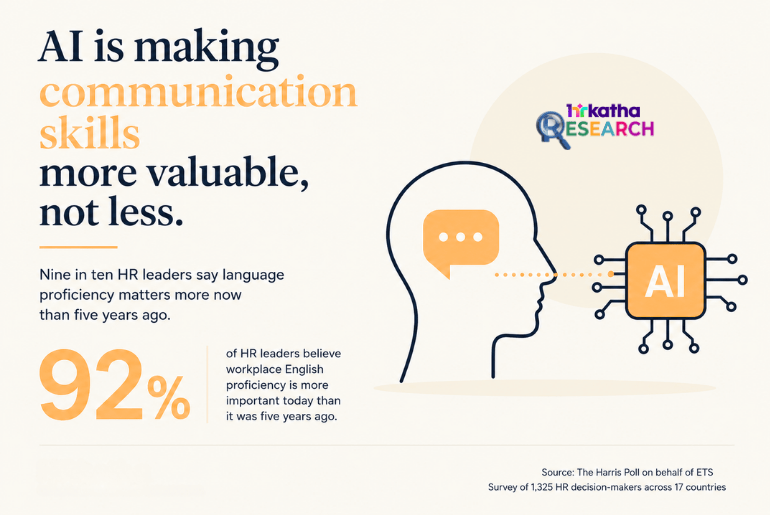
There was an assumption embedded quietly beneath much of the excitement around artificial intelligence: that machines would gradually reduce the importance of human language proficiency. If software could translate instantly, summarise documents and draft responses automatically, then fluency, especially in English, would matter less over time.
Employers increasingly believe the opposite.
A global survey of 1,325 HR decision-makers across 17 countries, conducted by The Harris Poll on behalf of ETS, finds that 92 per cent believe workplace English proficiency is more important today than it was five years ago. More strikingly, the increase is being driven not despite artificial intelligence (AI), but because of it.
This is not primarily about polished grammar or corporate etiquette. It is about operational capability in an AI-enabled workplace.
The AI-language paradox
The report captures a paradox that many organisations are only beginning to recognise. Artificial intelligence tools reduce certain communication frictions while simultaneously increasing the premium on clear human instruction, interpretation and judgement.
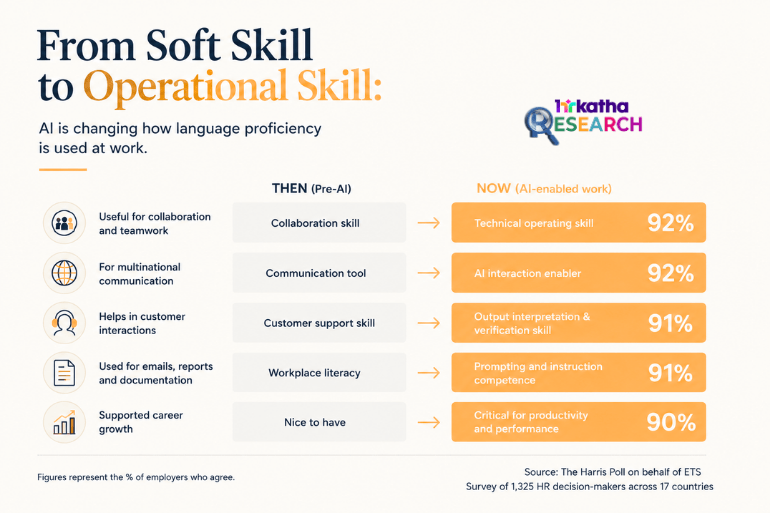
Across reading, writing, listening and speaking, roughly six in ten employers say AI cannot compensate for weak employee proficiency. Ninety-two per cent say English proficiency is becoming more important because employees increasingly work with AI tools that operate primarily through English interfaces. Ninety-one per cent say effective AI prompting itself requires working language competence.
This changes the role language plays at work.
For years, English proficiency functioned mainly as a collaboration skill, useful for multinational communication, customer interaction and global business coordination. However, AI is turning it into something closer to a technical operating skill. Employees are now expected not merely to communicate with people, but to instruct systems, verify outputs and navigate rapidly evolving digital workflows.
The worker unable to operate comfortably in that environment is not simply less articulate. Increasingly, they are less productive.
The execution problem
The organisational consequences show up most clearly in execution quality.
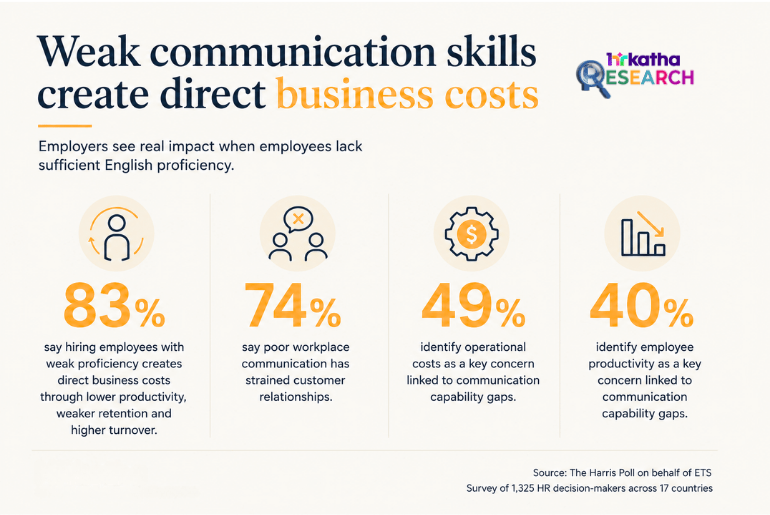
Seventy-four per cent of surveyed employers say poor workplace communication linked to insufficient English proficiency has strained customer relationships. Eighty-three per cent say hiring employees with weak proficiency creates direct business costs through lower productivity, weaker retention and higher turnover.
The largest operational concerns identified by employers are operational costs (49 per cent) and employee productivity (40 per cent), both of which respondents associate closely with communication capability gaps.
The consistency of the perception across very different economies is notable. The survey spans markets including India, Brazil, Saudi Arabia, Vietnam, Germany, Japan and Mexico.
Eighty-six per cent of respondents believe organisations whose employees lack working
English proficiency are at a competitive disadvantage. Ninety per cent say organisational performance is directly tied to employee language capability.
This does not necessarily prove causation. Human resource leaders may overstate the importance of language because it is highly visible and easy to measure, and because it is easier to screen for than the subtler competencies that actually drive performance. What the data does confirm is the direction of employer belief: communication capability is being reclassified from soft skill to operational infrastructure.
The assessment economy
Organisations are responding by formalising how they evaluate language skills.
Seventy-eight per cent of employers now use English assessments during hiring. Seventy-one per cent use them before training programmes, while around two-thirds use them to assess promotion readiness or post-training capability.
What is more revealing, however, is where employers believe current systems are failing.
The data suggests organisations are attempting to standardise communication capability because work itself is becoming more dependent on it, not because they have solved how to measure it well. The largest shortfalls are in assessing speaking and listening, the two skills most directly implicated in AI interaction. Organisations are scaling systems they do not yet trust.
Nine in ten HR leaders report at least one barrier to implementing language assessment systems at scale. Time constraints, organisational complexity and difficulty identifying trusted providers each affect roughly 36 per cent of respondents.
The AI acceleration
The strongest signal in the report concerns AI adoption directly.
Eighty-one per cent of employers say AI integration increases the importance of workplace English proficiency. More than half identify keeping pace with AI and technology change as a major organisational challenge.
This reflects something broader happening inside knowledge work. Artificial intelligence systems may automate portions of execution, but they also increase the volume of interpretation, coordination and oversight required from workers. Employees must frame better questions, evaluate machine-generated outputs and adapt continuously as workflows evolve.
The language burden, therefore, expands rather than contracts.
Artificial intelligence can generate text fluently. It cannot reliably determine whether a user has framed the right prompt, identified contextual nuance or recognised factual distortion. Those remain human responsibilities, and they depend heavily on comprehension.
The inclusion challenge
For India, the findings expose a particularly uncomfortable tension.
The country has spent years arguing, correctly, that capability matters more than pedigree. Talent from tier-2 and tier-3 cities has increasingly broken into sectors once dominated by elite institutions and English-speaking urban networks.
But AI-era work may be quietly rebuilding a different kind of gatekeeping.
The issue is not whether workers possess technical skills. It is whether they can operate effectively inside systems where interfaces, workflows, documentation and AI interactions remain heavily English-dependent. A technically capable worker who struggles with language may increasingly find themselves constrained not by intelligence or ability, but by operational friction.
That creates a workforce development problem rather than a cultural one.
The question for employers is not whether English should matter. The labour market has already answered that. The question is whether organisations are willing to invest seriously in helping employees build communication capability, or whether language proficiency becomes the new credential, a threshold that filters people out rather than a skill that gets developed in.
Otherwise, AI risks widening inequality inside labour markets that were only beginning to become more accessible.
The deeper shift
The broader lesson from the survey is less about language specifically than about the changing nature of work itself.
For decades, organisations treated communication skills as secondary to technical capability.
Now, AI is beginning to blur that distinction. As work becomes increasingly mediated through digital systems, the ability to communicate clearly, with both humans and machines, is becoming embedded within execution itself.
The companies adapting fastest to AI may not be the ones with the best tools. They may simply be the ones whose employees can use them properly.
And that, increasingly, appears to be a language question as much as a technology one.