


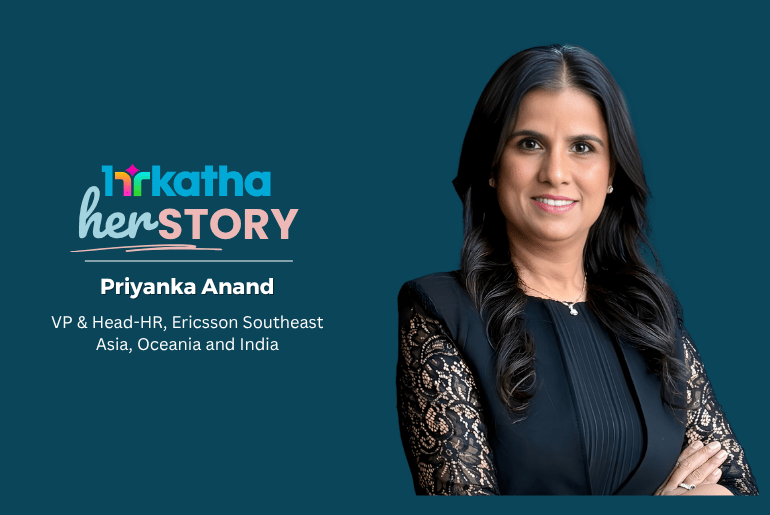
Leadership beyond borders
Working across geographies has been one of the most defining aspects of Priyanka Anand’s leadership journey.
Exposure to varied cultures, markets and leadership teams has reinforced a simple lesson for her. While business contexts may vary, people fundamentally seek the same things: meaningful work, opportunities to grow and leaders they can trust.
Over the years, she has watched HR itself transform, and she has changed with it. What she once saw as a primarily operational function, she now leads as a strategic partner shaping organisational capability, culture and long-term business success.
That shift, in her view, has raised the bar for what HR leaders need to understand. Business priorities, technology adoption, workforce transformation and the skills organisations will need in the future all now sit within her remit, not beside it.
What has remained unchanged for her, through every geography and every shift in the role, is a simple set of anchors: continuous learning, investing in people, and a people-first mindset. Those principles, she says, have carried her through periods of rapid change more than any framework or process ever could.
“People are the CEOs of their own careers. Our role as leaders is to create the conditions, opportunities and culture that allow people to succeed,” she says.
“People are the CEOs of their own careers. Leaders create the conditions for them to succeed.”
For Anand, leadership has always been about aligning people, purpose and business outcomes to create sustainable value, not just for the organisation, but for the individuals within it.
Where progress still needs to happen
Although women’s representation in leadership has improved globally, Anand does not believe the journey is anywhere close to complete.
She is candid that progress has been uneven, and that some of the toughest ground still lies in technology and engineering, sectors where women’s participation has historically been low, shaped by choices and norms that begin long before anyone enters the workforce.
For her, the fix cannot simply be hiring more women in.
She pushes for something more deliberate: environments where opportunities are visible, career paths are transparent, and people are actively supported to grow, through learning, reskilling, internal mobility and leadership development.
One gap, she believes, matters more than most.
“We still need to push harder on sponsorship. Sponsorship creates visibility, opens doors to critical experiences and helps talented women access opportunities that accelerate leadership growth.”
It is a distinction she returns to often: mentorship tells you what to do, sponsorship gets you into the room. For Anand, closing that gap remains unfinished business.
Values that travel
Anand does not believe culture should look identical everywhere she works, and she is comfortable with that.
Different countries bring different customs, expectations and ways of working, and she sees no reason to flatten that out. What she insists on instead is a smaller, non-negotiable core.
Integrity, respect, accountability and trust. For her, these cannot vary by geography, even when everything else does.
How leaders bring those values to life, she acknowledges, will look different from market to market. But the values themselves are where she draws the line.
Building for what comes next
“We are preparing for the future of work by building a learning-first, future-ready workforce that can evolve alongside AI, 5G, automation and emerging digital technologies,” says Anand.
Her focus is not on equipping people with today’s skills. It is on building the capacity to keep learning new ones, indefinitely, as the ground keeps shifting.
She points to her team’s role in supporting large-scale 5G deployments as evidence that this philosophy works in practice, not just in principle.
“Our responsibility is to help people continuously build adaptable skills so they can navigate change with confidence,” she says.
The future of work will be defined less by fixed roles and more by adaptable skills.
She is clear-eyed about where this is heading. Technology will keep reshaping how work gets done. But she remains convinced that people, not systems, will stay at the centre of innovation and business success.
Asking a better question
“I do not spend much time reflecting on whether my journey would have been different if I were a man,” says Anand.
Instead, she asks a different question, one she finds far more useful.
Are organisations creating environments where talent, capability and potential determine growth?
“When workplaces are fair, inclusive and focused on merit, everyone has a better opportunity to thrive,” she says.
“When workplaces are fair, inclusive and focused on merit, everyone has a better opportunity to thrive.”
She is quick to credit the organisations that invested in her own growth, and just as quick to turn that gratitude into responsibility. If leaders were given that chance, she believes they owe it to others, regardless of gender.
Her focus, consistently, comes back to the same three things: remove the barriers, expand the access, and let people rise because of what they contribute, not who they are.
Quick fire round
The most underrated skill in HR today?
Learning agility: the ability to continuously learn, unlearn and adapt in a rapidly-changing world.
A quote you live by at work?
“Innovative thinking and creativity, much like swimming and biking, are skills best learned through practice, reflection and repeated application.” (David Garvin)
A moment that made you proud to be in HR?
Seeing people realise their potential, whether through a career move, a leadership opportunity or a development experience.
What is the one HR myth you’d like to bust forever?
That performance and people experience are separate. Sustainable high performance is built when people feel trusted, supported and empowered to grow.
One workplace ritual you’ll never skip?
Listening. Whether through formal conversations or everyday interactions, it is the leadership habit I value most.
Accountability with compassion
Leadership, Anand believes, inevitably means making decisions that will not please everyone. She has made her peace with that.
What matters more to her than being liked in the moment is being fair, transparent and consistent. Respect, she has found, is earned when people know a decision was principled, evidence-based and made with both the organisation and its people in mind.
She rejects, quite firmly, the idea that accountability and empathy pull in opposite directions.
“People may not always agree, but when they feel heard and treated fairly, trust remains intact,” she observes.
It is a distinction she keeps returning to: leadership is not about choosing between being fair and being kind. It is about refusing to give up either one.
Keep saying yes
Looking back, Anand does not see her career as a straight line, and she has stopped expecting it to be one.
Some of her most formative experiences were never promotions. They were the assignments that stretched her thinking, tested her resilience, and did not look like progress at the time.
Her advice to her younger self, and to those earlier in their careers, is simple.
“Stay authentic, stay curious and do not wait until you feel completely ready before taking on the next challenge. Growth often begins just outside your comfort zone.”