


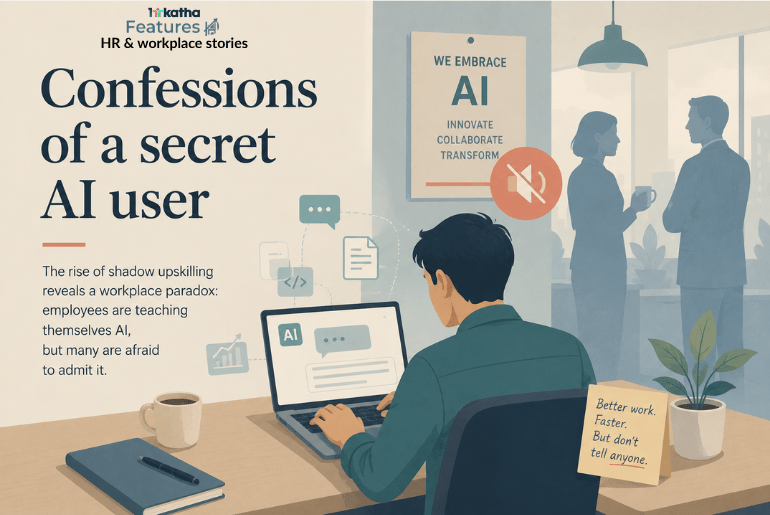
Somewhere in your organisation today, an employee has just used AI to rewrite a client proposal, debug a piece of code, prepare for tomorrow’s presentation or draft a difficult email. Along the way, they have learnt a better prompt, discovered a more efficient workflow and become marginally more productive than they were yesterday.
None of it will appear in the learning management system.
This is shadow upskilling: employees quietly teaching themselves how to work with AI, outside formal training programmes and often without telling their managers. Organisations are investing heavily in enterprise AI licences, structured learning pathways and mandatory certification programmes. Yet much of the capability they are paying to build is emerging independently, at individual desks, invisible to the very people responsible for developing talent.
The story, therefore, is not that employees are learning AI. That is entirely desirable. The more revealing story is that so many feel compelled to hide the learning.
From policing to orchestration
Preeti Kannan, CHRO, IIFL Finance, views shadow upskilling as evidence of a workforce that is naturally curious and proactive rather than evasive.
Her organisation has responded by building structures that make AI experimentation visible without making it risky. Dedicated AI teams work alongside business functions to identify practical use cases, while AI-enabled coaching platforms allow employees to experiment, practise and improve in environments that are both structured and supported.
The larger lesson extends beyond any individual initiative.
Traditional learning management systems were designed around scheduled courses, completion certificates and attendance records. That model increasingly captures only part of how capability develops. Employees now learn continuously through experimentation, peer networks, online communities and AI itself.
When AI becomes camouflage
Not every hidden use of AI represents genuine learning, however. Capt. John Gomez, vice president-HR, Kshema Power, offers a revealing example.
He recalls receiving a grievance report from a graduate engineer trainee working at a solar site. The document was written in polished, elaborate English that immediately suggested AI assistance. Yet, when Gomez spoke to the employee, the trainee struggled to explain the issue in simple language.
“He used AI as a shield to look professional, but the actual problem got buried under heavy vocabulary,” Gomez says.
The episode highlights an important distinction. Shadow upskilling and AI camouflage are not the same phenomenon. One reflects curiosity and initiative. The other conceals capability gaps. Treating both as misconduct would be a mistake, but so would treating both as evidence of successful learning.
For Gomez, whose organisation operates in a sector expected to require a 3-million-strong workforce by 2030, hidden capability creates a practical problem. Skills that remain invisible cannot be validated, shared or developed further. Equally, weaknesses hidden behind polished AI-generated output cannot be coached.
The trust deficit, not the skills deficit
The evidence is difficult to ignore. A KPMG–University of Melbourne study of more than 48,000 respondents, cited in the Harvard Business Review, found that 57 per cent of employees admitted to concealing their AI use at work. Separate Harvard Business Review research published in 2025 found that engineers believed to have used AI were rated nine per cent lower on competence for producing identical work compared with colleagues assumed to have completed it unaided.
Taken together, the findings expose an uncomfortable contradiction. Organisations encourage employees to embrace AI, yet employees believe that admitting to using it makes them appear less capable. Once that perception takes hold, concealment becomes a rational response rather than an ethical lapse.
Neha Singh, cluster head of HR, Sunteck Realty, captures the problem succinctly. The issue, she argues, is “a trust deficit, not a skills deficit.” Organisational trust and psychological safety influence disclosure far more than AI policies or approved tool lists ever will. Policy cannot substitute for trust. In fact, organisations that respond with tighter surveillance often achieve precisely the opposite of what they intend. The stronger the monitoring, the stronger the incentive to keep learning invisible.
The top-down, completion-tracked learning model is steadily losing relevance, Singh observes.
Organisations need learning ecosystems that recognise capability developed in the flow of work, combining skills intelligence, communities of practice and transparent recognition systems that reward demonstrated competence rather than merely completed courses.
Why policing fails and ignoring costs more
Faced with invisible AI adoption, many organisations instinctively reach for control. They block tools, monitor usage, tighten governance and require formal declarations.
Singh believes this approach misunderstands the problem. Surveillance rarely increases transparency. Instead, it encourages employees to move experimentation further underground.
Ignoring the phenomenon, however, is equally problematic. When organisations fail to recognise the capabilities employees are developing independently, valuable knowledge remains fragmented across individuals instead of becoming institutional capability.
The more sustainable response lies somewhere between the two extremes. Rather than policing behaviour, organisations need to create conditions in which employees see value in sharing what they have learnt because disclosure benefits them professionally.
The productivity bargain nobody discusses
Trust is not the only reason employees keep AI use private.
There is also a simple economic calculation. In many organisations, productivity gains are rewarded not with greater autonomy but with more work. An employee who discovers a way to complete a report in one hour instead of three has little incentive to announce the breakthrough if the likely consequence is simply being assigned two additional reports.
The result is a curious paradox. Organisations invest heavily in AI to improve productivity, while employees quietly protect the productivity gains they achieve because they fear efficiency will merely increase expectations.
Shadow upskilling, therefore, reflects more than organisational mistrust. It also exposes a flawed productivity bargain between employers and employees.
The choice facing HR
The organisations adapting successfully appear to share three characteristics.
First, they present AI fluency as evidence of initiative rather than dependency. Employees become far more willing to discuss AI when using it enhances professional credibility instead of diminishing it.
Second, they invest deliberately in psychological safety. Gomez’s trainee did not need punishment for using AI. He needed the confidence to admit where AI had compensated for a communication weakness so that the underlying capability could actually be developed.
Finally, they treat AI capability as organisational knowledge rather than individual advantage. Prompt libraries, peer learning communities, internal showcases and skills intelligence allow individual experimentation to become collective capability.
None of these changes is especially complicated. They simply require HR to relinquish the illusion that all meaningful learning happens inside formally-designed programmes.
Shadow upskilling is often described as a governance challenge. In reality, it is a trust test. Human Resource departments that continue measuring only formal learning risk mistaking certificates for capability, while the most valuable learning happens elsewhere, quietly improving productivity one prompt at a time. The organisations that succeed will not necessarily be those that teach AI the fastest, but those that discover what their employees have already learnt, recognise it, and turn invisible individual capability into institutional advantage.