


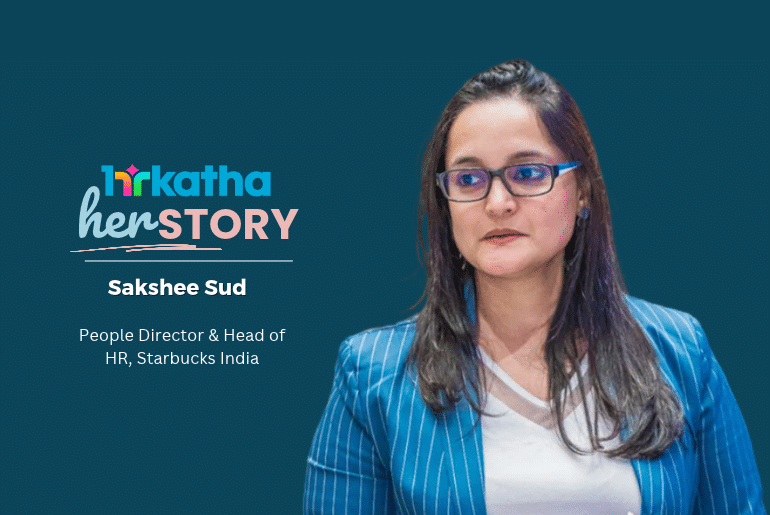
Trusting the journey
For Sakshee Sud, people director and head of HR, Starbucks India, one of the biggest lessons from her career has been to stop trying to predict where it will lead.
Early on, she spent considerable time worrying about the next five steps. Which role should she take? Was she progressing fast enough? Was she even on the right path?
Having worked across diverse industries, Sud can now look back at roles that stretched her and choices she made without complete clarity about where they would lead. Each helped shape the leader she became.
“Work hard, stay curious and don’t spend too much time worrying about whether you have everything figured out. You don’t. None of us do,” she advises younger professionals.
She suggests making the most of what is in front of you rather than trying to anticipate every turn in your career.
One of the most important responsibilities women leaders carry is to become the role models they did not always have themselves.
No women role models
One of the biggest barriers Sud encountered was not an obvious restriction imposed by someone else. It was the absence of enough women role models at senior levels.
Much of leadership, she believes, is learnt through observation. Young professionals watch how senior leaders handle conflict, influence decisions, negotiate with CEOs and navigate ambiguity.
“A lot of leadership behaviour is unconsciously picked up by watching people ahead of us,” she says.
For many young women, however, there have historically been too few women at senior levels to observe. Nor can they necessarily imitate the leadership styles around them and expect those behaviours to be interpreted in the same way.
“Many of us are navigating an environment where traditionally masculine traits, being highly assertive, forceful or visibly dominant, have often been interpreted as leadership, while women displaying exactly the same behaviour can sometimes be perceived differently, often negatively,” Sud explains.
She realised she had a choice: imitate the leaders she observed or discover what leadership looked like when it was authentically her own.
She chose the latter.
Over time, Sud learnt that it was possible to be empathetic without being soft, collaborative without being indecisive, and deeply people-oriented while remaining commercially tough.
That experience also shaped her sense of responsibility towards other women. She believes women leaders must become the role models they did not always have themselves, making it easier for the next woman to imagine herself in a similar position.
Keeping culture alive
For Sud, culture is not sustained through a programme, an annual town hall or values displayed on a wall. It is shaped by the hundreds of small interactions employees experience every day.
In a geographically dispersed business such as Starbucks India, that places enormous responsibility on store managers.
Whether employees feel respected, whether their ideas are heard, how feedback is delivered and whether good work is recognised depend heavily on their immediate manager.
Sud and her team therefore invest in developing people leadership capability, helping managers understand that their responsibility extends beyond delivering business results to shaping the environment in which employees work.
Employees, she believes, do not experience organisational values as abstract statements. They experience the behaviour of their leaders.
“The real test of culture isn’t what we say about ourselves when everything is going well. It is what an employee experiences on a difficult day, during a difficult conversation or when nobody is watching,” she says.
This understanding also shapes Sud’s approach to diversity and inclusion.
One initiative she is particularly proud of involved building inclusive leadership as a manager capability rather than treating it solely as an HR responsibility.
Her team worked on helping managers recognise bias and become more conscious of how they hire, develop, recognise and create opportunities for people.
For Sud, inclusion becomes meaningful when it moves beyond representation targets and becomes visible in everyday leadership behaviour.
The real test of culture isn’t what we say about ourselves when everything is going well. It is what an employee experiences on a difficult day, during a difficult conversation or when nobody is watching.
HR in a people-intensive business
The food and beverage industry presents Sud with a particular challenge: the employee is central to the customer experience.
In a café, warmth, attentiveness and the ability to make an interaction memorable are as important to the experience as the product itself.
That makes employee experience and customer experience closely connected.
Sud believes organisations cannot consistently expect employees to create warmth and connection for customers if those employees themselves have a poor experience at work.
The HR response therefore goes beyond conventional processes. It means hiring well, creating workable schedules, developing capability, recognising performance and providing opportunities for growth.
The sector’s young workforce makes this especially important. For many freshers, their store is their first experience of professional management, giving store managers considerable influence over how they understand work and leadership.
“If you want to improve the customer experience, don’t start with the customer. Start with the employee serving the customer. When employees feel valued, equipped and empowered, they are far more likely to create that same experience for the customer,” she believes.
Sud also rejects the idea that employee wellbeing must compete with customer-centricity.
There will be periods when business demands intensify, but the long-term answer cannot be to keep asking people to stretch further. Organisations need systems and managers that enable employees to perform sustainably.
For Sud, employee wellbeing is not a trade-off against business performance. It is one of the conditions that makes sustained performance possible.
Quick fire round
Latte or Americano, your go-to fuel?
Americano. Straight up, no frills, much like how I like to approach most things.
If HR were a drink on the Starbucks menu, what would it be?
Cappuccino. A strong balance of people, business and a little bit of magic.
Biggest leadership lesson learnt over a cup of coffee?
The best conversations are often the ones you never planned to have.
One HR book or podcast you’d recommend instantly?
The Advantage by Patrick Lencioni, because it is my firm belief that organisational health is often the biggest competitive advantage a company can build.
If not HR, what career would you have chosen?
An economist, or in a completely different life, a travel writer. I love understanding how the world works, and I love discovering it.
A changed definition of success
Sud’s understanding of success has changed considerably over the years.
Earlier in her career, it meant reaching the next level, earning more, leading a bigger team or moving further up the leadership hierarchy.
Today, she asks different questions. Has her work created meaningful change in the business? Has she helped the organisation make better decisions? Have the leaders who worked with her become stronger?
It is no longer simply about how far she has climbed, but what she has changed along the way.
That is also how she thinks about legacy. Years after she has moved on, she would like the organisation to continue benefiting from something she built, a leader she developed or a culture she helped strengthen.
For her, that has become a more meaningful measure of achievement than titles.
Not softies
One misconception Sud would particularly like to challenge is that women leaders are naturally softer and therefore less capable of delivering demanding business outcomes.
Being empathetic does not mean being less commercial. Being collaborative does not mean avoiding difficult decisions.
At senior levels, she argues, HR is fundamentally a business function. Its leaders need to understand profitability, productivity, growth, customer experience, costs and organisational capability.
Some of the most consequential business decisions are also people decisions: which capabilities to develop, where to deploy talent, how to structure teams and how to improve productivity.
Sud believes women should not have to abandon empathy or authenticity to prove their commercial judgement.
It is a conviction that brings her leadership journey back to where it began: learning to lead without feeling obliged to imitate somebody else.