



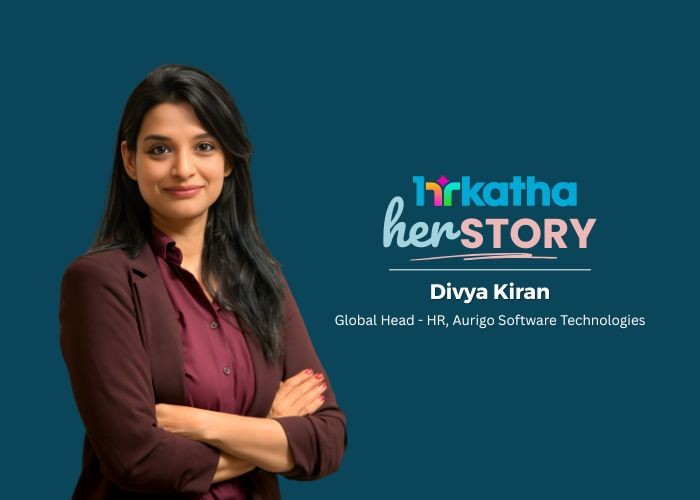
From finance to HR
“HR chose me,” says Divya Kiran, recalling how she found her way into the function whilst actually pursuing a career in finance.
At the time, she had approached a recruiting consulting firm to help her find a role in finance. During the process, however, they recognised that her profile and interests were better suited to their own organisation. That unexpected opportunity became her entry point into HR.

What began as a chance shift gradually evolved into a deeply meaningful profession.
Over the years, she has come to see HR as a function that shapes how organisations evolve. When talent systems, leadership capability, and culture align, companies are able to scale sustainably.
That larger impact is what has kept her deeply engaged.
Today, as VP and global head – HR at Aurigo Software Technologies, Divya Kiran leads with a clear belief: the most enduring impact of HR lies not in individual interventions, but in the systems that quietly enable thousands of people to perform at their best.
Addressing unconscious bias
“I have not experienced any gender bias in my career, and all the companies I have worked for have been extremely inclusive,” says Divya Kiran.
However, she acknowledges encountering more subtle forms of unconscious bias.
In environments where HR partners closely with highly technical teams, information is sometimes simplified or selectively shared—based on the assumption that HR professionals may not fully engage with complex technical or numerical discussions.
Her response has been straightforward: build credibility through engagement.
By asking the right questions, understanding the subject deeply, and contributing meaningfully to strategic discussions, HR can shift that perception.
When HR professionals bring analytical thinking, sound judgement, and experience to the table, the dynamic changes quickly.
Another area where bias often surfaces is around maternity.
“Maternity is simply a life stage and should not influence how organisations assess capability or growth potential.”
Throughout her career, she has encouraged organisations to distinguish clearly between performance and potential—evaluating individuals based on their contributions and future readiness, not personal circumstances.
“I’ve been part of promotion committees that promoted women on maternity leave,” she shares. Their leave was never treated as a constraint; decisions were anchored in the work they had done.
That, she believes, reflects the true maturity of an organisation’s culture.
Being agreeable versus being fair and transparent
The role of an HR leader often requires navigating difficult conversations while maintaining trust across the organisation.
It demands the ability to challenge decisions, address sensitive issues, and represent organisational interests—without eroding relationships.
Over time, Divya Kiran has learnt that the critical capability here is not agreeability, but the ability to conduct tough conversations with empathy.
This is not an inherent trait, but one that is consciously developed.
It requires clarity in communication, the ability to stand firm when needed, and the discipline to ensure that the other person feels heard.
Respect, in her experience, is not built by avoiding conflict. It is built through consistency, fairness, and transparency.
“Maternity is simply a life stage and should not influence how organisations assess capability or growth potential.”
Tough performance conversations
Some of the most difficult moments in HR arise during performance evaluations and employment transitions.
Terminations, she notes, are never easy. They affect individuals and their families.
Performance conversations can be equally complex. When feedback indicates that expectations are not being met, individuals may interpret it as a judgement of their personal worth.
In such moments, honesty becomes essential.
Difficult conversations must be approached with clarity, empathy, and transparency. Over time, credibility, trust, and respect are built through consistent behaviour.
When people recognise that intent is fair and judgement is grounded in knowledge and experience, they are more willing to engage—even when conversations are uncomfortable.
“When situations do not unfold as expected, acknowledging them and making amends helps rebuild trust.”
Equally important is humility.
Leaders are not immune to mistakes. The ability to acknowledge missteps and correct course strengthens credibility rather than diminishing it.
HR leadership, she enunciates, lies in navigating imperfect situations while remaining both principled and humane.
“When situations do not unfold as expected, acknowledging them and making amends helps rebuild trust.”
Building trust
One of the most defining moments in Divya Kiran’s career came during a complex organisational transition following a company buyout.
Within three months of joining, she had to lead a process involving the movement of hundreds of employees from one entity to another.
The challenge was significant.
The employees involved were not yet familiar with her. The transition offered them no clear advantage. In many ways, staying with existing contracts would have seemed the safer option.
Yet, nearly 97 per cent of employees agreed to the move.
The approach was deliberate.
Instead of addressing the entire organisation at once, she focused on building trust first—identifying a small group of respected influencers and engaging with them in depth.
By establishing credibility and transparency with this group, she created a network of trusted voices who could communicate the intent and implications of the transition more effectively.
“When people hear information from colleagues they trust, it carries far greater weight than a message coming from someone new to the organisation.”
The outcome reinforced a simple but powerful insight:
Organisational change travels faster through trust networks than through formal communication channels alone.
Quick fire round
One thing you wish people understood about being a woman in HR leadership?
Gender is rarely what defines our contribution. Leaders bring judgement, experience, and capability to the table.
Morning ritual that sets you up for success?
Breathing exercises help me start the day with clarity and focus.
If not HR, what career path would you have pursued?
Finance.
What energises you most about your work?
Designing frameworks and solving organisational challenges at scale.
Best investment you have made in yourself:
Education. Investing in continuous learning across institutions and leadership programmes has helped me stay intellectually curious and professionally relevant. It has enabled me to adapt to evolving organisational realities and leadership expectations.
‘Systems thinking’
One mindset that needs to retire, according to Divya Kiran, is the tendency for HR to defer critical decisions entirely to business leaders.
Statements such as “it is ultimately your call” may reflect collaboration, but they can also dilute the role of HR as a strategic partner.
HR must bring its own perspective, expertise, and conviction to decision-making.
The mindset that deserves far greater attention is systems thinking.
Many enter HR believing it is primarily about people. In reality, effective HR leadership lies in designing systems that enable people to succeed.
When strong organisational frameworks, processes, and cultures are in place, individuals naturally perform better within them.
The most enduring impact of HR, she reiterates, lies in systems—not isolated interventions.
Because while individuals move on, systems continue to shape organisational behaviour long after.