


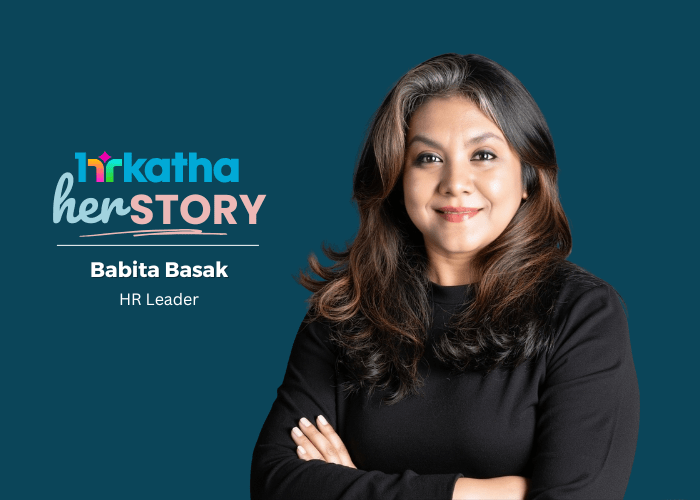
Falling for human depth
Looking back at her first HR role, Babita Basak was most surprised by how deeply the job touched people’s sense of purpose and identity. She had entered the profession expecting structure—processes, policies, hiring, performance reviews, compensation frameworks. What she didn’t expect was the sheer human depth of the work.
She noticed early on that work is more than a paycheck. For many, it’s where confidence is built, where belonging is felt, and where ambition is tested. A promotion wasn’t just a new title; it was validation. A difficult conversation wasn’t just feedback; it was a turning point. A manager’s encouragement wasn’t just support; it was fuel.
Sitting very close to these moments is the HR function. “You see how small decisions can change how someone feels about themselves at work. You learn that talent grows fastest when someone feels seen. And you begin to notice that organisations are shaped in everyday interactions—in the energy they create and the belief they reinforce,” she enunciates.
What also surprised her was how much quiet observation HR requires. She learnt to pick up what people were too shy to say, what leaders assumed employees already knew, and what teams needed before they had the language for it. For Basak, that makes the profession feel less tactical and more like stewardship.
What inspires her? The resilience of people. She admires how “even in environments with challenges and constraints, people look for ways to contribute, to learn, and to matter. HR gets a front-row seat to that resilience. It’s humbling and energising at the same time.”
The profession taught her that organisations are living systems. They learn, adapt, stumble, recover and grow. Being part of that growth is the part of HR that stays with you.
“When you approach work with curiosity and belief, risk stops being something to manage. It becomes a way of expanding what you are capable of.”
The thrill of ‘What if?’
Almost every role Basak stepped into was something she had never done before. Not surprisingly, therefore, unfamiliar territory became a pattern for her. What drew her to these roles? Her curiosity, her desire to build capability from scratch and then see how far it could scale.
She especially enjoys solving problems that don’t have templates. Scepticism doesn’t discourage her. Instead, it makes her more certain that something is worth attempting. The very thought of taking an idea from possibility to reality simply because you believed in it early is exciting for her.
If these transitions looked like risk to others, for Basak they felt like adventure—structured experimentation with conviction and purpose. “It’s the thrill of asking, ‘What if?’ and then discovering what happens when you commit to the answer” that keeps her spirits high. That’s how Basak feels “you learn new strengths, new limits, and new instincts along the way.”
And of course, it taught her that careers don’t grow only through experience; they grow through exploration. “When you approach work with curiosity and belief, risk becomes a way of expanding what you are capable of,” says Basak.
Directness and clarity
Basak’s non-negotiable is a workplace where disagreements can happen openly and directly. Conversations should not have to go through side channels, whispered triangulations, or post-meeting lobbying. If people can’t say in the room what they say outside the room, collaboration stops being real.
She values workplaces where directness is seen as clarity, not confrontation; where asking questions is not interpreted as criticism; and where feedback is not wrapped so tightly in politeness that its meaning disappears. When conversations are clean, work becomes easier. Expectations get clearer, misunderstandings resolve faster, and people learn how to work with each other instead of around each other.
This matters even more for women who communicate directly. Many women are naturally straightforward, but they often learn to soften their voice because directness more often is not perceived positively and often gets reprimanded. When a workplace allows direct women to speak simply and cleanly, without managing perceptions or cushioning their sentences, it creates space for more honest and confident participation from everyone.
When organisations avoid direct conversation, tension doesn’t disappear—it just moves underground. It resurfaces quietly as blame, as withdrawal, as misalignment, or as confusion. None of these help teams, and none of them build trust.
Healthy workplaces don’t fear differences in opinion. They allow people to negotiate those differences in daylight. When disagreement is normalised and not personalised, collaboration strengthens.
“When organisations avoid direct conversation, tension doesn’t disappear—it just moves underground.”
Quick fire round
Your mantra for difficult days?
Keep moving. Clarity arrives through action.
What’s the best career advice you’ve ever received?
Choose roles that stretch you, not roles that validate you.
One thing you wish people understood about being a woman in HR leadership?
Direct women aren’t difficult—they make work easier. But the way they say it gets judged more than what they’re actually saying.
Morning ritual that sets you up for success?
Quiet time alone before the world starts demanding attention.
If not HR, what career path would you have pursued?
A news reader or public-policy maker—don’t see these as alternate lives—they’re pathways I can still choose in time.
Jobs versus capabilities
Jobs are no longer the fundamental unit of talent, states Basak. Jobs are an industrial-era artefact designed for predictability—factory systems, command-control structures, and compliance logic. They served a purpose when markets were stable and output needed to be standardised. However, in contemporary knowledge environments, jobs make organisations rigid.
The more relevant unit for modern organisations is capability. Capabilities detach work from titles and reattach it to need, scale and timing. Capability does not ask ‘What is your title?’ but asks ‘What can you do at the level the business requires right now?’
This single shift changes how organisations handle decision-making, succession and mobility. Decisions follow contribution instead of hierarchy. Succession becomes readiness-based instead of time-based. Mobility becomes multi-directional instead of only upward. Titles can fade; capabilities can grow.
The shift is equally important in external hiring. Most companies still recruit by matching role to role and industry to industry. In doing so, they hire people who replicate what already exists. Capability-based hiring reverses the logic. Instead of asking, “Has this person done the same job before?” the more meaningful question becomes, “Do they understand the problem we are trying to solve?”
This leads to a different talent philosophy: build portfolios, not pipelines. Pipelines assume the future will look like the past. Portfolios allow organisations to respond to change without getting stuck. Companies that hire for capability will pivot faster than companies that hire for role.
From support leaders to business shapers
Basak admires how women have moved from being support leaders to being business shapers, and yet, she feels there remains a gap in where women’s influence shows up. The decisions that shape the future of a business still tend to sit elsewhere. Decisions about who creates the business strategy, who gets promoted, who gets developed, who gets funded, and who gets accelerated during inflection points often decide the trajectory of a company more than any policy or initiative.
That’s where we still need to push—not just for representation, but for authorship. Women don’t just need to be present in HR leadership; they need to be part of the rooms where future-shaping decisions are made. Influence matters most when it shapes outcomes, not just processes.
Women in HR are often assumed to be the ones who will soften messages, smooth over misunderstandings, and make difficult situations feel easier. It sounds positive on the surface, but it quietly puts you in a role you didn’t choose. Over time, she realised that doing this made others comfortable, but didn’t always move the work forward.
Today, she is aware that being understanding doesn’t mean avoiding directness. “You can care about others and still be clear about what needs to happen and it’s okay if they feel otherwise,” she explains. Clarity, for her, is often more desirable than cushioning.
It is not necessary to choose between being understanding and being clear. Bring both together, and the work moves faster and people grow stronger.