


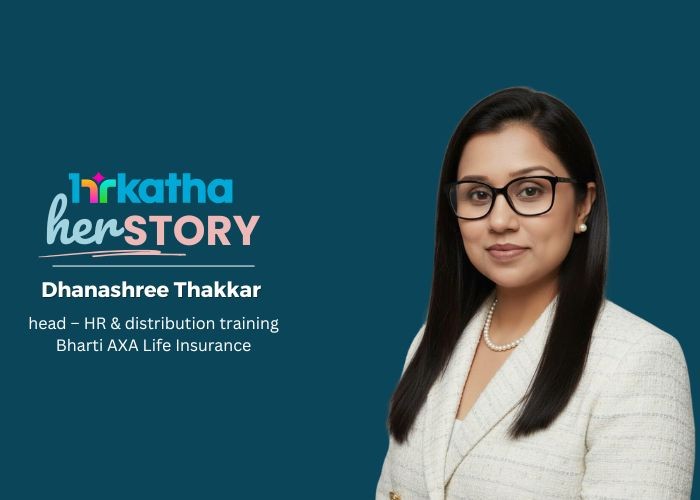
Bridging human behaviour with organisational purpose
“For many, there isn’t always a cinematic ‘Eureka’ moment or a feeling of ‘Aapka janm isi ke liye hua hai’ (you were born for this),” says Dhanashree Thakkar. Her journey into HR unfolded more as an organic evolution than a moment of sudden clarity.
She initially chose Arts to steer clear of Mathematics. In doing so, however, she discovered a genuine fascination with Psychology. That curiosity led her to pursue a master’s degree in Organisational Psychology, eventually opening the door to a career in HR.
The real turning point came through the work itself. Thakkar realised she was deeply energised by creation—not merely of processes, but of environments that bring tangible meaning to people’s lives.
She didn’t just find a career in HR; she found a way to bridge human behaviour with organisational purpose. That was when she knew she was exactly where she belonged.
Today, as head – HR & distribution training at Bharti AXA Life Insurance, Thakkar leads with a philosophy shaped by both personal experience and professional conviction: lead from conscience, not conformity.
“By leaning on a strong support system and finding my own voice, I stopped seeking a seat at the table and started building my own.”
Internal conscious unlearning
When you belong to a demographic that isn’t the majority, bias can often feel like a subtle but constant background hum. For Thakkar, the challenge was twofold: navigating the workplace as a woman and as a single working mother.
Early on, the biases were not always explicit but deeply felt. She remembers male colleagues raising their voices in all-male meetings or the quiet pressure to conceal aspects of her personal life.
“I found myself constantly auditing my own behaviour: Do I reveal I’m a single mum? How should I dress? Am I being too friendly or not assertive enough?” she recalls. “It often felt like both men and women kept me at a cautious distance.”
Overcoming this required what she calls an internal process of conscious unlearning.
“As women, we are often raised to seek validation—as daughters, wives and mothers—and taught to stay socially ‘quiet’ so as not to attract the wrong attention,” she observes.
Eventually, she realised she didn’t need external permission to lead.
“By leaning on a strong support system and finding my own voice, I stopped seeking a seat at the table and started building my own.”
That shift marked the moment when survival gave way to self-definition.
Leading with empathy and honesty
Some of the most defining moments in Thakkar’s career have come during difficult organisational decisions—especially retrenchment conversations, where the role of HR moves beyond policy into the realm of conscience.
Through these moments, she has anchored herself to four non-negotiable principles:
Lead with empathy and honesty: Even when the news is difficult, being genuine and helpful preserves the dignity of the individual.
The survival of the whole: Accepting the hard truth that sometimes one must “cut an arm to preserve the body”—making a painful decision today to safeguard the future of many.
Respectful candour: Staying authentic to one’s conscience while ensuring that even the toughest feedback is delivered with respect.
The mirror test: At the end of the day, a leader must be able to look in the mirror and say with conviction: I did what was right.
For Thakkar, these leadership principles naturally extend into how organisations design policies for their people.
“Even when the news is difficult, being genuine and helpful preserves the dignity of the individual.”
Corporate casteism
Thakkar is candid about what needs to change in corporate HR: she calls it the “casteism” of corporate benefits.
In many organisations, benefits are still tiered purely according to hierarchy. Yet an employee’s health, family security or mental wellbeing is not inherently lesser simply because their job grade is lower.
“It is time to move away from status-driven policies and towards a more equitable model that recognises the universal needs of our workforce,” she asserts.
She believes radical empathy must guide policy design—creating frameworks that meet employees where they are in life, whether that means support for a single parent, eldercare for those in the sandwich generation, or flexible pathways for those returning from career breaks.
“When we design for the individual’s reality rather than their designation, we build a truly resilient and loyal organisation.”
Policies reveal what organisations truly value.
Quick fire round
One book that changed your perspective on leadership?
Man’s Search for Meaning by Viktor Frankl.
Your mantra for difficult days?
Juice pivanu, carrom ramvanu and whatever makes your heart smile karvanu!
What’s the best career advice you’ve ever received?
Focus on perfection, success always follows.
Morning ritual that sets you up for success?
Great filter coffee, praying, these days petting the eager pet dog “Joey” and conversations (aka – nok jhok with my partner).
Humanising automation
For Thakkar, the future of HR will depend on balancing technological efficiency with human judgement.
She outlines several areas of transformation:
Humanising automation: Using AI and technology to handle paperwork so teams can focus on the “heart work”—empathy, advisory capability and people connection.
The phygital shift: Preparing a workforce that can serve customers seamlessly through both digital platforms and personal interaction across more than 200 cities.
Skills for 2047: In alignment with India’s “Insurance for All by 2047” mission, talent is being upskilled to move beyond product selling to becoming lifelong “Protection Partners” for Indian households.
Adapting to the Bima Trinity: Teams are being equipped with the digital fluency needed to operate in India’s emerging public digital infrastructure.
A culture of purpose: HR acts as the bridge between legacy trust and modern agility—ensuring employees feel they are not merely achieving targets but securing India’s financial future.
Trusting competence over others’ opinions
Her experiences have shaped how Thakkar now speaks to the next generation of women entering HR.
To the young women entering the domain, she has only this to say:
“I hope you’ve chosen this path because you’re passionate about it, not because society told you ‘HR is what women should do’.”
She suggests muting the inner noise and trusting one’s competence over others’ opinions. There is no need for external validation to prove your worth.
She adds, “How you carry yourself sets the tone for the women who follow you. You have a quiet but significant responsibility to pave a professional path that commands respect.”
She advises young women to never be shy about voicing their opinion. Your seat at the table is for your mind, not just your presence. True progress isn’t HR becoming a female-dominated ‘nurturing’ silo; it’s about balance.
“We need more men in HR and more women in tech and finance. That is how we finally dismantle the stereotypes that hold us all back,” observes Thakkar.
Currently, Thakkar is immersed in Harish Bhat’s Do the Right Thing, which echoes the same Tata values she first discovered early in her career through RM Lala’s The Creation of Wealth. These works have deeply shaped her leadership philosophy.
It is her belief that the true test of a leader isn’t how they handle success, but how they handle power—the temptation to use position or authority to diminish others.
She often returns to the stories of Ratan Tata as a masterclass in leading with humility and fairness; his commitment to “going to bed knowing I did not succumb, but did the right thing” is Thakkar’s professional North Star.
Closer to home, her greatest inspiration remains her father. His quiet resilience and the sacrifices he made to ensure his daughters had every opportunity define her understanding of purpose and dedication.
And in many ways, that example continues to shape the leader she strives to be.