

Close Menu
    Facebook X (Twitter) Instagram
    • Our Story
    • Partner with us
    • Reach Us
    • Career
    Subscribe Newsletter
    HR KathaHR Katha
    • Exclusive
      • Exclusive Features
      • Perspectives
      • Friday Features
      • herSTORY
      • Case-In-Point
      • Point Of View
      • Research
      • HR Pops
      • Dialogue
      • Movement
      • Profile
      • Beyond Work
      • Rising Star
      • By Invitation
    • News
      • Global HR News
      • Compensation & Benefits
      • Diversity
      • Events
      • Gen Y
      • Hiring & Firing
      • HR & Labour Laws
      • Learning & Development
      • Merger & Acquisition
      • Performance Management & Productivity
      • Talent Management
      • Tools & Technology
      • Work-Life Balance
    • Special
      • HR Forecast 2026
      • Cover Story
      • Editorial
      • HR Forecast 2024
      • HR Forecast 2023
      • HR Forecast 2022
      • HR Forecast 2021
      • HR Forecast 2020
      • HR Forecast 2019
      • New Age Learning
      • Coaching and Training
      • Learn-Engage-Transform
    • Magazine
    • Reports
      • Whitepaper
        • HR Forecast 2024 e-mag
        • Future-proofing Manufacturing Through Digital Transformation
        • Employee Healthcare & Wellness Benefits: A Guide for Indian MSMEs
        • Build a Future Ready Organisation For The Road Ahead
        • Employee Experience Strategy
        • HRKatha 2019 Forecast
        • Decoding and Driving Employee Engagement
        • One Platform, Infinite Possibilities
      • Survey Reports
        • Happiness at Work
        • Upskilling for Jobs of the Future
        • The Labour Code 2020
    • Conferences
      • Leadership Summit 2025
      • Rising Star Leadership Awards
      • HRKatha Futurecast
      • Automation.NXT
      • The Great HR Debate
    • HR Jobs
    WhatsApp LinkedIn X (Twitter) Facebook Instagram
    HR KathaHR Katha
    Home»Exclusive Features»HR Pops»Capability DNA: The genetic code of organisational capability
    HR Pops

    Capability DNA: The genetic code of organisational capability

    Tushir moves from Northern Trust Corporation where she was head of HR, Asia Pacific Servicing Centres
    mmBy Liji Narayan | HRKathaMarch 10, 2026Updated:March 10, 20264 Mins Read396 Views
    Share LinkedIn Twitter Facebook WhatsApp
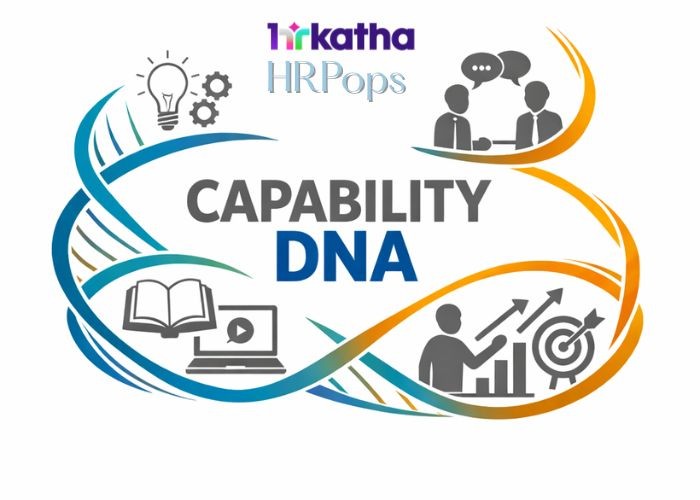
    Capability DNA_HR Pops
    Share
    LinkedIn Twitter Facebook WhatsApp

    What does it mean?

    Capability DNA refers to the distinctive mix of skills, behaviours, mindsets, and cultural traits that determine how an organisation performs and adapts. The metaphor borrows from biology: just as DNA determines genetic traits, an organisation’s capability DNA shapes how its workforce learns, collaborates, innovates and responds to change.

    In HR terms, it goes beyond listing technical skills. Capability DNA captures the deeper attributes that influence performance—learning agility, collaboration, digital fluency, and shared values. HR leaders use it to understand what strengths exist within a workforce and where capability gaps may hinder business goals.

    In essence, it is an attempt to answer a strategic question: what combination of capabilities makes an organisation succeed—and how can those capabilities be built deliberately?

    Where did the idea come from?

    The roots of capability DNA lie in the competency frameworks of the 1980s and 1990s, when HR departments began systematically mapping the skills and behaviours required for different roles.

    Early models focussed largely on technical expertise and role-specific competencies. Over time, however, the limitations of that approach became clear. Skills changed rapidly, and organisations needed employees who could adapt, learn, and collaborate, not merely perform predefined tasks.

    By the early 2000s, scholars such as Dave Ulrich began emphasising organisational capabilities—the collective strengths that allow companies to execute strategy effectively. The conversation gradually shifted from individual competencies to workforce capabilities.

    With the rise of digital transformation and Industry 4.0, the idea evolved further into what many HR leaders now call workforce capability DNA: a data-driven understanding of the capabilities embedded within an organisation.

    What makes up capability DNA?

    Several elements typically define an organisation’s capability DNA: technical expertise—the knowledge and skills needed to perform specific roles, though these now have a shorter shelf life; learning agility—the ability to acquire new capabilities quickly as industries evolve; soft skills—collaboration, communication, empathy, and adaptability, often the differentiators in modern workplaces; cultural traits—shared behaviours and values that support innovation, inclusion, and resilience; and digital fluency—comfort with technology, data, and automation. Together, these elements form the organisational “genetic code” that shapes performance.

    Why does it matter today?

    For HR leaders navigating rapid technological change, capability DNA has become a useful strategic lens.

    Organisations with strong capability DNA tend to adapt faster, adopt new technologies more smoothly, and sustain employee engagement during disruption. For HR, the concept functions both as a diagnostic tool and a design principle.

    It influences several core HR priorities: talent acquisition focusses on hiring for learning potential and adaptability rather than static skill sets; reskilling and upskilling builds capabilities that will remain relevant as technology evolves; retention and engagement fosters cultures where employees feel empowered to grow; diversity and inclusion ensures different perspectives strengthen organisational capability; and strategic workforce planning aligns talent capability with long-term business strategy.

    In short, capability DNA helps HR move from managing jobs to building organisational capability.

    The metaphor—and its limits

    The DNA metaphor is powerful, but it can also mislead.

    Unlike biological DNA, organisational capability is not fixed. Culture, leadership behaviour, incentives, and systems constantly reshape it. Organisations that invest heavily in capability-building programmes sometimes find little real change because the underlying culture or reward structures remain unchanged.

    There is also a risk of oversimplification. If HR frameworks label employees too rigidly—”high potential”, “low digital fluency”, “low adaptability”—those labels can become self-fulfilling prophecies, limiting growth rather than enabling it.

    Finally, much of capability assessment remains subjective. Judgements about “cultural fit” or “adaptability” can easily reflect bias unless measured carefully. What looks like weak capability DNA may simply be capability that doesn’t conform to existing power structures.

    Decoding the future

    Capability DNA represents the evolution of HR thinking—from cataloguing individual skills to understanding the collective strengths that drive organisational success.

    For HR leaders, the challenge is not merely identifying capability DNA but actively shaping it: building learning cultures, aligning leadership behaviour, and ensuring that capability frameworks remain flexible and inclusive.

    In a world where skills quickly become obsolete, the organisations that thrive may not be those with the strongest talent today—but those with the strongest capability DNA to keep learning tomorrow.

    Capability DNA competency frameworks concept functions Cultural Fit Culture diagnostic tool high potential HR Pop HR Pops HRPops Incentives leadership behaviour metaphor reskilling and upskilling role-specific competencies. talent acquisition focusses technical expertise—the knowledge and skills needed to perform specific role
    Share. LinkedIn Twitter Facebook WhatsApp
    mm
    Liji Narayan | HRKatha

    HRKatha prides itself in being a good journalistic product and Liji deserves all the credit for it. Thanks to her, our readers get clean copies to read every morning while our writers are kept on their toes.

    Leave A Reply Cancel Reply

    Related Posts

    Why building women’s leadership pipelines remains difficult

    March 10, 2026

    CEAT expands workplace policies to support women across career & life stages

    March 9, 2026

    Flipkart sees around 300 employee exits during annual performance

    March 9, 2026

    Oman orders early salary payments for employees ahead of Eid

    March 9, 2026
    Editorial

    When AI companies turn HR into their testing ground

    When a company builds artificial intelligence, its own workforce becomes the most visible proof. If…

    Sam Altman says listening to old people is a mistake; he’s half right

    When Sam Altman declared that “listening to old people is the biggest mistake young people…

    EDITOR'S PICKS

    Why building women’s leadership pipelines remains difficult

    March 10, 2026

    Capability DNA: The genetic code of organisational capability

    March 10, 2026

    HRForecast 2026: Work systems—not effort—will determine sustainable performance – Subrat Chakravarty, CHRO – Corporate, DS Group

    March 9, 2026

    When AI companies turn HR into their testing ground

    March 9, 2026
    Latest Post

    Trontek to expand, create 500+ jobs by FY27

    Uncategorized March 10, 2026

    Trontek, an Indian manufacturer of lithium-ion batteries with a strong presence in the energy storage…

    Why building women’s leadership pipelines remains difficult

    Exclusive Features March 10, 2026

    Diversity programmes typically measure success through representation percentages—how many women occupy positions across organisational levels.…

    Capability DNA: The genetic code of organisational capability

    HR Pops March 10, 2026

    What does it mean? Capability DNA refers to the distinctive mix of skills, behaviours, mindsets,…

    Ritu Tushir is head of HR, India for NatWest Group India

    Movement March 10, 2026

    NatWest Group India has appointed Ritu Tushir as head of HR, India. She moves from…

    Asia's No.1 HR Platform

    Facebook X (Twitter) Instagram LinkedIn WhatsApp Bluesky
    • Our Story
    • Partner with us
    • Career
    • Reach Us
    • Exclusive Features
    • Cover Story
    • Editorial
    • Dive into the Future of Work: Download HRForecast 2024 Now!
    © 2026 HRKatha.com
    • Disclaimer
    • Refunds & Cancellation Policy
    • Terms of Service

    Type above and press Enter to search. Press Esc to cancel.