


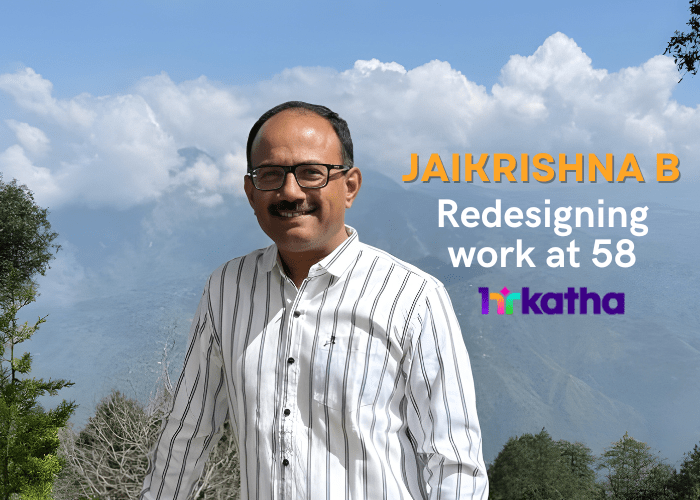
In corporate India, 58 is often treated as an exit ramp. Superannuation arrives, farewells are organised, and identities long fused with designation quietly dissolve.
Jaikrishna B sees it differently.
On May 7, 1990, he entered his first job as a management trainee. Thirty-five years later—25 of them in leadership roles shaping organisations, people and culture—he is stepping into what he calls Project ACT+. Not a consultancy. Not a firm with letterhead and office space. But a consciously designed portfolio life that blends advisory work, coaching, teaching, community contribution and a return to acting—a creative pursuit he set aside decades ago.
This is not reinvention. It is continuation by design.
The pivot that didn’t rush itself
He first imagined 50 as the moment of change. Then 55. Both felt premature.
“I realised I wasn’t ready—emotionally, financially, or in life wisdom,” he says.
Around 54, during a period when he admits he “wasn’t quite at his best,” the reflection deepened. The questions shifted from career progression to life architecture. Not What’s next? but How do I want to live and contribute in the years ahead?
It wasn’t burnout. It wasn’t dissatisfaction. It was alignment.
“I was operating at a high level of responsibility, but had not paused to ask whether my inner rhythm truly matched the outer pace of my life.”
That distinction matters. Many leaders speak of stepping back. Few speak of recalibrating rhythm.
Fifty-eight began to feel right—not as an escape from organisational life, but as a conscious milestone to reshape it.
“Transitions like these are not events. They are gradual redesigns”
What Project ACT+ represents
The acronym is deliberate.
- A stands for Advisory, Alma Mater and Acting.
- C includes Coaching, Consulting and Community.
- T spans Training, Teaching and Travelling.
- The + signals multiple dimensions within each.
But beneath the acronym lies something simpler: portability.
Jaikrishna plans to advise promoter families on governance and the human dynamics of family enterprises—drawing on certifications in family advisory and coaching earned over the last decade. He will support organisations on culture shaping, leadership development and change management. He intends to teach, particularly in Tier III and IV institutions. He will give back to his alma mater. And he will return to acting.
“Acting taught me to listen beneath words, to sense emotion, to notice unspoken dynamics,” he says. “These are the same sensitivities that matter in leadership and coaching.”
The creative and the corporate, in his view, were never separate disciplines. One nourishes the other.
“With experience comes perspective—and with perspective comes the desire to contribute differently”
The human system advantage
After 25 years inside complex organisations, one insight stands out to him: companies obsess over structure, targets and strategy. But their long-term health depends on what he calls the “human system”—trust, clarity of roles, emotional maturity in leadership and the quality of conversations.
“When you’re inside, you’re responsible for delivery and timelines. That’s vital, but it means moving at the organisation’s pace,” he says. “From outside, I can help leaders slow down enough to notice patterns they may be too close to see.”
Governance can become routine instead of principle. Leadership energy can drain unnoticed. Culture shifts subtly before it fractures.
Distance provides perspective. Perspective enables intervention.
The difference now is freedom—to carry lessons across contexts without being absorbed into the urgency of one system.
“Acting taught me to listen beneath words—the same sensitivity leadership requires”
Preparation as discipline
This transition was not impulsive.
Financially, it meant deliberate planning to ensure future choices were not driven by compulsion. Emotionally, it required “loosening identity from designation”—perhaps the hardest shift for senior leaders accustomed to defining themselves by role and title.
Professionally, he invested in capabilities that travel: family advisory certification, coaching credentials, facilitation experience, being coached himself. He paid attention to relationships built on trust rather than position.
“Transitions like these are not events,” he says. “They are gradual redesigns.”
His advice to professionals in their forties is measured: don’t rush the exit, but begin the groundwork. Build financial stability. Expand capabilities beyond your current role. Cultivate interests that create meaning beyond designation.
Grow into the person who can sustain the next chapter.
“I realised I had not paused to ask whether my inner rhythm matched the outer pace of my life”
A different rhythm of work
“Working at my own pace,” he clarifies, is less about time and more about rhythm.
Previously, organisational calendars defined the cadence of his days. Now he is intentionally protecting space for reflection, learning, family, health and creative expression. Advisory conversations, coaching sessions, teaching, community involvement and travel may coexist in a month—not as overload, but as integration.
“There’s no sense of more or less,” he says. “It’s simply a fuller expression of life.”
“It was less about stepping away from something, and more about stepping into a way of working that had been forming for years”
Not stepping away—stepping into design
At 58, Jaikrishna could have stayed on, negotiated part-time leadership, or extended his formal career arc. Instead, he chose to give shape to something that had been forming quietly for decades.
“With experience comes perspective, and with perspective comes the desire to contribute differently,” he says.
His previous roles were meaningful. They came with the pace and structure of organisational life. This phase retains the essence—governance, leadership, people development—while allowing choice over mix and tempo.
In a country where professional identity often fuses tightly with designation, Project ACT+ represents something subtle but significant: designing work before work designs you.
It is less an exit than an architectural shift.
And in an economy rethinking longevity, leadership and the future of careers, that shift may become less unusual than it appears today.