



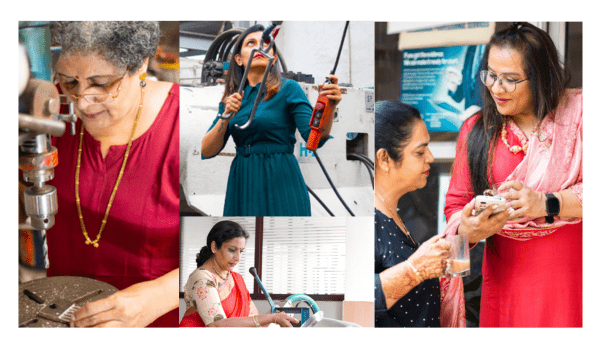
Will India succeed in becoming the third largest economy by 2030? If things continue at the heartening rate they appear to be, it surely will. Not only has digital transformation driven rapid growth but there is a sustained demand for Indian goods as well as Indian talent in the international market. Who has the potential to give this growth a much-required push? Indian women entrepreneurs of course. They are setting up businesses, creating jobs (especially for women), generating revenue and even serving as the backbone of the Indian economy. And there is data to prove this.
What the numbers say

The Indian economy relies heavily on its 63 million micro, small, and medium enterprises (MSMEs), as they contribute significantly to the gross domestic product (GDP), as well as to its exports and employment. In 2020-21, MSMEs managed to generate employment for 9.3 million people. That’s not all, these MSMEs are currently sustaining over 111 million jobs, accounting for 30 per cent of GDP.
India has about 3,40,000 small and medium enterprises (SMEs), of which 17,500 are owned by women!
Role of ‘Goldman Sachs 10,000 Women’
This programme is committed to supporting the economic empowerment of women in India. While it is a known fact that women-owned MSMEs are expected to contribute over US$2 million to the Indian economy by 2023, these businesses do face challenges in terms of finding the right talent, obtaining loans and raw material, accessing latest technology and resources, reaching out to potential markets and so on.
Considering that MSMEs play a big role in mitigating poverty and accelerating growth among the underprivileged lot, by ensuring a more proportional distribution of income and labour, empowering women entrepreneurs has been a step in the right direction.
The programme understood that access to finance is a major issue for women-owned businesses which also experience a rejection rate for loans that is 2.5 times more than what is experienced by businesses run by men.
Of the women who have participated in the ‘10,000 Women’ programme, 43 per cent had encountered direct challenges in accessing capital before being part of the programme. Four in ten participants admit that gender bias had held them back before they joined the programme.
The complex documentation required by banks is a big put off for many, especially when the awareness regarding the available products is low. Also, most do not have collateral to offer and are discouraged by the rigid eligibility criteria. Add to that the prejudice that exists in India against women who choose to own and run businesses of their own.
The programme realises that the key lies in recognising the value that women entrepreneurs bring to the business ecosystem. There is a need to address the unique challenges that women need to overcome due to which the size, scale, and productivity of their businesses is adversely affected. That is where they require the real support to grow their businesses.
What does the programme actually do?
Negotiation: The programme has helped its participants learn the skill of negotiation, not only to get more orders, but also to build robust business ecosystems. It offers women the required tools to be able to excel in marketing and managing their own businesses, thus accelerating growth.
Confidence: The Goldman Sachs 10,000 Women programme helps boost the confidence of the women allowing them to communicate and negotiate convincingly with potential clients.
Assessment: It teaches the businesswomen to evaluate the feasibility of projects in terms of revenues, costs, and risks. It teaches them how to raise finances externally and generate revenue without making additional investments.
Encouraging results
Across key business areas, ‘10,000 Women’ graduates are doing much better than their peers. A whopping 90 per cent have either introduced or increased the use of technology in their business since the pandemic struck. About 32 per cent have managed to launch a new product or service within six months of graduating!
A significant 40 per cent are trading their goods and services internationally within 30 months of graduating. The possibility of growth is rather promising, with a good 87 per cent of the graduates from the programme expecting to increase the number of people employed in their businesses in the next two years! A majority (95 per cent) anticipate an increment in revenue in the next two years.
That is not all. On average, each Goldman Sachs 10,000 Women graduate creates five new jobs and and also adds Rs 12 million in the form of revenue within 18 months of graduating.
The 10,000 Women community, on the whole, has created 2,000 new jobs and added Rs 28 billion in revenue within 18 months of graduating.
Upholding ‘Make in India’, many ‘10,000 Women’ graduates are exporting overseas, expanding their client bases globally. About 40 per cent of the businesswomen have traded their goods and services worldwide, while 29 per cent of the total revenue of these graduates comes from international clients. About 34 per cent of these graduates have expanded their business operations to international markets or are catering to global clients. A significant 74 per cent of these graduates have trained their staff. Forty per cent have implemented formal written feedback for their staff.
Eight per cent offered commission, merit pay, bonuses, or other incentives to their employees. A very encouraging 90 per cent have either introduced or increased the use of technology in their business since the pandemic. About 81 per cent are actively engaged in digital marketing activities, more than double the number before they joined the programme. It is also heartening to see that 90 per cent of graduates are actively leveraging social media for wider outreach.
About 93 per cent of graduates feel that sustainability is integral to their business plans, with 60 per cent stating their businesses should actively contribute to the net-zero agenda and support green initiatives.
‘Goldman Sachs 10,000 Women’ graduates employ twice as many women on average compared to other women entrepreneurs. Eighty-eight per cent also mentor other women in their network, while 58 per cent participate more frequently in local community groups and associations. Sixty-five per cent have taught business skills to other women in their network and community.
With an estimated 16,500 women being mentored every year, a programme like this can truly champion women’s empowerment in the country.