


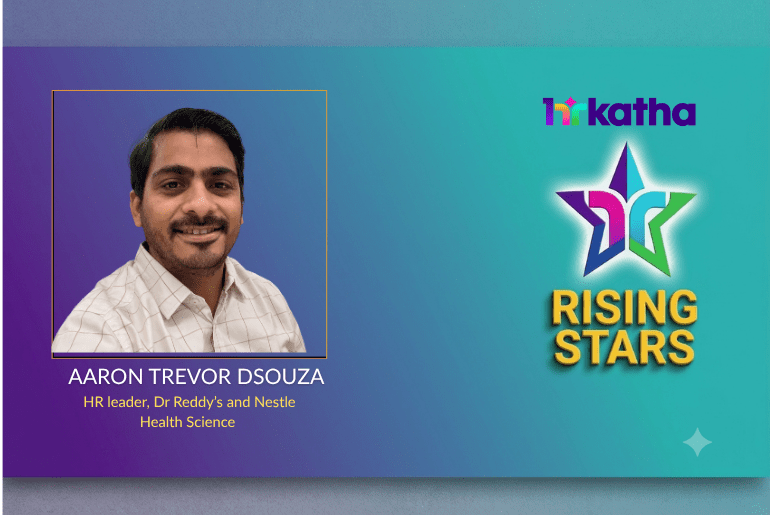
Second Runner-Up | HRKatha Rising Star Leadership Award 2025
Long before Aaron Trevor Dsouza had a job title in HR, he had a habit that hinted at where he might eventually end up. He was curious about how people made a living: the margins of the local chai tapri owner, the way a taxi driver planned his day, why one roadside dhaba flourished while another struggled.
What interested him was not merely the economics. It was the judgement behind it: how people organised limited resources, made decisions and found ways to produce an outcome. That curiosity about people and business, rather than a carefully mapped career plan, eventually pulled him towards HR.
The journey since has taken Dsouza through back-end operations at Genpact, an HR degree at XISS Ranchi, a campus placement at Jubilant Life Sciences and, from 2011, a career at Dr Reddy’s Laboratories spanning plant HR, industrial relations, learning and development, talent management, organisation design and an international assignment in North America.
It has also brought him to an unusual assignment. As HR leader for the Nutrition Joint Venture between Dr Reddy’s Laboratories and Nestlé Health Science, Dsouza has had to help create the people architecture for a new organisation drawing employees, practices and expectations from different sources.
Dsouza was named Second Runner-Up at the HRKatha Rising Star Leadership Award 2025, recognition that spans that assignment and the breadth of the HR career leading up to it.
Building a third identity
Creating HR for a joint venture is different from inheriting an established function. There are systems to put in place and roles to define, but the more complicated question is cultural: how do people arriving from two parent organisations, alongside external hires, begin to see themselves as part of something distinct from either?
For Dsouza, the answer could not simply be to select the better practices from each parent and stitch them together. The new organisation needed its own employee experience, leadership practices and ways of working, while retaining what was useful from both sides. The subsequent integration of an additional Trade Team added another layer to that work.
What the experience taught him was less about the mechanics of HR design than about the sequencing of change. Systems can be created relatively quickly; acceptance cannot. Consistent leadership, transparent communication and change management have to move alongside structural decisions if people are to understand not only what is changing but why. A new organisation can acquire systems almost overnight. A shared identity takes longer.
Trust before title
Dsouza’s view of leadership begins from a similar premise: designation may provide authority, but it does not automatically create influence. He believes HR becomes valuable to the business when leaders begin treating the function as an advisor rather than merely as the representative of a process. Getting there requires understanding how the business actually works, something he says comes as much from asking questions, sitting with experienced colleagues and observing decisions as it does from formal learning.
The habit has to continue even as seniority grows. Curiosity, in his view, becomes more valuable rather than less once people begin assuming that a leader already knows the answers. Combine that understanding with empathy and consistent judgement, and credibility follows. It cannot simply be claimed by virtue of role.
The team that stayed with him
Ask Dsouza about one of his most rewarding professional experiences and he does not begin with the joint venture. He goes back to his first large team: six people in learning and development, many of them fresh from campus or with limited professional experience.
Dsouza invested heavily in coaching and mentoring them, trying to create a relationship in which his responsibility extended beyond allocating work to helping them become capable of taking on larger roles. Many of those team members have since progressed within Dr Reddy’s or into leadership roles elsewhere.
The experience shaped his view of what people expect from a manager. Employees who believe their manager is genuinely invested in their growth, he argues, are more willing to stretch themselves and more receptive to both appreciation and difficult feedback. For him, the lasting evidence of leadership is therefore not simply what a team delivers while a manager is present, but what its people become afterwards.
When easy and right diverge
One of Dsouza’s more difficult leadership decisions involved a high-performing team member and a serious data-integrity issue. Performance made the decision harder, not easier. The employee was delivering results, but Dsouza concluded that overlooking an integrity breach because of those results would create a different and potentially larger problem.
The episode reinforced a principle he has carried forward: performance cannot compensate indefinitely for behaviour that undermines trust. Difficult decisions still have to be handled with honesty and fairness, but empathy does not require avoiding the decision itself.
Performance management belongs to managers
That emphasis on accountability also informs one of Dsouza’s less conventional views about HR: performance management does not belong to HR. It belongs to leaders.
Human Resources can design the architecture, establish the process, provide tools and help managers conduct better conversations. But the responsibility for setting expectations, giving feedback, developing capability and dealing with underperformance cannot be outsourced to the people function. When performance management is treated as an HR process, managers can begin to see goal-setting and development conversations as administrative obligations. When it is understood as a leadership responsibility, the quality of those conversations becomes part of how managers themselves are expected to lead. The same principle applies to talent development. HR can create the conditions for people to grow. Managers have to do the growing with them.
What should HR measure?
Dsouza applies a similarly business-led test to HR’s own performance. Engagement scores, quality of hiring and leadership-pipeline strength all matter, but he is wary of treating the measures themselves as outcomes. Their value ultimately depends on whether they help the organisation perform better.
That is particularly relevant in a new organisation, where HR has an opportunity to design systems without inheriting every legacy practice that came before. The question is not simply what an established HR function normally measures, but what information will help leaders make better decisions as the business grows.
Quick Takes
Coffee or tea: Tea.
Spreadsheets or storytelling: Storytelling, backed by data.
Self-description in three words: Approachable. Honest. Solution-oriented.
Remote or hybrid: Hybrid, with two to three remote days a month. Flexibility matters, but he believes culture still requires regular human interaction.
Why he is a Rising Star
Dsouza’s career reveals a recurring comfort with situations where the structure is not already provided. That is most visible in the Nutrition Joint Venture. The challenge was not simply to establish HR processes for a new entity, but to help people arriving with different organisational histories begin operating as one workforce. His response was to focus as much on communication, leadership consistency and identity as on the architecture itself.
The same instinct appears at a smaller scale elsewhere in his career. With his first large team, the task was to develop relatively inexperienced professionals rather than inherit finished capability. In performance management, he argues for moving accountability back to managers rather than allowing an established HR process to obscure who actually owns performance. When integrity and performance collided, he chose the principle that needed to survive beyond the individual case.
What connects these examples is not simply a willingness to build. It is an understanding that HR leadership becomes most revealing when there is no ready-made answer to administer. Processes can tell an HR professional what normally happens next. Leadership is tested when someone has to decide what should exist in the first place.
Rising Stars is HRKatha’s editorial series profiling the next generation of HR leaders shaping the future of the profession. The series features winners and finalists of the HRKatha Rising Star Leadership Awards alongside emerging professionals whose work, ideas and leadership potential deserve wider recognition.