


Close Menu
    Facebook X (Twitter) Instagram
    • Our Story
    • Partner with us
    • Reach Us
    • Career
    Subscribe Newsletter
    HR KathaHR Katha
    • Exclusive
      • Exclusive Features
      • Perspectives
      • Friday Features
      • herSTORY
      • Case-In-Point
      • Point Of View
      • Research
      • HR Pops
      • Dialogue
      • Movement
      • Profile
      • Beyond Work
      • Rising Star
      • By Invitation
    • News
      • Global HR News
      • Compensation & Benefits
      • Diversity
      • Events
      • Gen Y
      • Hiring & Firing
      • HR & Labour Laws
      • Learning & Development
      • Merger & Acquisition
      • Performance Management & Productivity
      • Talent Management
      • Tools & Technology
      • Work-Life Balance
    • Special
      • HR Forecast 2026
      • Cover Story
      • Editorial
      • HR Forecast 2024
      • HR Forecast 2023
      • HR Forecast 2022
      • HR Forecast 2021
      • HR Forecast 2020
      • HR Forecast 2019
      • New Age Learning
      • Coaching and Training
      • Learn-Engage-Transform
    • Magazine
    • Reports
      • Whitepaper
        • HR Forecast 2024 e-mag
        • Future-proofing Manufacturing Through Digital Transformation
        • Employee Healthcare & Wellness Benefits: A Guide for Indian MSMEs
        • Build a Future Ready Organisation For The Road Ahead
        • Employee Experience Strategy
        • HRKatha 2019 Forecast
        • Decoding and Driving Employee Engagement
        • One Platform, Infinite Possibilities
      • Survey Reports
        • Happiness at Work
        • Upskilling for Jobs of the Future
        • The Labour Code 2020
    • Conferences
      • Leadership Summit 2025
      • Rising Star Leadership Awards
      • HRKatha Futurecast
      • Automation.NXT
      • The Great HR Debate
    • HR Jobs
    WhatsApp LinkedIn X (Twitter) Facebook Instagram
    HR KathaHR Katha
    Home»Special»Editorial»The certainty tax: Why uncertainty makes bad decisions inevitable
    Editorial

    The certainty tax: Why uncertainty makes bad decisions inevitable

    When the future is unknowable, rational short-term decisions aggregate into long-term organisational damage no one intended
    mmBy Dr. Prajjal Saha | HRKathaMarch 30, 20265 Mins Read216 Views
    Share LinkedIn Twitter Facebook WhatsApp
    Share
    LinkedIn Twitter Facebook WhatsApp

    The conflict in West Asia has introduced real uncertainty into global markets. Oil supply routes face disruption. Energy prices fluctuate. Supply chains adjust. Forecasts carry wider error bars than usual.

    Many HR leaders across India must be responding in familiar ways. Hiring slows. Training budgets are reviewed. Promotions are delayed. Major initiatives are paused pending “more clarity.”

    zoha

    Each decision, considered individually, is rational. Why commit to fixed costs when revenue visibility is weak? Why invest in capability when the environment remains unclear?

    The problem is not that these decisions are irrational. The problem is that they are rational—and collectively destructive.

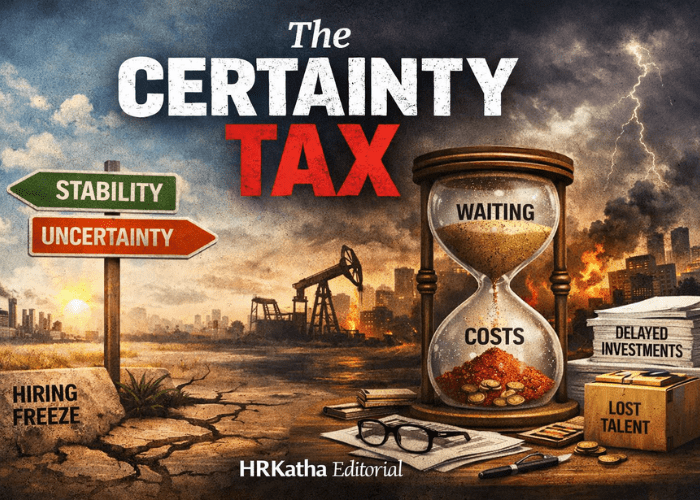
    This is the certainty tax: the organisational cost of waiting for clarity that rarely arrives when you need it.


    The rational freeze

    Uncertainty triggers defensive choices that make sense in isolation.

    Companies halt hiring. Headcount represents fixed cost; adding people during volatility increases exposure. Better to wait.

    Training budgets are deferred. If conditions worsen, recently trained employees may leave, making the investment seem wasted.

    zoha

    The biggest risk in uncertainty isn’t making the wrong decision—it’s waiting too long to make the right one.

    Promotions slow. Creating senior roles assumes sustained demand. If that demand fails to materialise, the organisation carries unnecessary cost.

    Strategic initiatives—systems, restructuring, transformation programmes—are delayed. Why commit to multi-quarter investments when the landscape may shift?

    No one gets criticised for caution during volatility. CFOs approve these decisions. Boards understand them.

    The damage appears later—when these choices compound.


    The aggregated cost

    While organisations wait for certainty, the system keeps moving.

    Talent does not pause. The people you most want to retain are the least likely to wait. Faced with stalled growth and frozen opportunities, they leave for organisations willing to act.

    By the time hiring resumes, the best people are gone.

    What organisations call prudence often looks like passivity to their best people.

    Capability quietly erodes. When development slows and promotion pipelines stall, skills don’t plateau—they decay. Engagement drops. The gap with competitors widens.

    And competitors do not all respond the same way. Some pause. Others continue hiring, investing and building.

    When conditions stabilise, the difference becomes visible. One group has momentum. The other has to rebuild.

    That gap is the certainty tax.


    The India-specific exposure

    India’s connection to Gulf stability makes this dynamic more than theoretical.

    Roughly nine million Indians work across Gulf countries, sending back an estimated $50 billion annually—around 3.5 per cent of GDP, more than India’s export exposure to the United States. States such as Kerala, Uttar Pradesh and Bihar are particularly dependent on these flows.

    Yet few organisations actively scenario-plan for disruption. Not because the risk is negligible, but because planning for uncertain outcomes feels premature.

    The certainty tax isn’t paid today. It shows up later—as lost talent, weaker capability and ground ceded to competitors.

    If conditions shift and large numbers of workers return, the impact will be immediate: labour supply changes, consumption patterns shift, and workforce dynamics reset.

    Waiting for clarity delays preparation for plausible outcomes.

    That, too, is the certainty tax.


    Why the pattern repeats

    Organisations treat uncertainty as temporary disruption rather than permanent condition.

    During the pandemic, many waited for clarity on remote work. Others acted—redesigning roles, hiring globally, building distributed systems. The latter gained lasting advantages.

    After the 2008 financial crisis, hiring freezes preserved cash but left companies understaffed for recovery.

    The pattern is consistent.

    Uncertainty emerges. Organisations pause.

    Conditions stabilise—slowly and unpredictably.

    Those who acted are ahead. Those who waited are catching up.


    Why waiting feels rational

    Caution is easier to defend than action.

    No one is criticised for freezing hiring during uncertainty. Many are questioned for continuing to invest if conditions worsen. The asymmetry makes caution feel safer.

    The costs are delayed. Talent loss, capability erosion and competitive gaps appear over time, making them harder to trace back to earlier decisions.

    And certainty always feels close. The next quarter, the next report, the next signal—clarity seems imminent. It rarely is.

    Meanwhile, the cost accumulates invisibly.


    The uncomfortable alternative

    Operating through uncertainty requires accepting discomfort.

    It means making decisions without full information. Hiring without guaranteed demand. Investing without clear timelines. Planning for multiple futures instead of waiting for one to emerge.

    Some bets will fail. Some investments will not pay off.

    But organisations that build this capability—acting despite uncertainty—consistently outperform those that wait.

    Not because they predict better.

    Because they move earlier.


    The real question

    The current uncertainty will pass. It always does.

    But it will be replaced by another.

    The question is not whether to wait for clarity.

    It is whether organisations can operate without it.

    Those that wait will preserve short-term stability.

    Those that act will build long-term advantage.

    Both will make mistakes.

    But only one group will be ready when conditions change.


    The cost of waiting

    Certainty is not coming back.

    The real cost of waiting is not caution.

    It is capability lost, talent gone, and ground ceded.

    In uncertain environments, the biggest risk is not making the wrong decision.

    It is waiting long enough that the right ones no longer matter.

    business strategy capability building economic uncertainty Future of work Hiring Freeze HR leadership HR trends LEAD Leadership Decision Making organisational strategy risk management Talent Management Talent retention Uncertainty in Business workforce planning Workforce strategy
    Share. LinkedIn Twitter Facebook WhatsApp
    mm
    Dr. Prajjal Saha | HRKatha

    Dr. Prajjal Saha, editor and publisher of HRKatha since 2015, leverages over 25 years of experience in business journalism, writing, and editing. He founded HRKatha to provide insightful analysis on the evolving workplace. With expertise spanning HR, marketing, distribution, and technology, Saha has a deep understanding of business dynamics. His authorship of the acclaimed Marketing White Book highlights his versatility beyond HR. A trusted voice across industries, his clear and thoughtful commentary has earned him a reputation for thought leadership, making him a reliable source of knowledge and insights for professionals navigating the complexities of the business world.

    Leave A Reply Cancel Reply

    Related Posts

    HRForecast 2026: Skills will rise, but degrees will remain relevant – Vinod Nair, CHRO, Aadhar Housing Finance 

    March 30, 2026

    Corporate buzzword detox: Say it simply, get it done

    March 27, 2026

    HRForecast 2026: HR will move from AI adopter to AI strategist – Paramjit Singh Nayyar, CHRO, Hero FinCorp

    March 27, 2026

    Only 5% of decisions may need a human. Are Indian organisations ready for the rest?

    March 25, 2026
    Editorial

    The certainty tax: Why uncertainty makes bad decisions inevitable

    The conflict in West Asia has introduced real uncertainty into global markets. Oil supply routes…

    Companies say retention matters. Their budgets say otherwise

    Every company declares that retaining talent is a strategic priority. Annual reports emphasise culture and…

    EDITOR'S PICKS

    HRForecast 2026: Skills will rise, but degrees will remain relevant – Vinod Nair, CHRO, Aadhar Housing Finance 

    March 30, 2026

    The certainty tax: Why uncertainty makes bad decisions inevitable

    March 30, 2026

    Corporate buzzword detox: Say it simply, get it done

    March 27, 2026

    HRForecast 2026: HR will move from AI adopter to AI strategist – Paramjit Singh Nayyar, CHRO, Hero FinCorp

    March 27, 2026
    Latest Post

    HRForecast 2026: Skills will rise, but degrees will remain relevant – Vinod Nair, CHRO, Aadhar Housing Finance 

    HR Forecast 2026 March 30, 2026

    The future of work is often framed in extremes. Skills versus degrees. AI versus human…

    The certainty tax: Why uncertainty makes bad decisions inevitable

    Editorial March 30, 2026

    The conflict in West Asia has introduced real uncertainty into global markets. Oil supply routes…

    Nokia plans workforce reduction; begins India restructuring

    News March 27, 2026

    Finnish telecom major Nokia is preparing for a significant workforce reduction as part of a…

    KnitWell Group names Sarah Evans as CHRO

    Movement March 27, 2026

    KnitWell Group has appointed Sarah Evans as its chief human resources officer (CHRO), placing her…

    Asia's No.1 HR Platform

    Facebook X (Twitter) Instagram LinkedIn WhatsApp Bluesky
    • Our Story
    • Partner with us
    • Career
    • Reach Us
    • Exclusive Features
    • Cover Story
    • Editorial
    • Dive into the Future of Work: Download HRForecast 2024 Now!
    © 2026 HRKatha.com
    • Disclaimer
    • Refunds & Cancellation Policy
    • Terms of Service

    Type above and press Enter to search. Press Esc to cancel.