Learning and development (L&D) together make extremely essential criteria in the path of growing with and within an organisation. However, with time, the needs of the hour change and so do the required skills to meet the specific demands. This renders learnt skills outdated, and there emerges a need to unlearn past learnings to accommodate newer ones. Starting from technology to behaviour, for every aspect, change is the only constant. Therefore, we need to create space inside the brain to introduce new skills.
Unlearning is the process of coming out of a shell of skills and knowledge, with the support of which an individual has been sustaining in a certain environment. While unlearning vacates the space allotted to a certain set of skills and knowledge in the brain, it does with a certain goal or purpose. It shows the extent to which our present skills or knowledge is irrelevant with respect to the time and need of the hour. Therefore, unlearning plays a key role in implementing relevance.
An important move towards growth and exposure is pushing one’s limits. Unless individuals step out of their comfort zones, they cannot expect to be exposed to new realms. In the journey of life, individuals may be required to stretch themselves and test their limits under different circumstances, which will more often than not involve unlearning.
With the changing times, people also change. So, it is important for leaders to unlearn primitive management skills and replace them with new ones in order to lead the new-age people.
Udbhav Ganjoo, head – HR, global operations, Viatris
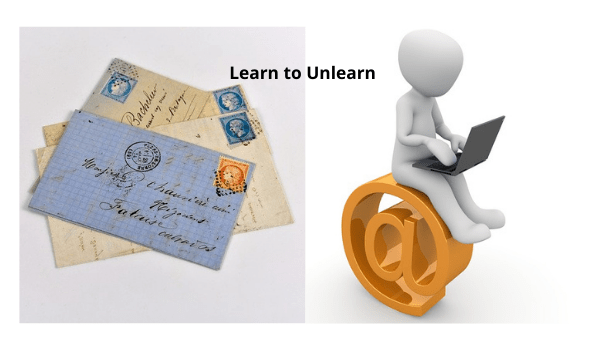
Anand Talwar, former CHRO, ITC Infotech, explains the process of letting old skills subside and allowing new ones to take over with a very simple example of letters being replaced by e-mails. He says, “People do not write letters nowadays and we do not have enough time to exchange letters and cards. The fast- paced world requires communication to happen fast and information to be exchanged faster than before. Therefore, gradually, people — irrespective of age — have adapted to the newer technologies which have not only made communication faster but also simpler. So, if the process of unlearning the act of exchanging letters had not taken place, e-mails would never have come into the picture. To stay at par with the era, one has to keep unlearning old habits and skills.”
Talwar further added, “Unlearning is not new. People keep unlearning with reference to the context, and the context keeps changing. The context of the 1980s was ahead of the context in the 1960s. So, the skill sets of the 1960s, with reference to a certain context, must have been unlearnt by the people in the 1980s. Hence, the importance of unlearning has been accepted down the ages.”
At times, unlearning helps enhance convenience. For instance, a process that has been performed a certain way for years may be done more conveniently and in a better manner using a better and more simple process. In such a case, unlearning becomes the key to convenience, which in turn has a positive effect on productivity.
Udbhav Ganjoo, head – HR, global operations, Viatris, says, “We are in an era where change is constant. It is extremely important for us to unlearn in order to replace old skills with new ones. People need to unlearn not just in terms of technology, but also in terms of behaviour. With the changing times, people also change. So, it is important for leaders to unlearn primitive management skills and replace them with new ones in order to lead the new-age people.”
Once an individual contributor is promoted to a senior leader’s position, he has to unlearn the behaviour of an individual contributor and learn how to lead a team, maintaining the right balance between the people and organisation.
Manoj Rajimwale, group CHRO, Endurance Technologies
Ganjoo further adds, “Learning and unlearning go hand in hand. In fact, unlearning is an important part of learning. Management, operations, manufacturing and all other functions undergo change and become off the sleeves after a certain point of time. Then, to survive competition both intra and inter organisational, unlearning is critical.” He states the example of the IT industry, one of the fastest-changing industries in terms of products and technology. So, if IT professionals do not unlearn to learn new things right on time, it will become a challenge for them to survive in the market.
Emphasising the role of unlearning in building new skills, Udbhav Ganjoo further explains, “Employees are adapted to something in particular, but once the process for that particular function becomes outdated, they have to unlearn it in order to stay relevant. Right now, the workplace has expanded beyond the office walls and entered the personal space. So, if we don’t unlearn our old habits, work culture and behaviour, then it may affect our productivity, which in turn may impact the organisation as a whole.”
If the process of unlearning the act of exchanging letters had not taken place, e-mails would never have come into the picture. Gradually, people — irrespective of age — have adapted to the newer technologies which have not only made communication faster but also simpler.
Anand Talwar, former CHRO, ITC Infotech,
Manoj Rajimwale, group CHRO, Endurance Technologies, enunciates, “Technology moves in and out of the market. Other than technical skills, management skills also need to change with time and changing job roles. Once an individual contributor is promoted to a senior leader’s position, he also has to undergo the process of unlearning. He has to unlearn the behaviour of an individual contributor and learn how to lead a team, maintaining the right balance between the people and organisation. On becoming a leader, he is immediately expected to unlearn the approach he may once have had towards the organisation when he an individual contributor.” Talking about the role of unlearning in building new skills, Rajimwale says, “Unlearning cannot be random. It has to happen for the sake of replacing the old set of skills with a new one. A space cannot remain vacant. So, one has to immediately look for something new and relevant to learn, while he is unlearning a skill.”
Without doubt unlearning is an important part of the learning process. We can’t learn a new skill unless we unlearn an older one. The space of intellect in our brain cannot remain vacant or water tight. Skills have to be learnt and unlearnt in order ensure relevance and be able to run at par with time.