
Close Menu
    Facebook X (Twitter) Instagram
    • Our Story
    • Partner with us
    • Reach Us
    • Career
    Subscribe Newsletter
    HR KathaHR Katha
    • Exclusive
      • Exclusive Features
      • Perspectives
      • Friday Features
      • herSTORY
      • Rising Stars
      • Case-In-Point
      • Point Of View
      • Research
      • HR Pops
      • Dialogue
      • Movement
      • Profile
      • Beyond Work
      • By Invitation
    • Brief News
      • Global HR News
      • Compensation & Benefits
      • Diversity
      • Events
      • Gen Y
      • Hiring & Firing
      • HR & Labour Laws
      • Learning & Development
      • Merger & Acquisition
      • Performance Management & Productivity
      • Talent Management
      • Tools & Technology
      • Work-Life Balance
    • Special
      • Editorial
      • HR Forecast 2026
      • Cover Story
      • HR Forecast 2024
      • HR Forecast 2023
      • HR Forecast 2022
      • HR Forecast 2021
      • HR Forecast 2020
      • HR Forecast 2019
      • New Age Learning
      • Coaching and Training
      • Learn-Engage-Transform
    • Studio
      • The CHRO Playbook
      • Quick HR Insights
      • The Corner Office
    • Reports
      • Whitepaper
        • HR Forecast 2024 e-mag
        • Future-proofing Manufacturing Through Digital Transformation
        • Employee Healthcare & Wellness Benefits: A Guide for Indian MSMEs
        • Build a Future Ready Organisation For The Road Ahead
        • Employee Experience Strategy
        • HRKatha 2019 Forecast
        • Decoding and Driving Employee Engagement
        • One Platform, Infinite Possibilities
      • Survey Reports
        • Happiness at Work
        • Upskilling for Jobs of the Future
        • The Labour Code 2020
    • Forums
      • HRKatha Inner Circle
      • HRKatha Futurecast
      • Leadership Summit 2025
      • Rising Star Leadership Awards
      • HRKatha Futurecast 2025
      • Automation.NXT
      • The Great HR Debate
    WhatsApp LinkedIn X (Twitter) Facebook Instagram
    HR KathaHR Katha
    Home»Special»HR Forecast 2021»“Participation and sustainability of women’s employment will increase,” Lalit Kar
    HR Forecast 2021

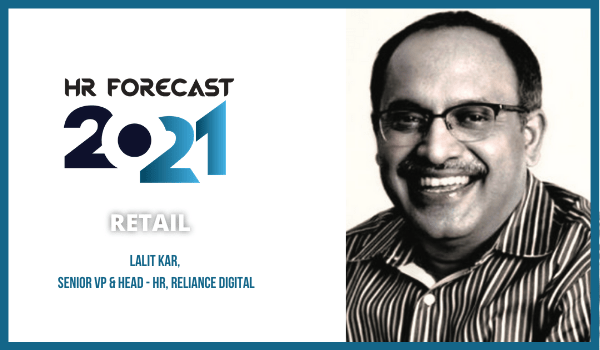
    “Participation and sustainability of women’s employment will increase,” Lalit Kar

    HRK News BureauBy HRK News BureauApril 13, 20214 Mins Read70500 Views
    Share LinkedIn Twitter Facebook WhatsApp
    Share
    LinkedIn Twitter Facebook WhatsApp


    2020: What to learn – what to erase

    A major paradigm shift has happened in terms of accepting ‘work from home’ (WFH) as a way of life. The pandemic compelled WFH and there was a realisation that this forced choice could turn out to be a better alternative in many ways. Earlier the size of meetings and training programmes was limited by the size of the room or venue. Now a large number of employees can be reached out to. It truly flattened the organisation, as communication by and with leaders became direct. Virtual instructor-led training (VILT) also became a way of learning, enabling training delivery to a large number of participants. The hybrid model is going to be the future. All the job roles will now be categorised into three buckets – Jobs which will call for presence of employees everyday; jobs which will be a combination of working from home for a few days in a week and attending the workplace on some other days; and jobs which can be carried out remotely.

    The size of the office will reduce and hence the rentals, accruing a major saving for the companies. The participation and sustainability of women’s employment will increase. The one thing I want to erase from my memory is the scene of ‘reverse migration’ of labour and their families to their villages.

    HR has shown great agility and business acumen

    In 2020, HR contributed to business continuity in terms of ensuring that every employee is enabled with connectivity to work from anywhere; a safety protocol is introduced and implemented in the workplace; intelligent manpower planning is done for immediate replacement in the event of an infection in the workplace; higher connect and engagement is maintained with employees for the upkeep of their morale; more training and learning opportunities are created; several HR processes such as recruitment, onboarding, induction and so on are reimagined and modified; new businesses are provided complete HR and training support (in Reliance Retail, new businesses such as the e-commerce and B2B2C businesses were added during 2020), and restructuring, remodelling, re-aligning for cost rationalisation and introduction of new employment models, such as gig, freelancers and part timers.

    “The criticality of HR will largely depend upon the sector the organisation belongs to and the stage a particular organisation is in”

    While HR will not become a business function, it will continue to remain a very important function. The criticality of HR will largely depend upon the sector the organisation belongs to and the stage a particular organisation is in — build-up, growth, maintenance or decadence. In the service sector, people are the most critical resource. Challenges of talent availability, people cost, attrition, performance and so on, compel HR’s involvement in business. The involvement of HR in the build-up and growth stages will continue to be higher. Since the economy is on a path to revival, HR’s involvement will be higher in the coming months.

    2021 – changing organisational design

    It will all be about organisational design, with technology as an enabler. Gradually, organisations will be a combination of: a core central team, which will provide strategic direction and leadership; technology, which will be employed for repetitive, routine work; analytics, artificial intelligence, big data, cloud and so on; and gig, freelancers and part- timers, who will be increasingly included, as more and more tasks will be performed remotely.

    Managing hybrid workforce is more challenging

    2020 is a major watershed year. Organisations will now transition into a hybrid model in a major way. With two distinct models – fully remote vis-à-vis fully on-site employees working in one organisation, leaders will be bothered about organisational culture. Whether those working remotely will own the vision, mission and values of the organisation in the same measure as those fully working in office will be the big question. A lot of cultural assimilation and integration programmes and a huge thrust on communication will follow. Gradually, emphasis will be on a ‘results only’ approach. Human resources will end up grappling with designing or amending areas, such as: an effective induction programme for the remote employees so that they do not feel at sea in a new organisation; attendance (availability in true sense), leave policies which could be different for the two types of employees; different compensation and reward policies for two types of employment (one group may be given conveyance allowance for attending work in the office, whereas the other may be given a connectivity allowance); IT and data security policy; POSH – now definition of workplace will include their home or any location they work from; and scope of work, which can be assigned to gig or freelancers as they work for several organisations.

    Lalit Kar Reliance Digital
    Share. LinkedIn Twitter Facebook WhatsApp
    HRK News Bureau

    Leave A Reply Cancel Reply

    Related Posts

    Jeeva Balakrishnan is CHRO, Cholamandalam Investment & Finance

    November 14, 2024

    Lalit Kar elevated as senior VP – workforce management at Reliance Retail

    October 25, 2023

    The salary cut conundrum: Exploring resistance and strategies after layoffs

    May 23, 2023

    How different is ‘The Great Attrition’ from ‘The Great Resignation’

    January 19, 2023
    zoha
    Editorial

    GCCs are not shrinking, the jobs that made them are

    The numbers that describe India’s GCC story in 2026 are impressive. More than 2,100 centres.…

    The Tata tussle: why employees are distant but not indifferent

    In the space of five weeks, the chairman of one of India’s most storied conglomerates…

    EDITOR'S PICKS

    HR Perspectives by Sharad K. Sharma: “We focus on making people decisions with clarity and fairness”

    September 30, 2026

    20% of managers say AI is cutting their need for empathy. Just 12% see the opposite

    September 30, 2026

    Dominant anxiety: The fear that follows every AI rollout

    September 29, 2026

    Paras Health is trying to build one HR system for a workforce that has nothing in common

    September 29, 2026
    Latest Post

    Vishal Upadhyay moves up the HR leadership ranks at Waree Group

    Movement October 1, 2026

    Waree Group has elevated Vishal Upadhyay to vice president – human resources. Upadhyay has been…

    HCLTech offers Rs 18 lakh starting salary as it steps up ‘Elite Engineer’ hiring

    Brief News September 30, 2026

    HCLTech will pay some freshers four times what it pays others. The top of its…

    Former Ford employee alleges forced-ranking system used to drive ‘soft layoffs’

    Brief News September 30, 2026

    A former Ford employee has sued the automaker, alleging that its performance- management system was…

    DoorDash opens first India office in Hyderabad, plans to scale workforce to 3,000

    Brief News September 30, 2026

    DoorDash has opened its first office in India in Hyderabad, beginning operations with around 500…

    Asia's No.1 HR Platform

    Facebook X (Twitter) Instagram LinkedIn WhatsApp Bluesky
    • Our Story
    • Partner with us
    • Career
    • Reach Us
    • Exclusive Features
    • Cover Story
    • Editorial
    • Dive into the Future of Work: Download HRForecast 2024 Now!
    © 2026 HRKatha.com
    • Disclaimer
    • Refunds & Cancellation Policy
    • Terms of Service

    Type above and press Enter to search. Press Esc to cancel.