



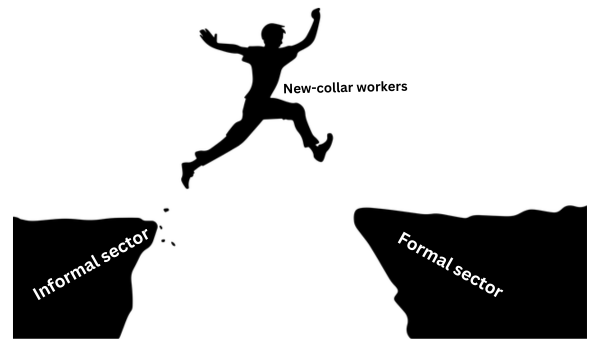
When asked whether they would choose a job with health benefits and a formal agreement over one without a contract, a whopping 93 per cent admitted they would choose the former. Clearly, the new-collar workers have come to realise that a fixed income, along with security and benefits can actually improve their lifestyle. The importance of security and benefits has been driven home by the pandemic. So, who are these new-collar workers?
Well, this generation of workers has aspirations similar to those of formal workers. The new-collar workers are beginning to prioritise security and benefits over daily wages. This cohort comprises people who develop relevant skills, both technical and soft, that are in demand. The objective is obviously to be able to bag jobs, primarily in the tech space, through nontraditional education paths. These workers lack the conventional four-year college degree. Instead, they get trained at vocational institutes, community colleges, software boot camps, or opt for certification programmes, or even on-the job apprenticeships or internships.
As per a recent report, a good 50.78 per cent of informal workers admit they are likely to take up an offer with health benefits and a formal agreement, while over 41 per cent said they are very likely to do so. About 42 per cent of formal workers agree and 52.23 per cent strongly agree that their chances of improving their lifestyle are better with a formal job that offers benefits and a formal contract than a job without these.
The new-collar lot is seeking more than just money from professional opportunities. They are considering factors such as prestige and career potential too. They realise that the formal sector offers work and financial benefits that cannot be challenged. There is more transparency, which leads to better access to services and more protection, benefits and rights.
Most (84 per cent) of the informal workers admit that technology (mobile phones and internet) has spread more awareness about the benefits of formal employment.
The survey conducted over a period of about five months, covered more than 4,000 respondents across Bangalore, Chennai, Delhi, Hyderabad, Kolkata, Mumbai, Pune, Ahmedabad, Baroda, Coimbatore, Indore, Lucknow, Ludhiana and Nashik.
Amongst various insights, one interesting on is that more women aspire to move from the informal to the formal
Sector. While 63 per cent of women (informal employees) are willing to settle for a lesser salary provided they are offered health benefits and a formal contract, only 28 per cent of informal male workers said they were likely to do so.
Informal male workers feel professional networking plays a major role in bagging formal jobs, while women believe education helps secure a formal job. About 62 per cent of men and informal workers believe that an external reference or recommendation is required to obtain a formal job, while only 55 per cent of women share this view. While 37 per cent of male informal workers feel lack of awareness of job opportunities hinders a to shift to the formal sector, only 33 per cent of women share this view.
Amongst informal workers across these metros and non-metros, about 52.49 per cent agree and 45.13 per cent strongly agree that that they have a better chance of improving their own and their family’s lifestyle if they take up a formal job.
Interestingly, 14 per cent of informal workers associate a job with learning new skills compared to only 10 per cent of formal workers. About 10 per cent of informal workers treat their job as a means to support their passion compared to only five per cent of formal workers.
A majority (97 per cent) of informal workers feel there is more opportunity for salary growth in a formal job
with a contract, as opposed to an informal job without a contract. Also, 86 per cent of informal workers believe there is growth opportunity in terms of professional skills in a formal job than an informal one. A good 92 per cent of formal workers also agree.
When it comes to social security, over 71 per cent of formal employees and about 69 per cent of informal workers feel life insurance should be offered by their employers. Over 75 per cent formal workers and 79 per cent informal workers expect their employers to offer the ESI benefit, that is, employees’ state insurance. About 74 per cent formal workers and 72 per cent informal workers expect provident fund facility, while 25 per cent formal and 49 per cent informal workers expect disability insurance. Paid leave is expected by about 58 per cent formal and 71 per cent informal workers.
What is worth nothing is that the youngsters are the ones keen on life insurance and ESI security. Over 66 per cent of informal workers in the 18 to 24 age bracket and over 71 per cent of those in the 25 to 34 age group expect their employers to offer life insurance. Amongst the older lot, only about 70.34 in the 35 to 44 age group and over 68 per cent in the 45+ age group expect life insurance.
Over 82 per cent of those in the 18 to 24 age bracket expect ESI benefit from their employers, while over 72 per cent in this age bracket expect provident fund.
The survey — which covered over 4,179 people across age groups, across seven metros and seven non-metros— reveals that about 80 per cent of the informal employees expect their employers to provide them with the security of ESI and other medical benefits. A whopping 83 per cent in the 18 to 25 age bracket, and 81 per cent in the 26 to 35 age bracket amongst informal workers expect ESI. A good 79 per cent are ready to compromise on 20 per cent or more of their salary if the job offered security and benefits equivalent to their counterparts in the formal sector.
Clearly, the new-collar generation’s priorities and aspirations are similar to those of formal workers, and they are giving more importance to security and benefits over their hourly or daily wages. Almost one in every five informal employees in the 18 to 25 age range associates a job with building a career compared to only 10 per cent of those over 45 years of age. About 17 per cent of those in the 18 to 25 age range associate a job with learning new skills compared to only 12 per cent of those above 45. Their transition from the informal space to the formal should be facilitated.