


A marathon of compounding decisions
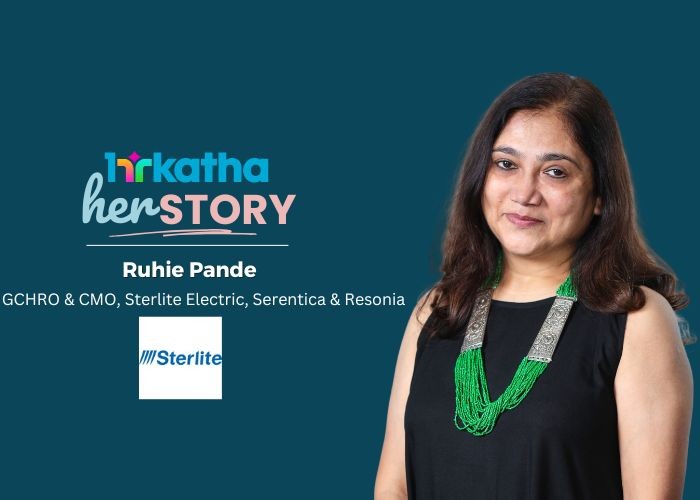
Ruhie Pande sees her career as a marathon of compounding decisions. She keeps asking herself whether the move she is making today is building a capability that will serve her five years from now.
On being asked what advice she would give to her younger self, Pande is quick to say: “Stop trying to be the best ‘HR practitioner’ in the room and start striving to be the ‘best business leader’ in the room instead.”
Why? Because Pande has come to realise that each organisation is different, and there is no one-size-fits-all approach. True organisational impact only comes from speaking the language of the business fluently. Unless you understand the P&L and the technical mechanics of the industry, your people strategies will remain ‘add-ons’ rather than core drivers of value.
Rather than mastering HR theories, she would prefer to spend time understanding business levers and focusing on an HR strategy that drives the core business levers.
This does not sound surprising coming from a woman who urges everyone to “build your wisdom as much as your knowledge.”
Today, as group CHRO and CMO, Sterlite Electric, Serentica & Resonia, Pande leads across three remarkably diverse businesses with this philosophy at the core.
Choosing to call out bias
Early on in her career, there were situations where Pande happened to be the only woman in a meeting full of men. At times, leaders would even use inappropriate language, which made her feel awkward. In such situations, she simply chose to walk out of the meetings.
She was aware of the “old boys’ networks” that often operated in corporate environments, with decisions frequently being made during smoke breaks or post-work drinking sessions. Instead of resenting this and being left behind, she chose to join these informal discussions. Of course, this required some personal sacrifices, including staying away from her young kids at times. However, a supportive family helped her through it all.
Later in her career, she admits that the biases became more subtle, but she never shied away from calling them out.
One particular discussion remains fresh in her mind where some male colleagues were praising women teammates who worked until the last day of their pregnancy and stayed connected throughout their maternity break. As the only woman leader in the meeting, she called out the bias.
Unconscious and conscious biases exist even today, and Pande is committed to always calling them out.
“Staying connected to work during maternity break is a woman’s choice, but by praising such behaviour, we risk turning it into an unhealthy expectation.”
Creating a resilient human grid
Psychological safety rooted in transparency is Pande’s non-negotiable. She always believed: “Culture is not what you write on the office walls; it is what happens when things go wrong.” If an engineer on a remote site or a technician on the shop floor feels they cannot flag a concern without fear of retribution, the organisation is fragile.
For her, transparency is not just about sharing information but about creating a ‘human grid’ that is as resilient as the electrical ones they build. This means having noisy conversations during transformations, embracing a culture rooted in ‘Red is Good’, and ensuring that every employee understands the why behind the decisions.
Respect is another non-negotiable and in her own words: “To raise standards, you do not have to raise your voice.”
“Stop trying to be the best ‘HR practitioner’ in the room; instead, strive to be the best business leader in the room”
A seat at the high table of strategy
Women, according to Pande, have progressed remarkably in HR. They have successfully converted HR from being a ‘pink-collar’ administrative function to now having a seat at the high table of strategy.
They are leading the charge in M&A, business transformation, and board-level strategy. They are now seen as ‘business architects’ who shape the very fabric of growth. Pande calls this “a massive victory.”
However, she also believes that women must push harder in engineering the ecosystem. In sectors such as renewables and transmission, women should move beyond just talking about diversity, and go on to ‘farm’ and ‘strengthen’ it. Women need to move beyond the corporate office and look at the shop floor—that is where the real action happens. Her response to this? In-house programmes, such as Project Pragati and Project Shakti.
“We are not just looking for ready talent; we are building the pipeline from scratch,” she shares. “Women in our factories operate machines, women at our sites work on ‘Right of Way’ and other business challenges.”
Whilst women are proving that they can lead in high-voltage environments, this also requires their organisations to intentionally redesign everything—be it the infrastructure at their sites, shift timings, or management sensitisation.
Yet, there need to be more women in leadership roles, she feels, as she also mentions in her research paper ‘Foot in the Door: Women Navigating the Glass Ceiling in the Indian Real Estate’.
Quick fire round
Best career advice you have ever received?
Identify “your stamp”. Ask yourself what you would like to be remembered for after you leave the organisation.
One thing you wish people understood about being a woman in HR leadership?
HR leaders are business leaders first and HR leaders second.
Best investment you have made in yourself?
Pursuing a Master’s in Organisational Psychology from Birkbeck, University of London—one of the best educational experiences for any HR professional.
One skill you are currently developing?
The intersection of AI and human intuition. I want to understand how to use technology to strip away the noise of data processing so we can focus on the “signal” of human potential.
Your definition of success today versus 10 years ago?
Ten years ago, success was about a personal seat at the table. Today, it is about the strength of the leadership pipeline I leave behind and the social impact of the workforce we are building.
Guiding hands
There have been leaders to push her, trust her and give her the canvas to paint her own path during various phases of her career. From Harsh Mariwala of Marico, she learnt how HR can be result-driven and also a key business driver. From Pirojsha Godrej, she learnt decision-making, risk-taking, and how to bet on people and give them autonomy. Pratik Agarwal, her current boss, has shown her how empowerment can be taken to a different level. From him, she learnt that leadership is not about control but about empowering others to be the custodians of the organisation’s future.
Sharpening empathy with data and business acumen
One thing she is very clear about is that the ‘human’ in ‘human resources’ cannot be allowed to be a limitation. While she admits that ‘empathy’ is the superpower that women possess, it needs to be sharpened with data and business acumen.
She encourages women to “be radically curious”—to understand how a wind turbine works in the renewable energy space, or get into the functioning of the supply chain in the manufacturing sector.
“When you understand the ‘noise’ of the business, you can provide much better ‘signals’ as an HR leader,” she points out.
Success, for Pande, is no more about a personal seat at the table but about the strength of the leadership pipeline she leaves behind and the social impact of the workforce they are building.