



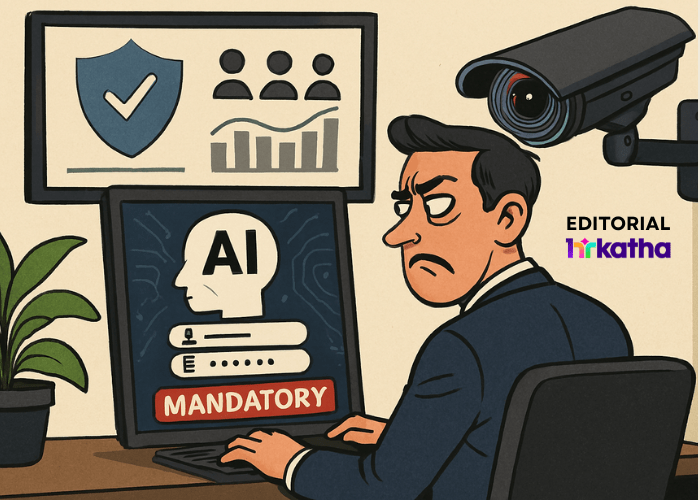
When consulting firms tie promotion to AI usage while threatening to “exit” resisters, they present the policy as capability building. It may be something more structural: a way to reshape the workforce, test organisational loyalty and modernise the firm’s image under the language of transformation.
Accenture has begun tracking senior staff logins to its AI tools and linking promotion decisions to “regular adoption” of artificial intelligence. The firm has trained 550,000 of its 780,000 employees in generative AI and monitors weekly usage data. Its chief executive, Julie Sweet, told investors the company would “exit” employees who fail to get the hang of AI at work. This follows 11,000 layoffs earlier in the year.

The juxtaposition is revealing. Accenture is not publicly measuring whether AI improves client outcomes, work quality or productivity. It is measuring logins. The mandate is not “use AI where it adds value” but closer to “use AI, demonstrably”. The firm has also acknowledged that older and more senior employees tend to be more reluctant adopters than younger staff—a demographic split with organisational consequences.
None of this proves the policy is misguided. Consulting firms face real pressure to master the tools they recommend to clients. If AI is becoming foundational to how businesses operate, it is reasonable for a consultancy to insist its workforce develop fluency. A firm that cannot credibly demonstrate internal adoption risks losing commercial relevance.
Yet what Accenture is measuring suggests a different priority.
Activity without outcomes
Weekly logins reveal little about whether AI improves a pitch deck, sharpens an analysis or strengthens a client recommendation. They reveal who opened an application. It is a dashboard that measures motion and calls it progress.
When organisations reward visible activity over measurable results, employees optimise for appearances before impact. They log into tools, mention AI in meetings and circulate AI-generated drafts with prominent disclaimers. These signals satisfy the metric without guaranteeing meaningful integration into the work itself.
What remains conspicuously absent is measurement of what actually matters. Client satisfaction surveys exist. Project success metrics are routinely tracked. Strategic recommendations have observable adoption rates. The data required to test whether AI usage correlates with superior outcomes is available. Yet firms are not publishing such correlations—or apparently prioritising them.
If strong evidence showed that heavy AI users consistently outperform others on meaningful dimensions, that evidence would justify adoption mandates more persuasively than login counts ever could. The emphasis on usage metrics suggests that demonstrating productivity gains at scale is either difficult or secondary. Tracking logins offers a clean, visible number for investors and client pitches. Tracking outcome variance by usage would raise harder questions about whether the mandate improves work or simply ensures compliance.
The business model imperative
The policy also serves commercial positioning. Accenture reported stronger-than-expected results in December, driven by demand for AI-driven services. Every major client engagement now involves discussions of AI transformation. A consultancy that cannot demonstrate internal fluency risks losing credibility when advising clients on adoption.
In that environment, AI adoption becomes less a tool than a stage prop—useful not only for doing the work, but for signalling that the performance is under way. Mandated usage becomes marketing collateral. Consultants function as living case studies of reinvention. If clients believe the narrative and award contracts, revenue follows whether or not AI has yet delivered measurable productivity gains internally.
This dynamic helps explain the urgency behind adoption requirements. Employees who resist do not merely underperform; they complicate the firm’s positioning. A senior consultant achieving strong results without AI suggests the technology may be optional. That possibility sits uneasily with a strategy built on selling transformation.
Experience as liability
Senior consultants may be more cautious not because they lack capability, but because they have lived through successive waves of management fashion. They remember technologies that promised revolution and delivered incremental improvement. That history generates calibrated scepticism—a form of pattern recognition about the gap between marketing claims and operational reality.
Under a universal adoption mandate, however, such scepticism becomes harder to express. The demographic split Accenture acknowledged—older employees more reluctant, younger ones more receptive—appears natural. But it may also reflect differences in institutional memory. Those who have witnessed multiple cycles of corporate reinvention are often slower to equate novelty with necessity.
The economic implications are difficult to ignore. Senior consultants are expensive, and consulting operates on pyramid structures that require continual churn at higher levels. AI adoption requirements can accelerate this churn while providing a rationale that appears skills-based and neutral. Advancement criteria shift; those who adapt quickly progress. The uneven demographic impact can be attributed to individual choice rather than organisational design.
Compliance signalling
“Regular adoption” is deliberately elastic. Promotion decisions inevitably involve judgement about enthusiasm as well as competence. Employees who visibly embrace the firm’s technological direction signal alignment. Those who question AI’s usefulness in certain contexts risk appearing out of step.
This ambiguity creates managerial discretion. A consultant who logs in weekly but expresses doubts about AI’s value in complex client relationships may be seen as insufficiently committed. Another who uses the tools sparingly but champions them publicly may be rewarded for cultural alignment.
Senior consultants may reasonably conclude that AI offers limited value in specific domains. High-stakes client relationships depend on trust and judgement. Strategic advisory work requires contextual understanding. Some negotiations may be situations where algorithmic assistance adds little. Under a mandate that treats adoption as a cultural litmus test, expressing that judgement becomes professionally risky.
A spreading template
Other firms are watching closely. Technology companies and consultancies are experimenting with linking compensation or progression to AI adoption. The attraction is clear: such mandates simultaneously build internal capability, reinforce external positioning and adjust workforce economics, all while resting on criteria that appear neutral and skills-based.
For Indian IT services and consulting firms, the template is particularly relevant. Many operate similar pyramid models and face comparable pressures to demonstrate their own transformation journeys to clients. Approaches that align capability building with organisational redesign will inevitably attract attention.
The pattern is likely to intensify. Earlier technology initiatives focused on deployment and training. AI adoption mandates establish a different precedent: fluency becomes a prerequisite for career progression, with usage tracking serving as evidence for personnel decisions.
The choreography of change
What emerges is an elegant piece of organisational design. The mandate supports commercial positioning, enables workforce adjustment and tests cultural alignment within a framework that appears meritocratic.
The emphasis on usage over outcome measurement may be the policy’s most revealing feature. If AI adoption were demonstrably enhancing work quality at scale, outcome metrics would strengthen both internal legitimacy and external credibility. The focus on proxies suggests that value is harder to capture—or less central to the immediate objective.
Firms that optimise for what is easy to count risk mistaking the choreography of change for change itself. Employees respond rationally to incentives. If visibility carries more weight than impact, visibility is what organisations will receive.
Stripped of rhetoric, the approach reflects practical calculations. Consulting firms must project technological leadership, align their workforces with that image and manage the economics of large organisational pyramids. Adoption mandates serve these goals and may well accelerate genuine learning. But they blur the boundary between developing capability and enforcing conformity.
The danger is not that firms push employees to learn new tools. It is that they begin to confuse visible adoption with genuine advancement. When organisations reward the signals of transformation more than its substance, they risk building cultures fluent in performance but thin in progress. AI will reshape consulting. Whether it improves it will depend less on how often employees log in than on whether firms remain willing to measure what truly matters.