


Winner | HRKatha Rising Star Leadership Award 2025
Every generation of HR professionals inherits a different challenge. Earlier generations had to prove HR belonged in business conversations. Today’s challenge is different. The HR function has to demonstrate that it can think like the business itself.
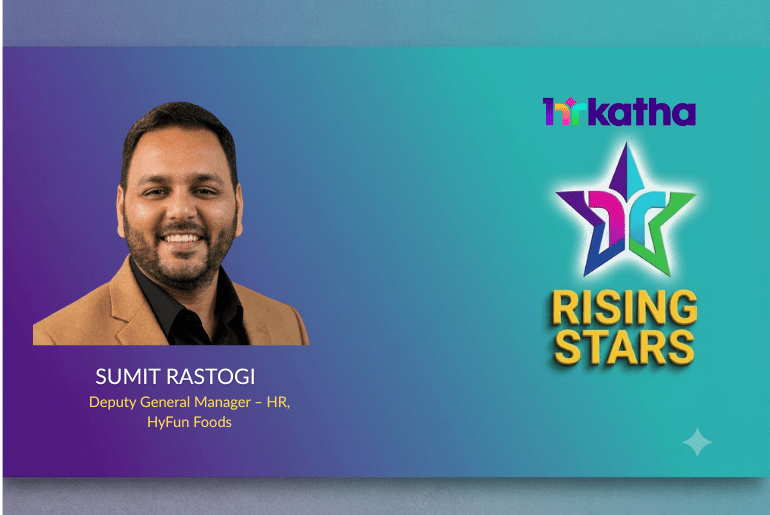
Sumit Rastogi belongs to a generation trying to make that shift.

An engineer by training, he approaches HR less as a support function than as a business capability whose success should be measured in commercial outcomes rather than activity alone. Whether discussing hiring, diversity, technology or workforce planning, he returns repeatedly to the same principle: people practices create value only when they strengthen business performance. It is a perspective that runs through every part of his work, and one that reflects where HRKatha’s Rising Star Leadership Awards see the profession heading rather than where it has traditionally stood.
From engineer to HR strategist
Engineering taught Rastogi to solve problems through systems. HR taught him that systems only work when they are designed around people.
“People are not algorithms,” he says, “but systems can either empower or break them.”
That thinking explains why he describes himself as a functional entrepreneur. Instead of viewing HR as an internal support service, he believes it should be run with the same commercial discipline as an independent business unit, where every initiative is expected to create measurable value.
One idea illustrates that philosophy particularly well. If he were leading the HR function tomorrow, every HR business partner and talent professional would spend time working alongside the people they support, whether on a manufacturing floor, inside a technology team or in a product development unit. He calls the idea reverse shadowing.
“You cannot build a high-performing culture or write a realistic annual operating plan from an isolated glass cabin,” he says. For Rastogi, understanding work at ground level is not about visibility. It is about making better business decisions.
Building systems, not slogans
That operational mindset also shapes his approach to diversity, equity and inclusion. Rather than treating inclusion as a communication exercise, he prefers building systems that widen access to opportunity: Glamazon for LGBTQ+ inclusion, Rekindle for women returning after career breaks, and dedicated hiring channels for persons with disabilities run with NGO partners including Sarthak and Dr. Reddy’s Foundation. In his view, these programmes work only when they become embedded in everyday hiring and talent practices rather than existing as standalone initiatives.
His definition of engagement is equally practical. “Engagement happens when inclusion is operationalised,” he says. Transparent expectations, clear performance measures and empathetic leadership do more than make employees feel included, he argues. They encourage people to take ownership of outcomes, which is ultimately what organisations need from any culture initiative.
Measuring HR through business outcomes
Ask Rastogi how he evaluates HR’s contribution and the answer is characteristically direct. He starts with business performance.
One example comes from talent acquisition. By strengthening internal mobility, expanding employee referrals and building stronger in-house sourcing capability, his team reduced dependence on external recruitment agencies, generating savings of more than ?2 crore while simultaneously improving hiring speed for leadership roles.
For Rastogi, those are the numbers that matter. Employee engagement, capability development and talent acquisition all have value, but only if they ultimately improve organisational performance. HR, he believes, earns credibility when people metrics translate into business metrics.
Technology should elevate judgement
Rastogi sees artificial intelligence less as a replacement for HR than as an opportunity to redefine it. As AI automates administrative work, he believes HR professionals should move away from processing information and towards interpreting it: analysing workforce data, anticipating attrition, identifying capability gaps and spotting organisational risks before they become business problems.
Technology removes routine work. Judgement remains human. That distinction, he believes, will define the next generation of HR leaders.
Looking ahead
Rastogi’s long-term ambition is to build an AI-enabled talent ecosystem where workforce intelligence, compensation benchmarking and talent mapping become largely automated, allowing HR leaders to devote more time to governance, employee relations and strategic decision-making.
He also believes the profession can do more to accelerate emerging leaders by creating stronger mentoring networks, greater cross-functional exposure and more opportunities to participate in strategic business conversations. Those experiences, he argues, develop commercial judgement far more effectively than formal training programmes alone.
________________________________________
Quick Takes
Leadership style, in one word: Bias for action.
An HR superpower for a day: Predictive retention, knowing what it takes to retain high performers before they consider leaving.
A surprising skill that makes him better at HR: Salesmanship.
First response when an employee questions a salary slip: Sit beside them, walk through the numbers and listen first. Empathy comes before explanation.
Why he is a Rising Star
Rastogi approaches HR with an engineer’s instinct to simplify, measure and improve systems.
Throughout his conversation with HRKatha, the same philosophy appears repeatedly: understand how the business creates value, build people practices that strengthen commercial outcomes, and use technology to remove friction rather than replace judgement.
His emphasis on measurable business impact does not come at the expense of people. Instead, he argues that HR earns credibility when inclusion, talent development and workforce planning are designed with the same rigour that organisations apply to finance, operations or manufacturing. That combination of commercial thinking and people-centred execution is exactly what HRKatha’s Rising Star Leadership Award 2025 was designed to recognise.
His career is still evolving, but it already reflects a broader shift taking place across the profession. HR is no longer expected simply to support the business. Increasingly, it is expected to think like one.
Rising Stars is HRKatha’s editorial series profiling the next generation of HR leaders shaping the future of the profession. The series features winners of the HRKatha Rising Star Leadership Awards alongside emerging professionals whose work, ideas and leadership potential deserve wider recognition.
