



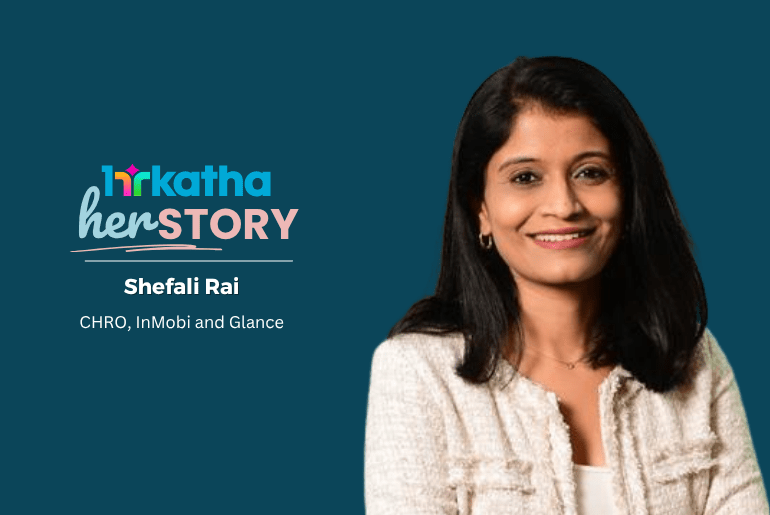
Following her internal compass
The biggest professional risk Shefali Rai took was walking away from her formal training as an engineer to move into human resources.
In a culture where success was often narrowly defined through careers in engineering or medicine, pivoting into an entirely different domain, with no guaranteed trajectory, was daunting. There was no established map to follow and little social permission to stray from the expected path.

Yet that decision became the foundation of her career.
“Follow your internal compass, ignore the noise of conventional expectations, and back yourself with unwavering self-belief,” she says.
Today, as CHRO at InMobi and Glance, that same instinct continues to shape how Rai leads. She trusts her reading of a situation, even when it takes her away from the safer or more conventional route.
“Follow your internal compass, ignore conventional expectations and back yourself with unwavering self-belief.”
AI is liberating, not replacing
“Artificial intelligence is not replacing humans; it is liberating them,” says Rai.
As an HR leader in a deep-tech environment, she sees AI absorbing much of the operational, repetitive and process-heavy work that has historically consumed human energy.
What remains, in her view, is a largely unexplored space for ingenuity, creativity and strategic thought.
She does not see leadership’s role as protecting old ways of working from automation. It is about architecting the future and deciding how organisations can make the most of the human potential that technology releases.
The organisations that succeed, she believes, will be those where human capability and technological intelligence amplify each other rather than compete for the same territory.
Betting on people before they bet on themselves
Rai describes her leadership style as one of high-conviction empowerment: recognising possibility in people and backing it fiercely, sometimes before they can see that potential themselves.
Early in her career, she understood management largely through the lens of performance tracking. Over time, her approach evolved into something more fundamental: turning belief into reality.
She credits that shift to leaders who recognised her potential long before she fully trusted it herself.
“True leadership isn’t just about managing output. It is the art of believing in people before they even believe in themselves, and building an ecosystem where that trust translates into extraordinary performance,” she says.
That belief now sits at the centre of how she builds and leads teams.
Beyond corporate boundaries
The defining test of that leadership philosophy came during the peak of the COVID-19 crisis.
As the pandemic disrupted lives across the country, Rai’s team moved far beyond what would ordinarily be considered the remit of a corporate HR function.
They mobilised emergency response teams, set up a hospital and airlifted employees and their families from remote villages to safety.
The experience remains one of the moments that made her proudest to be in HR.
It also demonstrated something larger about the function. In moments of genuine crisis, the boundaries between organisational responsibility and human responsibility become difficult to defend.
For Rai and her team, helping people through the emergency was not an additional initiative. It was the work that the moment demanded.
“HR is not a support function. It belongs in the core architecture of business strategy and decision-making.”
Retiring the compliance-first mindset
Rai is direct about what HR needs to leave behind: an excessive dependence on rigid, compliance-first processes.
Every time human behaviour, creativity and connection are forced into a bureaucratic box, she believes something vital is lost. Psychological safety, trust and the ethos that makes a culture work cannot be produced through rules alone.
What deserves far greater attention is the ability to unlock human potential.
In a corporate world dominated by metrics, recognising a genuine game changer requires intuition and courage. It may mean backing someone who has had a difficult year on paper but whose underlying capability remains strong.
“We need to build that conviction in ourselves and embed it into the DNA of our business leaders,” she says.
The mentors who took the risk
Two leaders played particularly important roles in shaping Rai’s journey.
Manisha, former HR head at InMobi, took an unprompted risk on her early in her tenure. Rai was new to the company and wanted to move entirely away from talent acquisition. Manisha gave her the freedom to experiment.
That experience showed Rai what it means to receive a breakthrough opportunity based on trust rather than an established track record.
Naveen Tewari, founder and CEO of InMobi and Glance, reshaped the way she thinks about business itself.
From him, she learnt what she describes as fearless leadership: operating without being paralysed by the possibility of failure and leading an organisation through vision and audacity.
Both experiences reinforced the leadership philosophy she now practises herself: back people before certainty arrives.
Quick fire round
The most underrated skill in HR today?
High-impact, strategic communication that aligns a diverse workforce behind a singular vision.
A moment that made you proud to be in HR?
During the peak of the COVID-19 crisis, when our team shattered corporate boundaries to mobilise emergency response teams, set up a hospital, and airlift employees and their families from remote villages to safety.
A workplace trend you think is overrated?
Rigid corporate hierarchies, particularly the outdated symbolism of leaders isolating themselves in corner cabins instead of being on the floor with their teams.
What is one skill you are currently working on developing?
Deepening my AI literacy to effectively architect the intersection of technology and human talent.
If not HR, what career path would you have pursued?
Music. It is the ultimate form of human expression and connection.
No pre-paved path
Rai’s advice to young professionals is blunt: do not allow external conditioning, societal expectations or familiar comfort zones to dictate your career.
To her younger self, she would offer similar advice. Experiment relentlessly. Build skills across domains that may appear unrelated. Understand different aspects of the business before feeling pressured to specialise.
Careers, in her view, should not be treated as paths already paved by someone else.
They are built through the decisions people make for themselves, often before they know exactly where those decisions will lead.
Redefining HR’s seat at the table
Rai believes women in HR have moved beyond the era of representation for its own sake.
Women now lead large global HR functions because they bring strategic acumen, empathy and the ability to synthesise competing perspectives into a coherent direction.
But she believes women leaders must go further and help redefine the seat HR itself occupies at the table.
A CHRO, in her view, is no longer simply a people architect. The role is that of a business architect.
Every commercial, financial or product milestone is ultimately also a people milestone because organisations cannot deliver without the talent, culture and leadership required to make it possible.
“We need businesses to stop viewing HR as a support function and fully integrate us into the core architecture of business strategy and decision-making,” she states.