



Lessons learnt early
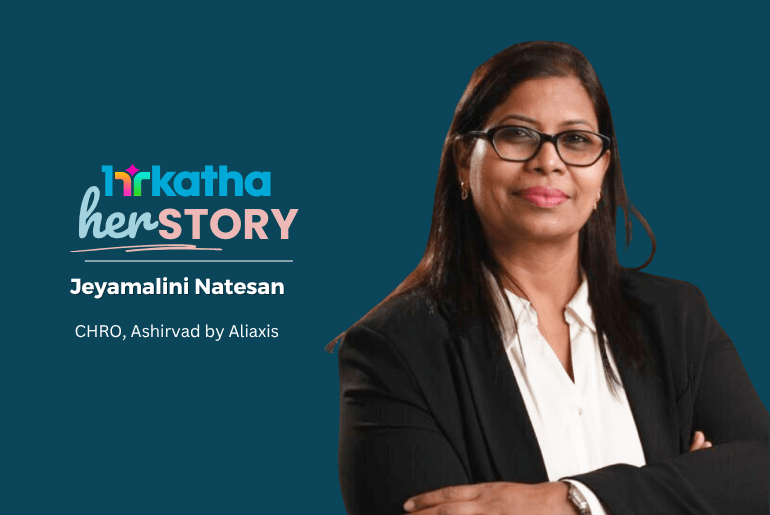
Early in her career, Jeyamalini Natesan had the opportunity to work directly with MDs and CEOs. The exposure gave her an early understanding of business strategy and, more importantly, showed her how HR could move beyond being a support function to become a genuine business partner.
It also shaped something more fundamental in how she approached the profession. No two people respond to the same situation in exactly the same way. For Natesan, that meant HR demanded agility, empathy and the ability to constantly balance business priorities with employee expectations.

Today, as CHRO at Ashirvad by Aliaxis, those early lessons continue to shape how she leads.
Speaking up for credibility
Being a woman in HR brought with it a subtle challenge for Natesan: the need to consistently demonstrate that her expertise extended well beyond traditional people management.
Her response was to deepen her understanding of the business and ensure that HR decisions were increasingly data-driven and connected directly to organisational goals. Continuous learning helped, as did a relentless focus on outcomes.
But knowledge alone was not enough.
“In addition to having the knowledge and action plan, having the courage to speak up, irrespective of hierarchy, brought in the credibility and influence,” she says.
Over time, speaking up became as important as being prepared. It allowed her to move from contributing to HR conversations to influencing broader business decisions.
“Courage to speak up, irrespective of hierarchy, built credibility and influence.”
Learning to start again
Moving across industries and geographies, and repeatedly stepping into unfamiliar territory, has been one of the bigger professional risks Natesan has taken.
“I have been into consulting, automotive, banking and financial services, pharmaceuticals, complex chemical manufacturing, startups and even packaging,” she shares.
She has also worked across geographies and managed multiple unions across locations, including through periods when maintaining uninterrupted operations was particularly challenging.
Each transition required her to understand a new business model, adapt to a different culture and work with teams carrying very different expectations. More importantly, each move required her to question whether what had worked before would work again.
The experience taught her to remain curious rather than become overly attached to familiar solutions.
“When you remain curious and open to change, you build resilience and broader perspective,” she says.
For Natesan, moving across industries was therefore not simply about accumulating experience. It was about repeatedly becoming a learner again.
Beyond conventional solutions
Some of the toughest decisions Natesan faces are those where business needs and employee expectations collide directly.
In those moments, she returns to organisational values, fairness and data-backed insight. But she also believes difficult situations require the willingness to look beyond conventional solutions.
“Challenges are opportunities to create solutions that are more balanced and sustainable,” she believes.
The same philosophy shapes how she thinks about performance. Stretch goals have a place, but they cannot exist in isolation. Employees also need the right training, technology and timely feedback if they are expected to deliver against higher expectations.
“Performance and empathy must coexist to build a lasting high-performance culture,” she says.
For Natesan, the two are not competing ideas. Sustained performance becomes more likely when people understand what is expected of them and feel equipped to deliver it.
“Performance and empathy must coexist in a lasting high-performance culture.”
Where the numbers still need to change
Natesan has seen visible progress in representation and inclusion over the years, with organisations paying greater attention to flexibility, wellbeing and the conditions that allow women to sustain careers.
At Ashirvad by Aliaxis, initiatives such as Women of Wonder (WOW) and WOWMOM are designed to support women across different stages of their professional and personal lives.
“Ensuring women feel safe at work is our priority. Providing the needed infrastructure and policies that facilitate a safe work atmosphere and career growth opportunities are key to our DEI agenda,” she shares.
But she does not mistake progress for completion.
Manufacturing, in particular, remains an area where women’s representation needs to improve. For Natesan and her team, the challenge is therefore not merely to introduce programmes, but to create the conditions in which more women can enter, remain and progress in the sector.
Care, dare and deliver
“Strategic HR means anchoring our purpose and values, care, dare and deliver, in our ways of working,” states Natesan.
In practice, that begins with clarity around both the ‘what’ and the ‘how’. Goals need to be measurable and aligned with business priorities, but the organisation also needs the capability to deliver them.
Her team uses interventions such as Catalyst, Lead with Purpose and emerging leadership programmes to build that capability and strengthen the leadership pipeline.
For Natesan, strategic HR therefore goes well beyond policy or programme design. It is about creating the conditions for performance, developing future-ready capability and encouraging people to take ownership of sustainable, profitable growth.
That requires HR to understand not merely what people need, but what the business is trying to become.
Quick fire round
If not HR, what career path would you have pursued?
Business strategy, as that is in my interest as well.
What energises you most about your work?
People, and the ability of leaders to shape their careers.
Best investment you’ve made in yourself?
Continuous learning. I am a strong believer in learning and the value that adds to an individual.
One skill you’re currently working on developing?
I am a certified coach, and I am working on further development in the field of coaching.
Your definition of success today versus 10 years ago?
Success today for me is about how people value you as a leader, and also as a human being.
Preparing people for constant change
“We are in a VUCA world, and change is here to stay,” Natesan points out.
For her, preparing people for the future begins with accepting that permanence itself has become increasingly rare.
But asking people to adapt is not enough. The first responsibility of leadership is to communicate transparently about what a change means, including both its opportunities and its consequences.
Natesan also believes employees need to be heard during implementation. When people understand why something is changing and have a voice in how that change takes shape, they are more likely to take ownership rather than simply comply.
Structured learning, development interventions and leadership programmes then provide the capabilities needed to operate in that new environment.
For Natesan, resilience is not created by repeatedly telling people to embrace change. It grows when people understand the change, participate in it and feel equipped for what comes next.