



Company: Pinnacle Sales Corp (fictitious), a B2B enterprise sales firm with 1,100 employees, selling software and managed services solutions to large corporates across manufacturing, logistics and financial services.
Background

Rajiv Malhotra is the kind of salesperson most organisations spend years trying to find.
Last year, he brought in Rs 50 crore in revenue, three times the next-best performer on the team. His client relationships run deep, his conversion rate is exceptional and leadership has long credited him with holding a significant part of the company’s commercial engine together.
But Rajiv has another reputation, and it has been building for almost as long.
He publicly berates junior sales representatives in meetings. His criticism is frequently demeaning and sometimes personal. People around him describe working with him as exhausting and, for some, genuinely distressing. Three members of the sales team have resigned in the past 18 months, each citing his behaviour as a primary reason.
HR has issued two formal warnings. Both were documented. Both times, Rajiv acknowledged the concerns and agreed to change.
Both times, little changed.
Last week, a fourth resignation landed on HR’s desk. The departing employee, a high-potential junior representative who had been with the company for two years, named Rajiv explicitly in her exit interview.
Her manager forwarded it to the CHRO with a single line:
“We need to make a decision.”
The dilemma
Should HR recommend termination, accepting the commercial impact of losing its Rs 50 crore performer in order to protect the people Rajiv continues to harm?
Or should it retain him, invest in intensive coaching and impose much tighter behavioural accountability, accepting that exceptional commercial talent may sometimes warrant more effort before an organisation gives up on it?
And if Rajiv is given one final opportunity, should HR simultaneously begin reducing the company’s dependence on him so that the next decision is not held hostage by his revenue contribution?
What’s really at stake
This is a test of what happens to organisational values when enforcing them becomes expensive.
Rajiv’s commercial value is not theoretical. Losing him could unsettle major client relationships and create an immediate revenue gap. Replacing someone who generates Rs 50 crore is not the same as replacing an average performer. Leadership cannot simply pretend otherwise.
But the cost of keeping him is no longer theoretical either.
Four employees have now chosen to leave. Two formal warnings have produced no sustained change. Others are watching, including people who may never complain formally but are drawing their own conclusions about what the organisation will tolerate from someone valuable enough.
There is a wider risk too. Behaviour that repeatedly produces results without meaningful consequences can become instructive. Other managers see what gets rewarded. Junior employees learn what they may have to tolerate to succeed. Over time, one difficult high performer can influence a culture far beyond the people who report directly to him.
That makes the Rs 50 crore argument both compelling and incomplete. The organisation knows what Rajiv brings in. It is much harder to calculate what his behaviour is costing in attrition, disengagement, lost potential and the credibility of every value the company asks employees to believe in.
The deeper question is harder to avoid: if values apply until the commercial cost becomes too high, are they really values at all?
We asked three HR leaders how they would approach this dilemma.
What HR leaders said
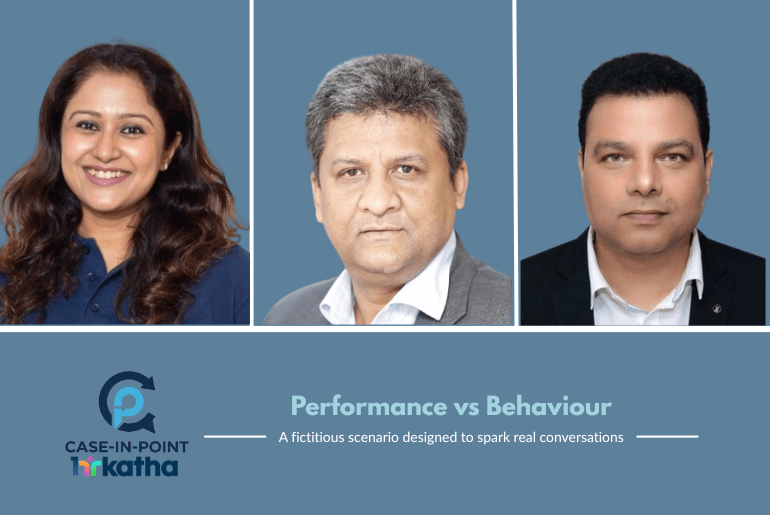
Divya Mohan, CHRO, InsuranceDekho
“I would resist framing this as a choice between Rs 50 crore of revenue and culture. The real question is how the organisation protects the business without allowing performance to become a licence for unacceptable behaviour.
 Rajiv is clearly a valuable business asset. But there is already a visible cost: three resignations, repeated concerns and two HR interventions that have not produced change. Another warning by itself is unlikely to achieve anything different.
I would have the CEO or business head take this conversation directly. Rajiv should hear clearly that his contribution is recognised, but it does not place him outside the standards expected of everyone else.
At the same time, I would invest in him. Executive coaching, honest 360-degree feedback and a senior leader who can challenge him and help him understand the impact of his behaviour.
People sometimes genuinely do not realise how they are being experienced by others. If there is talent worth retaining, the organisation has a responsibility to help that person change, not simply warn them and wait for them to fail.
But this cannot be open-ended. Set clear expectations, give him a reasonable window to demonstrate change and be absolutely clear about the consequences if he does not. I would also leave his client relationships and revenue responsibility intact. We should not create a business problem while trying to solve a people problem.
Exceptional performance should earn investment, not immunity. And if the organisation can retain the Rs 50 crore performer while helping him become a better leader, that is the outcome worth working towards.”
Dipankar Ghosh, Group Head, HR, Apollo Tyres
“Rajiv presents a classic leadership dilemma: what should an organisation do when its best performer damages the work environment?

Culture is ultimately defined not by what an organisation says, but by what it practises. If stated values include respect, dignity and collaboration, but those principles are suspended for the highest revenue generator, employees will quickly recognise the inconsistency.
The cost of tolerating this behaviour extends beyond the three resignations already on record. There may be many who have not yet spoken up. There may be peers watching Rajiv’s conduct go unchecked and concluding that it appears to work. There is likely a set of high-potential employees quietly disengaging. The cascading effect can be an erosion of collaboration, suppression of innovation and a weakening of the broader sales organisation over time.
If I were the CHRO, I would recommend an unequivocal final warning with a clearly defined and short timeframe for change. The expectations would be specific, measurable and linked to consequences. If he fails to change, termination should follow, even if it means a substantial short-term revenue loss.
Alongside this, I would immediately develop a business continuity plan. The next set of high-potential performers would be accelerated, Rajiv’s superior would reconnect with key accounts, the central sales support team would be put on alert, and HR engagement with his team would be strengthened. I would operate on the assumption that he may not be part of the organisation within a few quarters.
The ultimate test of culture is not how an organisation treats its average performer. It is whether its highest performer is held to the same standards as everyone else.”
Manish Dwivedi, Group CHRO, Allana Group
“The dilemma surrounding Rajiv is not simply about losing Rs 50 crore in revenue. It is about what the organisation is prepared to protect when commercial performance and cultural accountability come into conflict.

Rajiv has repeatedly humiliated junior colleagues, created a climate of fear and contributed to the exit of three employees. HR has already intervened twice without sustained behavioural change. At this point, the issue is no longer about giving a high performer another opportunity to improve. It is about accountability, leadership maturity and institutional credibility.
Retaining him solely because of his revenue contribution would create a dangerous precedent. It would communicate, implicitly but unmistakably, that performance can buy exemption from organisational standards. Over time, such exceptions erode trust, weaken the authority of managers and send a damaging message to employees: values matter, unless the numbers are large enough.
The right approach is to protect the institution while managing the business consequences. A fair and well-documented disciplinary process should be completed, while simultaneously putting in place a robust revenue continuity plan covering customer transition, succession and account institutionalisation. If there is no credible evidence of sustained behavioural change, separation is the appropriate decision.
Culture is tested not when doing the right thing is easy, but when doing so carries a significant business cost. A high performer delivers results. A true leader delivers results without compromising the dignity, trust and effectiveness of those around them. No individual, however valuable, should become larger than the institution itself.”
If you were the CHRO at Pinnacle Sales Corp
Four resignations.
Two warnings.
No sustained change.
But Rs 50 crore in revenue is at stake.
What would you do?
• Recommend termination and accept the commercial consequences?
• Give Rajiv one final, time-bound opportunity to change while reducing the company’s dependence on him?
• Invest in intensive coaching with explicit behavioural expectations and consequences?
Or is the bigger question this:
How much bad behaviour can exceptional performance buy?
Share your perspective in the comments or on LinkedIn using #HRKathaCaseInPoint.