



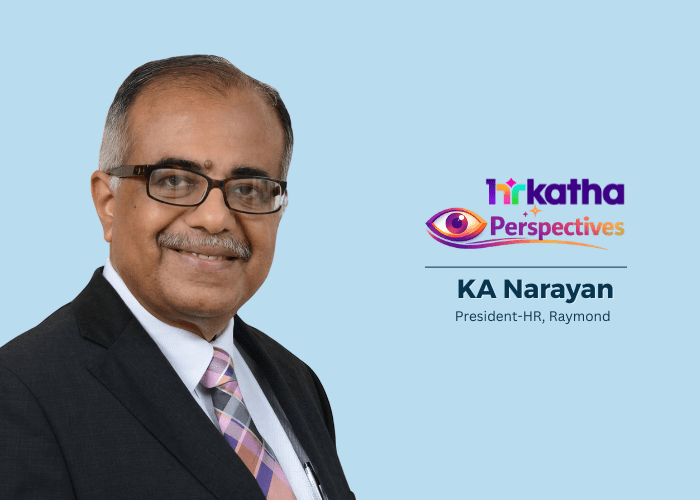
Raymond is not one kind of company. Its workforce stretches across manufacturing plants, retail stores, corporate offices and multiple businesses, each with a very different experience of work. Long-tenured employees who have built careers inside the organisation work alongside newer talent with different expectations of recognition, autonomy and growth. Managing that range, across legacy and newer businesses, factory floors and corporate functions, gives the people challenge here a particular complexity.
K.A. Narayan has been navigating that complexity as President-HR, working alongside Raymond’s chairman for nineteen years. In conversation with HRKatha, he explains why care that extends beyond employees to their families can be a powerful reason to stay, why building people-manager capability is the only reliable way to create a consistent employee experience at scale, and why emotional intelligence matters more as organisations confront greater uncertainty and technological disruption.

What actually keeps people
Beyond compensation, what have you learnt about why people stay at Raymond, and how are those expectations changing with a younger workforce?
The more I look across different parts of the organisation, the more I see that people value nurture and care. Over the years, we have created an organisation where we genuinely care for our people. When emergencies arise, we support employees and their families. Our approach does not stop with the employee.
Transparency and collaboration have also helped hold our people together. We have built a culture where people help each other and where there is a strong sense of empowerment.
In many organisations, employees are told what they need to do. At Raymond, we allow people to make decisions, experiment and even fail. That sense of empowerment is something our people genuinely value.
What we are now learning is how those expectations are changing, particularly with Gen Z. Younger employees come with different expectations around recognition, autonomy and the pace of growth. We use engagement studies to understand what they are looking for and then build the systems and processes that can respond to those needs.
Senior employees have an important role here too. Their experience can help younger colleagues develop the competencies they need to succeed. But it is a two-way relationship. It works best when both generations understand what the other brings.
“That is the leadership capability that endures. Everything else can be taught. This has to be developed, and developed continuously.”
The manager is the world
With employees spread across plants, stores and corporate offices, what actually determines whether the Raymond experience feels consistent?
That is a genuinely difficult challenge, and over the years I have come to one clear conclusion: an employee’s experience is ultimately defined by the manager they report to. For an employee, the manager is the world.
That is why, when we talk about employee experience at Raymond, we are really talking about building the capability of our entire people-manager cohort. We have around 600 people managers across functions and businesses. They are trained to address employee concerns, recognise performance, provide rewards where appropriate and surface success stories at the corporate and group level
We have a structured programme that runs throughout the year, covering everything from goal-setting and performance measurement to feedback, on-the-job learning and the communication skills critical to good management. Learning from the job is also captured and shared so that good practices travel across the organisation.
We have an annual recognition event where the chairman personally presents awards to employees across businesses and categories. That signal from the top matters. It reinforces that people managers are not merely operational supervisors. They are the defining point of the employee experience.
If that experience has to remain consistent across a workforce as varied as ours, investing continuously in managers is the only reliable way to achieve it.
“That level of promoter commitment is a differentiator, particularly compared with organisations where HR may still be viewed primarily as a transactional function.”
Building the pipeline deliberately
In a diversified group, where future leaders need both functional depth and an understanding of very different businesses, how do you build the leadership pipeline internally?
We have several programmes focused on developing leaders internally. These include multi-tier leadership programmes for middle-level leaders, high-potential employees and senior leaders. They are structured programmes run in partnership with leading institutions and universities, complemented by initiatives we conduct internally.
Alongside these, we have Raymond University, where we build functional capabilities. We have a manufacturing academy and a retail academy, both with rigorous curricula designed around the specific requirements of our businesses. The programmes combine internal leaders with university faculty to build the capabilities required across the group.
The combination of leadership development and functional capability-building creates the feeder pipeline of future leaders we need.
It is not enough to develop leadership competencies in isolation. People also need to understand the businesses they may eventually be asked to lead. Raymond University helps us build that depth.
“Our approach does not stop with the employee. We extend that support to their families as well.”
HR at every important table
After nineteen years working closely with the promoter, what have you learnt about what gives HR genuine influence in business decisions?
I am not sure I would say HR’s role has simply evolved. It has always been evolving. It is never in a steady state.
The way I measure it is by asking one question: is HR part of all strategic decisions?
At Raymond, HR is integral to business decision-making. HR leaders sit on the management committees of each of our businesses, giving them a voice at the table. They play a significant role in driving change management. Whatever transformation is taking place, HR is involved in driving it. We also have forums where HR leads employee communication and participates in both strategic planning and strategy execution.
What makes the Raymond context particularly unusual is the partnership between HR and the promoters. Our chairman has been deeply committed to having HR as a close ally. The fact that I have spent nineteen years working with him reflects how seriously he takes that partnership. He is passionate about building leadership and developing talent.
That level of promoter commitment is a differentiator, particularly compared with organisations where HR may still be viewed primarily as a transactional function.
For HR professionals building careers in this kind of environment, there is only one way forward: understand the business. HR professionals need exposure across functions rather than remaining confined to HR. They need to understand technology, disruption and business imperatives, and translate those realities into ways of helping employees deliver performance consistently.
That is how HR makes an impact. It is also how HR professionals grow.
“Care extended to employees’ families is one of the most underrated retention mechanisms.”
Emotional intelligence, then spiritual intelligence
After several decades of watching leaders succeed and struggle, what capability do you believe will matter most in the years ahead?
Through my own journey and from working closely with leaders across industries, I have come to one clear view: at the heart of leadership effectiveness today is emotional intelligence.
People have talked about emotional intelligence for many years, but its importance is becoming increasingly evident. That is particularly true given how brittle and uncertain the world has become and the disruption technology continues to bring.
If you can develop leaders who are highly emotionally intelligent and, over time, move towards what I would call spiritual intelligence, I believe that is the way to navigate the future.
Academic and technical qualifications remain important. But society is under tremendous stress, and organisations are operating through constant shifts in performance and uncertainty. Leaders need the emotional intelligence to understand each member of their team, their peers, their superiors and other stakeholders. They need to see people from a 360-degree perspective while remaining resilient enough to deliver performance despite the uncertainty around them.
That is the leadership capability that endures. Everything else can be taught. This has to be developed, and developed continuously.
“We allow people to make decisions, experiment and even fail. That sense of empowerment is something our people value.”