


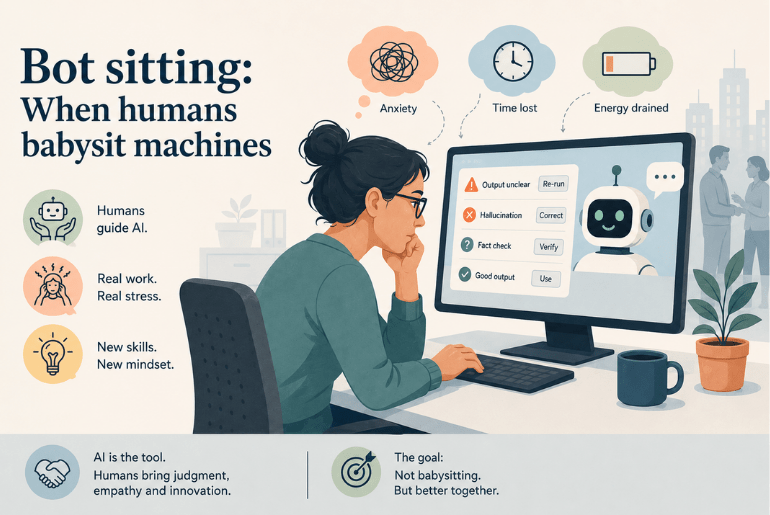
What does ‘bot sitting’ mean?
Bot sitting is the informal term for the work employees do supervising artificial intelligence (AI) systems: prompting them, checking their answers, correcting errors, supplying missing context, trying again when outputs go wrong, and deciding whether the eventual result can actually be trusted.
The irony is difficult to miss. Artificial intelligence was introduced partly to remove mundane work. Bot sitting can become mundane work of a different kind.
This does not mean AI is failing. Human supervision is inevitable when powerful technologies are introduced into complex workplaces. The problem begins when organisations count the productivity AI supposedly creates without counting the human effort required to make that productivity possible.
That effort rarely appears in job descriptions, workload calculations, or performance measures. Yet somebody is doing it.
Where did the idea come from?
The expression began appearing as generative AI moved from experimentation into everyday workplace use. Once employees started using AI for writing, coding, analysis, customer service, research and administrative work, a less glamorous side of automation became visible.
Generating an answer was often remarkably fast. Producing an answer good enough to use was not always so simple.
Employees found themselves rewriting prompts, supplying context the system had missed, checking sources, correcting hallucinations, comparing versions, and reviewing work that could not safely be accepted at face value. A task that appeared automated often still contained substantial human labour, except that the labour had moved from production to supervision.
Automation had not necessarily removed the work. In some cases, it had rearranged it.
Why is it relevant for HR?
Bot sitting matters because it changes what work actually consists of.
An employee may appear to complete a task faster with AI, but that tells HR very little about how much effort was involved. If twenty minutes of creation becomes five minutes of generation followed by fifteen minutes of checking, correcting, and validating, the productivity gain looks rather different.
It also changes the skills employees need. Writing the first prompt is only part of the job.
Knowing whether an AI-generated answer is plausible, spotting what is missing, recognising fabricated information, providing better context, and deciding when not to use AI require judgement.
That capability deserves more attention than prompt engineering alone. Prompts will evolve as tools improve. Judgement is likely to become more valuable.
There is an accountability question too. When AI produces something wrong, who owns the mistake? In most organisations, the answer remains the employee. That makes human oversight essential, but it also means organisations cannot simultaneously demand faster AI-enabled output and pretend that verification requires no time.
The uncomfortable reality
Much of the business case for AI rests on time saved. Bot sitting complicates that calculation.
A tool may produce a report in seconds, but someone still has to determine whether the numbers are correct. A chatbot may handle customer queries, but humans deal with the exceptions it cannot resolve. AI may screen hundreds of applications, but recruiters remain accountable when good candidates are wrongly excluded.
The machine gets credited with speed. The human absorbs the supervision.
This creates a peculiar form of invisible labour. Employees are increasingly responsible not only for their own work but also for the quality of work produced by systems they did not design and cannot fully control.
There is a danger here for HR. If organisations redesign productivity expectations around theoretical AI savings without understanding the supervision required, workloads can quietly expand. The hour supposedly “saved” by AI simply becomes an hour available for more work, even when part of it was never saved in the first place.
Bot sitting then stops being an amusing description of working with imperfect technology. It becomes a workload problem.
What should HR recognise?
The first requirement is not another AI programme. It is a more accurate picture of work.
HR needs to understand where employees are spending time prompting, reviewing, validating, and correcting AI, and whether those activities are temporary consequences of immature technology or permanent parts of redesigned jobs.
Job roles and performance expectations should reflect that reality. Employees responsible for AI-assisted work need time for verification and clear rules around accountability. Managers also need to distinguish between productive human oversight and unnecessary supervision caused by poorly chosen tools or badly designed workflows.
Most importantly, organisations should not automate a task and assume the job has therefore become smaller. Sometimes automation eliminates work. Sometimes it shifts work elsewhere.
HR needs to know which has happened.
The takeaway
Bot sitting reveals something easily obscured by the excitement around AI. Automation does not simply divide work between humans and machines. It creates new work at the boundary between them.
Some of that work will disappear as AI improves. Some will remain because judgement, accountability, and context cannot simply be delegated to a machine.
For HR, the challenge is to recognise that labour before setting new expectations around productivity.
Because the real measure of AI efficiency is not how quickly the machine produces an answer.
It is how much human work remains before anyone is willing to trust it.