



Longevity used to be an uncomplicated corporate asset. Stay long enough and you accumulated institutional memory, customer relationships and an understanding of the business that newcomers could not easily replicate.
Then the business changed.

Canon India has employees who have spent more than two decades with the company. Shikha Rai, senior vice president for IT and HR, is one of them. The challenge she describes is not how to retain these employees. It is how to ensure that what they know remains valuable when AI, automation and changing customer expectations are altering how work gets done.
“AI is what we are looking at right now as the engine to improve our productivity multifold,” she says.
That creates an interesting people problem. Canon now has four generations working together: Baby Boomers, Gen X, Millennials and Gen Z. The older employees possess years of domain knowledge. Younger employees often arrive with greater fluency in newer technologies and different expectations of work.
The obvious temptation is to treat one group as teachers and the other as learners. Canon is trying to make both play both roles.
Reverse the mentoring
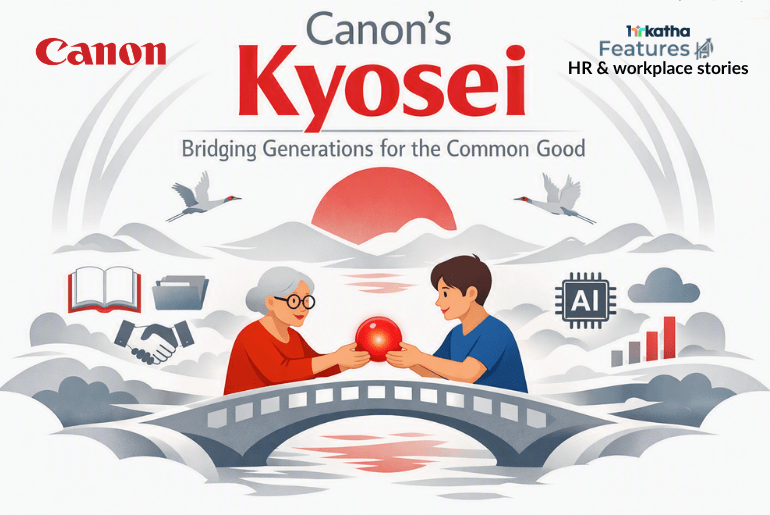
Younger employees proficient in digital tools such as Power BI mentor senior colleagues. Those senior colleagues, in turn, share the domain knowledge that takes years to acquire.
“AI is what we are looking at right now as the engine to improve our productivity multifold.”
Shikha Rai, senior vice president for IT and HR, Canon India
Knowledge travels in both directions.
Reverse mentoring is hardly a new management idea. What makes it useful is when it moves beyond an HR programme and becomes part of how work gets done. For Canon, it also addresses a practical problem: neither technological fluency nor accumulated experience is particularly useful if the two remain separated by generation.
Other interventions are deliberately age-specific. Older employees have access to financial and retirement-planning sessions. Gen Z employees participate in HR committees and interact with senior leaders to discuss their expectations.
Canon even carries a “Gen Z word of the week” on its intranet. It sounds frivolous until one considers how much workplace friction begins with language. Different generations can interpret directness, hierarchy, feedback and even professionalism differently. Small misunderstandings accumulate surprisingly quickly.
Building successors before they are needed
The same concern with longevity runs through Canon’s succession planning.
Its framework combines a 4A model, covering ambition, ability, agility and alignment, with three years of performance data and nine-box assessments. Employees identified for future roles receive individual development plans reviewed quarterly.
The useful part is not the framework itself. Nine-box grids and potential assessments are hardly unusual. What matters is whether succession planning begins early enough for people to acquire capabilities before a vacancy appears.
AI is now being layered into that development architecture.
Canon began with a full-day workshop for senior management, intended to establish a common understanding of what AI can do and where it should not be used. This is being followed by 24 sessions covering 890 AI licences across the organisation through classroom and online learning.
There are two objectives: improving individual productivity and identifying organisational use cases.
The first is easier to teach than to prove.
Canon tracks training through a dashboard and uses pre- and post-assessments for skill-based programmes. Behavioural changes feed into its biannual performance process, where KPIs and behaviour each account for half of the evaluation.
At organisational level, the company looks at sales per person every quarter.
“That’s like a macro view of whether everything that we are doing is really impacting the productivity of the organisation,” Rai says.
Sales per person cannot neatly isolate the effect of AI training from market conditions, product performance or dozens of other variables. But the instinct is important. Canon is trying to connect learning with an organisational outcome rather than allowing completion rates to become evidence of success.
For a company with long-tenured employees, the real measure will be whether experience becomes more productive when combined with new technology rather than being displaced by it.
When equal treatment becomes unfair
The same willingness to reconsider familiar HR assumptions appears in Canon’s approach to maternity.
Women returning from maternity leave are excluded from the bell-curve assessment and evaluated only for the period during which they were actually at work.
Managers receive temporary support for three months before an employee begins maternity leave and for three months after she returns. The arrangement creates a 12-month support window around the absence and reduces the operational pressure that can otherwise turn maternity into a problem for both manager and employee.
Daycare support also extends beyond statutory requirements. Employees can choose facilities closer to home rather than being restricted to office-adjacent options, an arrangement better suited to hybrid working patterns.
Perhaps the more revealing intervention happens three months after a woman returns.
Canon calls it Reboot.
The conversation addresses an assumption that often goes unstated: that returning mothers should be protected with lighter workloads.
Canon found that some women wanted precisely the opposite.
“Women, when they come back, want something which is very, very challenging, because they must prove themselves, they must add value,” Rai says.
Reboot brings employee and manager together to establish what the returning employee actually wants rather than allowing managerial assumptions, however well intentioned, to determine her work.
It is a small intervention aimed at a larger problem. Support can become limiting when managers begin making career decisions on an employee’s behalf.
Canon also monitors pay parity, examines promotions for gender and regional bias and asks recruitment partners to provide balanced candidate pools. The principle is not preferential treatment, Rai argues, but preventing a career interruption from becoming a lasting career disadvantage.
Well-being beyond the employee
Canon’s broader well-being architecture extends from preventive healthcare and insurance to mental health, financial planning and social connection.
Employees can use medical coverage for parents or parents-in-law. An anonymous employee assistance programme covers dependants as well as employees. The company monitors indoor air quality and lighting, interventions that are decidedly less fashionable than wellness apps but arguably closer to the everyday experience of work.
Its Beyond Work communities bring employees together around interests such as food, biking, cricket and gardening. HR facilitates the groups rather than running them.
Financial well-being includes retirement planning, financial literacy and interest-free loans. Canon also introduced financial-awareness sessions specifically for women after employees expressed a desire for greater confidence in investment decisions.
Taken individually, these could easily become another long catalogue of corporate benefits. Canon attempts to connect them through Kyosei, the Japanese idea of living and working together for the common good.
The philosophy matters only to the extent that employees experience it. But it does provide a thread between interventions that might otherwise appear unrelated: intergenerational learning, maternity reintegration, family healthcare and employee communities all recognise that people rarely fit neatly into the categories organisations create for them.
The relevance question
Canon’s more difficult experiment is therefore not any single programme.
It is attempting to make accumulated experience and emerging capability reinforce each other.
The company has people who carry decades of institutional knowledge. It has younger employees arriving with different technological instincts and different expectations of careers. It is putting AI tools into the hands of 890 employees while trying to preserve the judgement and domain expertise that technology cannot instantly reproduce.
That balance will become harder as AI changes more jobs.
For long-tenured employees, experience can remain an advantage only if it continues to absorb new capability. For younger employees, technological fluency becomes more valuable when combined with the context that comes from understanding customers, businesses and consequences.
Canon’s reverse mentoring makes that exchange unusually visible. The 24-year veteran may know the business better. The 24-year-old may know the tool better.
The organisation needs both to keep learning from each other.
For a company trying to keep experience relevant in a changing workplace, that may be a more consequential measure of longevity than tenure itself.