


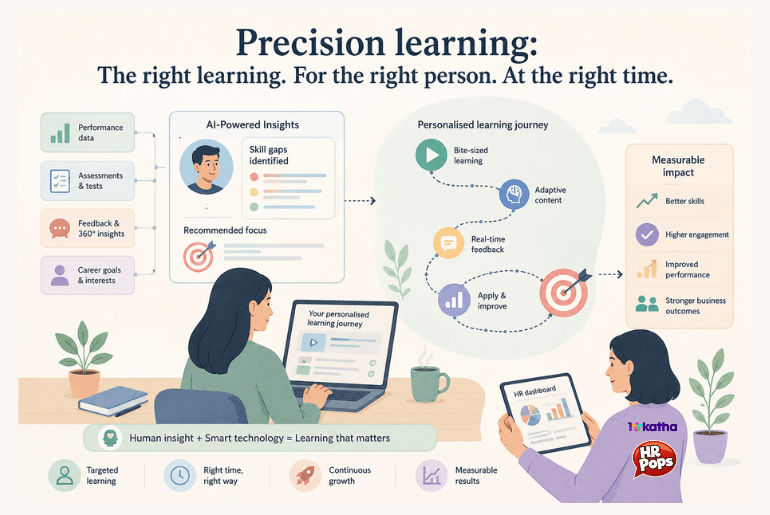
What does ‘precision learning’ mean?
Traditional corporate learning begins with a programme. Precision learning begins with a gap.
The idea is to identify what an individual actually needs to learn and deliver an intervention suited to that need, rather than putting an entire workforce through the same course. It draws on the logic associated with precision medicine, where treatment is tailored to the characteristics of an individual rather than applied uniformly to everyone.
In learning, data from assessments, performance, behaviour, and feedback can be used to identify specific capability gaps. Technology can then adjust the content, difficulty, format, or timing accordingly.
The principle is simple: the right skill, for the right person, at the right time. What makes it difficult is knowing precisely what “right” means.
Where did the idea come from?
The idea gained momentum as digital learning became capable of doing more than simply putting classroom content online.
Adaptive learning systems had already been used in education to adjust questions and content according to how learners performed. As digital platforms accumulated more information about learner behaviour, similar thinking entered corporate learning. Advances in analytics and AI made increasingly personalised learning pathways technically possible.
The appeal for organisations was obvious. Corporate training had long struggled with a familiar problem: large numbers of employees attended the same programmes despite having very different levels of knowledge, experience, and need. Considerable money was spent teaching some people things they already knew while failing to address what others genuinely lacked.
Precision learning promised to replace that blunt instrument with something closer to diagnosis.
AI has made that promise considerably more ambitious. Learning systems can increasingly recommend content, adjust pathways, identify emerging skill gaps, and deliver assistance closer to the moment an employee actually needs it.
Why is it relevant for HR?
The case for precision learning becomes stronger as skills change faster.
When organisations could predict reasonably well what a job would require for the next several years, periodic training programmes made sense. When roles are being reshaped by AI, automation, and changing business models, waiting for the next annual learning calendar becomes harder to justify.
Precision learning allows HR to move from asking, “What training should we provide?” to asking, “What capability is missing, where is it missing, and what is the smallest useful intervention that could close the gap?”
That changes learning and development substantially. Two managers attending the same leadership programme may need completely different things. One may struggle with delegation, another with conflict, and a third with commercial judgement. Putting all three through identical modules is administratively convenient, but hardly precise.
The approach can also make learning more useful for workforce planning. If organisations have a credible picture of existing capabilities, they can identify emerging gaps across teams and decide whether to build, buy, or redeploy talent before shortages become urgent.
Perhaps most importantly, it changes how HR measures learning. Training hours and completion rates tell organisations what employees consumed. Precision learning should tell them what employees became better at.
The uncomfortable reality
That is also where the promise begins to collide with reality.
Precision learning requires precision about skills. Many organisations do not have it.
Job descriptions are outdated, competency frameworks are broad, performance data is inconsistent, and managers frequently disagree about what good performance actually looks like. Feeding all of this into a sophisticated AI platform does not magically produce an accurate diagnosis.
It produces personalised recommendations based on imperfect assumptions.
There is an important distinction here. Personalised learning is not necessarily precision learning. A platform recommending different courses to different employees may look sophisticated, but if it does not understand the actual capability gap, it is merely personalising content distribution.
The data required also creates uncomfortable questions for HR. How much information about an employee’s performance, behaviour, learning habits, and weaknesses should a system collect? Who can see it? Could a learning recommendation later influence promotion or performance decisions? And what happens when an algorithm repeatedly decides that particular groups need remedial development?
These are not arguments against precision learning. They are reminders that greater precision requires greater responsibility.
There is also something technology cannot diagnose neatly. Development is not always about closing a measurable skill gap. A manager may need confidence rather than content. A promising employee may need exposure rather than another course. Someone struggling in a role may have a poor manager rather than a capability problem.
An algorithm can recommend learning. Judgement is still required to decide whether learning is actually the answer.
The takeaway
Precision learning represents a useful correction to decades of one-size-fits-all corporate training.
Its promise is not that every employee receives a different course. It is that organisations become better at understanding what people genuinely need to become more capable.
For HR, that means resisting the temptation to confuse sophisticated recommendations with sophisticated learning. The technology can personalise endlessly. Precision depends on whether the diagnosis underneath it is any good.
Because the biggest problem with generic training was never simply that everyone received the same thing.
It was that organisations often did not know what each person needed in the first place.