


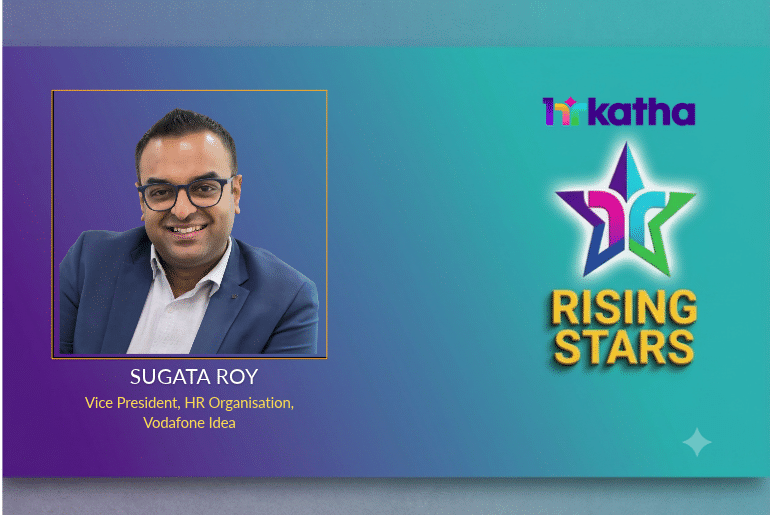
Sugata Roy’s journey into HR began in an unlikely place: a genetics laboratory.
Before pursuing an MBA in HR, he studied physiology and genetics, disciplines that taught him to look beyond what was immediately visible and investigate the systems producing an outcome. Understanding a biological process meant asking questions, examining evidence and identifying relationships that were not always apparent at first glance.
That habit of inquiry stayed with him when he moved from studying human biology to understanding human behaviour at work.
At Vodafone Idea, Roy applies a similar curiosity to organisations. He sees performance, engagement and retention not as isolated HR outcomes but as the result of interconnected systems, decisions and behaviours. When something changes, his instinct is to investigate what lies beneath the numbers rather than respond only to the visible symptom.
For Roy, HR is, therefore, less about administering established processes and more about continually questioning whether those processes are producing the intended results.
Evidence over instinct
Roy’s scientific background has influenced how he approaches everyday HR decisions.
Attrition figures, engagement trends and performance data are not merely measures to report. They are starting points for understanding why employees behave as they do and what the organisation might need to change.
“Science doesn’t stand still, and neither does HR. My philosophy has to evolve with it,” he says.
That does not mean abandoning experience or intuition. Rather, Roy believes HR must become better at testing its assumptions against evidence.
He identifies three capabilities that will become increasingly important: data-driven decision-making, the ability to redesign work as AI changes roles and processes, and building a workforce whose skills can evolve with business requirements.
The common thread is adaptability. HR cannot assume that a policy, role or capability framework remains relevant simply because it worked in the past.
For someone trained to investigate systems, the question is not only whether a process is functioning. It is whether the organisation is still asking it to solve the right problem.
Unlocking careers, not just managing them
One of Roy’s most substantial assignments involved rethinking how talent moved through the organisation.
The starting point was a fragmented HR technology landscape, with systems operating in silos and limiting the organisation’s ability to connect information about employees across different stages of their careers.
Roy and his team worked to bring these systems into a unified portal. They then developed an AI-based recruitment engine linked to the organisation’s competency framework, with greater emphasis on matching skills and potential to role requirements.
The work extended beyond hiring.
Performance, competency and potential data were brought together to strengthen succession planning and identify employees who could be prepared for larger responsibilities.
That thinking eventually informed Ignite 2.0, a leadership development programme designed to identify high-potential employees and provide them with exposure and stretch assignments.
Roy reports that the internal fill rate increased by 20 per cent and attrition declined by approximately 10 per cent during this broader transformation.
But the outcome he finds most meaningful is less easily captured in a dashboard: employees who had not previously imagined themselves in leadership positions began taking on responsibilities that once appeared beyond their reach.
For Roy, that is what a connected talent system should make possible. It should help organisations recognise capability that conventional career structures may overlook, while giving employees a clearer path to demonstrate what they can do.
The genome of the organisation
Roy’s longer-term ambition brings his scientific background back into the picture.
He imagines what he calls a “genome of the organisation”, an AI-powered talent-intelligence system that brings together information about employees’ skills, performance, aspirations and potential. The biological metaphor reflects his desire to understand how different elements of organisational capability connect.
Rather than examining recruitment, performance, learning and succession as separate activities, he wants organisations to develop a more integrated picture of their workforce. Such a system could help identify emerging skill gaps, suggest possible career paths, highlight retention risks and match employees with opportunities based on capability rather than tenure alone.
In some respects, the ambition builds on the work already underway through the recruitment engine and Ignite 2.0. But the idea also raises questions that matter in people management.
Skills change, aspirations evolve, and predictions about individuals can be wrong. A system designed to identify potential must not become one that permanently defines an employee’s possibilities.
Data privacy, transparency and human oversight would therefore be as important as analytical sophistication. The value of Roy’s idea lies in making talent decisions better informed, not in assuming that an organisation can predict every employee’s future.
Asking questions instead of picking sides
Roy brings the same investigative instinct to situations where leadership priorities and employee expectations appear to conflict.
Consider the familiar disagreement over productivity and flexibility. Business leaders may worry about performance and coordination, while employees may want greater control over how and where they work. Roy’s first response is to examine what each side is trying to achieve.
He believes both may share an interest in sustainable performance, even when they disagree about the conditions needed to produce it. That does not eliminate the conflict. It creates a more useful starting point.
Roy prefers to bring evidence about engagement, attrition and performance into the discussion while helping employees understand the operational constraints facing the business. The eventual answer may be a phased arrangement rather than a complete resolution of every competing demand.
For him, HR’s role is not always to provide an immediate solution. Sometimes its greater contribution is asking questions that help both sides understand the problem differently.
Quick Takes
An unpopular HR opinion: We spend more time writing job descriptions than checking whether the job still needs to exist.
A surprising skill that makes him better at HR: Music. It taught him timing and listening. The space between notes can matter as much as the notes themselves, just as the pause in a conversation can reveal what someone is really trying to say.
A question he wishes more people asked HR: “What is HR curious about right now?” People often want project updates, but rarely ask about the questions driving the work.
Conflict style: Mediation.
Team energy booster: Coffee breaks and informal conversations.
Why he is a Rising Star
Roy brings a researcher’s curiosity to HR, looking beyond individual metrics to understand the systems shaping organisational behaviour. His work connecting recruitment, competency data, succession planning and leadership development shows how that thinking translates into practical outcomes. His proposed organisational genome extends the same approach, though its value will depend on preserving human judgement alongside technological capability. What distinguishes Roy is not simply his interest in data, but his willingness to question the assumptions behind established HR practices.
Rising Stars is HRKatha’s editorial series profiling the next generation of HR leaders shaping the future of the profession. The series also features winners and finalists of the HRKatha Rising Star Leadership Awards alongside emerging professionals whose work, ideas and leadership potential deserve wider recognition.
