


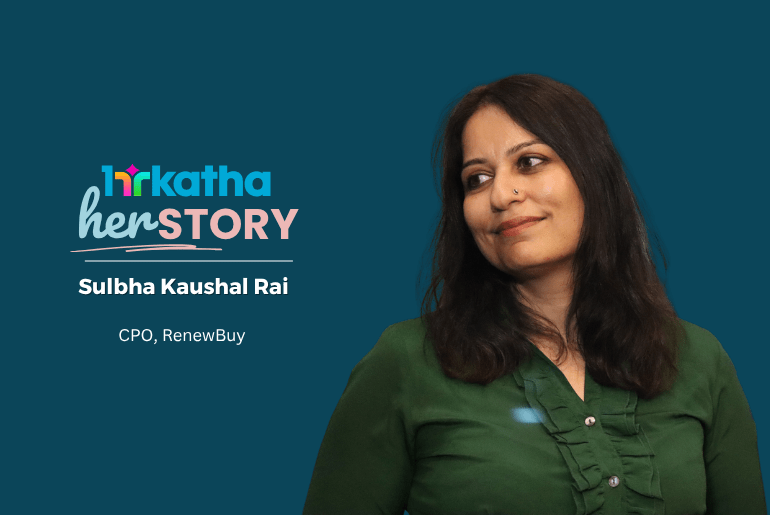
When she said she wanted to lead sales, Sulbha Kaushal Rai was cautioned that it “wasn’t that simple”, that it required rough language and tough conversations. She went to the ground instead, learnt the business from the people who ran it, and let outcomes do the arguing.
Belonging in HR
For Sulbha Kaushal Rai, chief people officer, RenewBuy, HR was not the career she originally expected to pursue. She completed her MBA with finance as her major and HR as her minor, fully expecting her future to lie in finance.
During an internship at EY, however, she was placed with the HR team. It was not her first preference, but the opportunity to work at a Big Four firm was exciting enough for her to embrace whatever came her way, from employee engagement and learning processes to leadership interactions and problem-solving across teams.
The pull towards finance remained. She even explored an opportunity in tax consulting, and that was when something became clearer.
Rai enjoyed numbers and could happily spend hours working through spreadsheets. But the sense of fulfilment she was looking for came from somewhere else. What energised her was understanding a business problem, identifying the people or process bottleneck behind it, and finding a way to align organisational needs with individual aspirations and capabilities.
“HR gave me a view of the entire organisation and an opportunity to influence both people and business outcomes,” she says.
She did not choose HR because she wanted to move away from numbers. She chose it because she discovered that some of the most interesting business problems sit at the intersection of numbers, people and execution.
That was when she knew she belonged in HR.
Subtle assumptions
Rai considers herself fortunate not to have encountered overt gender discrimination. The assumptions she faced were subtler, and became more visible when she began stepping beyond a conventional HR mandate.
When she expressed an interest in leading sales, she was cautioned that sales was “not that simple”, that it required rough language and tough conversations.
Later, when she took responsibility for business operations, one of the first suggestions she received was to engage a consultant who could help her navigate the function.
Rai did not necessarily interpret these reactions as attempts to exclude her. To her, they reflected a particular picture of what a sales or operations leader was supposed to look and sound like.
Rather than respond defensively, she went to the ground.
She learnt the business from people across functions and levels, understood the operating metrics and built credibility through outcomes.
The experience reinforced two ideas.
First, toughness should not be confused with aggression. Leaders can set high standards, make difficult decisions and demand accountability without resorting to disrespectful language.
Second, women need to be explicit about the roles they aspire to, and prepared to demonstrate their readiness for them.
Eventually, Rai got the opportunity to lead field sales and business operations while continuing as chief people officer. She did not try to imitate a conventional image of a business leader. She delivered results in her own leadership style.
“Toughness should not be confused with aggression.”
Challenge and support
Rai describes her leadership style as that of a coach with high standards.
“I give people meaningful responsibility, the authority required to deliver it and the support to succeed,” she says.
She enjoys stretching people beyond what they initially believe they can do, but does not believe in delegating and disappearing.
“Challenge and support must travel together,” she believes.
That philosophy developed partly from something she had to unlearn herself.
Earlier in her career, Rai was quick to step in when a problem emerged. Solving it herself felt like the surest way to guarantee a strong outcome.
Over time, she realised that repeatedly being the solution could become a constraint on the team’s growth.
Today, she spends more time creating clarity, asking questions, agreeing on outcomes and allowing people to find their own route. She reviews progress without taking ownership of the problem back from them.
She remains deeply people-oriented, but says she has become more direct and outcome-focused with experience.
“Empathy, to me, does not mean lowering the bar. It means understanding what a person needs in order to meet it.”
Focus on systems, not interchangeability of people
One HR belief Rai would like organisations to retire is the assumption that people are interchangeable.
“Retire the belief that people are interchangeable. Pay more attention to the systems that either enable or constrain their performance,” she says.
Treating every performance problem as a people problem, she believes, can lead organisations towards the wrong solution.
Sometimes an employee is not underperforming because of a lack of capability or intent. The problem may lie in unclear priorities, multiple approvals, conflicting goals, inadequate technology or poorly designed work.
Before replacing talent, Rai believes leaders should ask whether the work itself needs to be redesigned and whether capable employees can be reskilled or redeployed.
It is not merely a more humane response. In many cases, it can also be faster and commercially more sensible than repeatedly buying skills from the external market.
For Rai, this requires HR to pay much closer attention to organisational friction: the things that prevent capable people from doing good work.
It also changes the role of people analytics.
Too much HR reporting, she argues, focuses on lagging indicators. An attrition percentage tells an organisation what has already happened. It does not reveal which critical capability is leaving, under which manager, what triggered those departures or what might have prevented them.
People analytics becomes strategic when it begins explaining why one team performs better than another and where management intervention could change an outcome.
HR, in her view, needs to move from reporting events to anticipating business and talent risks.
“HR should spend less energy policing responsible employees and more energy enabling them to perform.”
Respect as a condition for sound decisions
Respect is non-negotiable for Rai.
People can disagree, challenge decisions and hold one another accountable, but she does not believe any result justifies humiliation, intimidation or unfair treatment.
Nor does respect mean avoiding difficult conversations.
In fact, Rai sees a respectful culture as a precondition for greater candour. People are more willing to question an idea, admit a mistake or surface bad news when disagreement does not carry the risk of a personal attack.
That willingness to speak up matters beyond employee experience. It affects the quality of decisions an organisation makes.
For Rai, respect is therefore not simply a cultural value. It is a condition for sound decisions and sustainable performance.
Redesigning for the future
Rai does not see the future of work as a remote-work debate or an AI agenda alone.
For her, it is fundamentally about redesigning work, skills and operating models.
“Our organisation has been navigating this at scale through automation, process redesign and the integration of two businesses,” she says.
Each change raises a similar set of questions. What work should technology perform? Where is human judgement essential? Which capabilities will the combined organisation need? And how can people make the transition without the business losing execution momentum?
Answering those questions requires HR to remain close to business strategy, external trends and frontline realities.
Rai believes the function must anticipate capabilities before they become scarce or prohibitively expensive, create internal learning and mobility pathways, redesign roles as technology changes work and equip leaders to manage uncertainty.
But there is another requirement that matters just as much: timing.
Transformation works better, in her experience, when technology, process and people decisions are made together.
If HR enters the conversation only after the business design has been completed, its role is reduced to managing the consequences. It needs to be present while the future operating model is still being shaped.
Quick fire round
If you could insure one everyday item for free, what would it be?
Instead of an everyday item, I would prefer education to be free.
Which emoji best describes your HR team’s vibe right now?
The juggling emoji. We are balancing transformation, integration and business continuity, all at once.
What’s the quirkiest interview answer you’ve ever heard?
“Aap jitne bande bologe, utne bande do din mein hire kar doonga.” The confidence was impressive. The workforce planning was less clear.
Morning ritual that sets you up for success?
I write down the decisions and problems that need my attention, identify what requires my judgement, and delegate the rest with clear outcomes.
One skill you’re currently working on developing?
Thinking and operating like my “inner CEO”, using technology, product thinking and coaching to build the next chapter of my professional journey.
Clarity of ambition
“Never become a tick-in-the-box professional,” Rai advises.
Whatever the assignment, she believes HR professionals should understand why it exists, how it affects the business and what a good outcome actually looks like.
That also means learning the business as seriously as they learn HR.
Spend time with customers, sales teams, operations and finance. Understand how the organisation creates value. The deeper that understanding, the more credible and useful people judgement becomes.
Rai also believes professionals should be explicit about their ambitions and ask for opportunities before they feel completely ready.
Her own experience of moving into sales and business operations reinforced that lesson. Opportunities outside the conventional boundaries of a role are unlikely to arrive if nobody knows you want them.
Her other advice follows the same philosophy: do not confuse empathy with avoidance, have difficult conversations with respect, use data without losing sight of the human story behind it, and keep learning.
“The profession is changing too quickly for past expertise alone to remain sufficient,” she says.
No to policy-policing
If she had the opportunity to dismantle one traditional layer of HR, Rai would choose policy-policing and rebuild it around people enablement.
Many organisations, she believes, design rules around the small minority of employees who might misuse freedom. The result is that everyone else has to navigate layers of approvals and controls.
That can create friction without necessarily creating integrity.
Rai would start instead with clear principles and ways of working: define the outcome expected, establish the boundaries that cannot be crossed, and make clear where employees are trusted to exercise judgement.
Policies should remain where law, safety, fairness or material business risk genuinely requires them. Even then, she believes they should be simple, proportionate and easy to understand.
Her starting assumption is that most people come to work wanting to contribute and can be trusted to act responsibly. Where that trust is deliberately breached, the organisation should respond fairly and decisively.
HR, she argues, should spend less energy policing responsible employees and more energy enabling them to perform.