


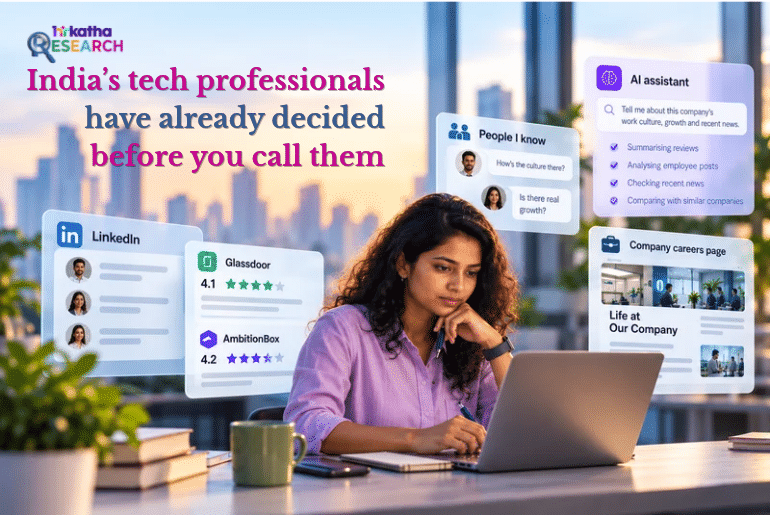
The careers page was designed to present an employer on its own terms. But candidates increasingly arrive there with an opinion already formed, assembled from sources the organisation neither owns nor controls.
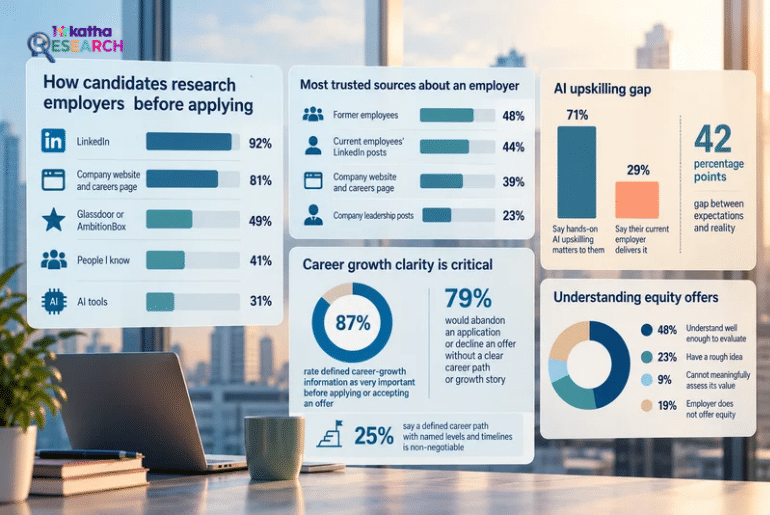
A study titled What Talent Wants 2026, based on a survey of 2,000 tech, product and data professionals across India, reveals how far this shift has progressed. Ninety-two per cent research employers on LinkedIn before applying, while 81 per cent visit company websites and careers pages. Nearly half consult Glassdoor or AmbitionBox, 41 per cent ask people they know, and 31 per cent now use AI tools.
The careers page remains important. But it is no longer necessarily the first stop. It is one source in a research exercise candidates may have begun long before the employer knows they are interested.
That changes employer branding. An organisation’s reputation is no longer primarily what it publishes about itself. It is also what former employees say, what current employees post, what unanswered reviews suggest and what AI systems assemble from information scattered across the internet.
The hierarchy of trust makes the point. Former employees are among the most trusted sources, selected by 48 per cent of respondents, followed by current employees’ LinkedIn posts at 44 per cent. Company websites attract 39 per cent, while leadership posts are selected by just 23 per cent.
The lived employee experience has become the employer brand, whether the organisation manages it deliberately or not.
The growth signal
If one finding runs through the survey, it is the importance of career growth clarity.
Eighty-seven per cent of respondents rate defined career-growth information as very important before applying or accepting an offer. More significantly, 79 per cent say they would abandon an application or decline an offer without a clear career path or growth story. For 25 per cent, a defined path with named levels and timelines is non-negotiable.
Yet only 46 per cent describe their current career path as very clear. Among GCC employees, the proportion falls to 36 per cent, compared with 50 per cent in IT services and 51 per cent in startups.
This is uncomfortable for organisations that have invested in competency frameworks and internal mobility programmes. Such systems may exist, but their existence is not the same as employees understanding where they can go.
Career architecture has moved from being an internal HR mechanism to part of the proposition candidates expect to evaluate before joining. A company unable to explain how a role develops is asking candidates to accept uncertainty about something they increasingly regard as central to employment.
The manager test
Candidates are evaluating not just organisations but the people they may work for.
Fifty-six per cent say their prospective manager’s profile is very important before accepting an offer. Half would abandon an application or decline an offer if the organisation’s leadership were difficult to find or understand online.
Candidates can examine a manager’s professional history, LinkedIn activity and public contributions. None of these establishes whether someone is a good manager, but they shape expectations before the first meeting, and when that information is absent, the uncertainty itself can become a reason not to proceed. Leadership visibility has become a recruitment variable whether organisations manage it deliberately or not.
The 42-point AI gap
The largest expectation-delivery gap in the survey concerns hands-on AI experience.
Seventy-one per cent say hands-on AI upskilling matters to them. Only 29 per cent say their current employer delivers it, a difference of 42 percentage points.
The distinction between learning about AI and working with it matters. Candidates are not merely looking for courses or certifications. They want opportunities to use AI in real projects and develop expertise through their everyday responsibilities.
An organisation may offer extensive AI training while providing few opportunities to apply it. From the employee’s perspective, the capability being promised and the experience being delivered are not the same.
That gap creates a potential retention problem. Employees who believe practical AI exposure will improve their future employability have reason to look elsewhere if their current roles offer little opportunity to develop it.
For technology employers, access to meaningful AI work is becoming part of the career proposition, not simply another learning-and-development benefit.
The equity blind spot
Equity is supposed to align employees’ interests with an organisation’s long-term performance. But that depends partly on employees understanding what they have been offered.
Only 48 per cent of respondents say they understand RSU vesting, dilution and fair value well enough to evaluate an equity offer. Another 23 per cent have only a rough idea, while 9 per cent cannot meaningfully assess its value. Nineteen per cent report that their employer does not offer equity.
Fewer than half regard RSUs or equity as a reason to stay.
For employers using equity as a retention instrument, this presents a problem. An award may have substantial financial value, but its motivational effect weakens when recipients cannot assess what it is worth, when it becomes available or how its value might change.
Better communication cannot resolve every weakness in an equity plan. But compensation design and compensation understanding are different things. An organisation can spend considerably on equity without ensuring employees recognise its value.
The GCC advantage, and its limits
One of the survey’s most consequential findings concerns global capability centres.
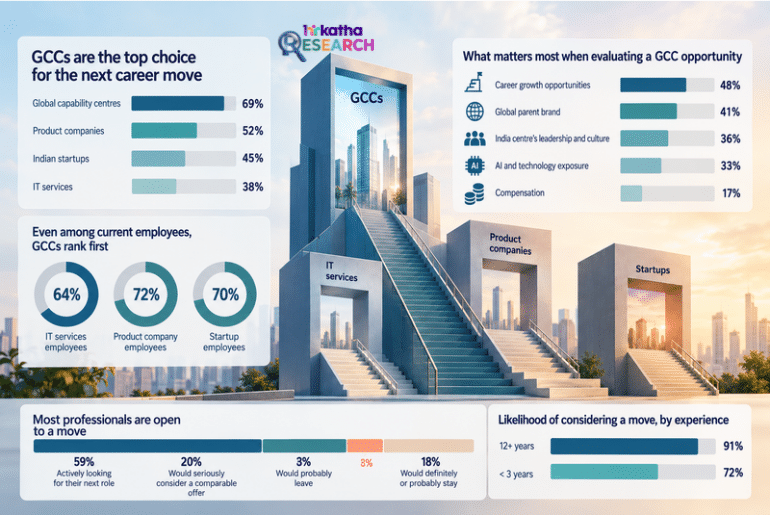
Sixty-nine per cent of respondents rank a GCC as a first choice for their next career move.
Among professionals currently in IT services, 64 per cent rank GCCs first. The corresponding figures are 72 per cent for product-company employees and 70 per cent for those in startups.
The rankings are not mutually exclusive, but they reveal the strength of GCCs’ appeal among the professionals surveyed.
For individual GCCs, however, the advantage is less straightforward.
When evaluating a GCC opportunity, career growth leads at 48 per cent, ahead of the global parent brand at 41 per cent. The India centre’s leadership and culture follow at 36 per cent, AI and technology exposure at 33 per cent, and compensation at 17 per cent.
The multinational name still matters. But candidates increasingly want to know what the Indian operation offers in its own right: the career they can build, the leadership they will work under and the complexity of the work.
There is also a weakness beneath the appeal. Only 36 per cent of GCC employees describe their current career path as very clear, the lowest proportion among the principal employer categories compared.
GCCs may be a preferred destination, but that does not automatically make every GCC a preferred employer.
The restless majority
Beneath these expectations sits a workforce that appears considerably less settled than current employment status suggests.
Fifty-nine per cent of respondents say they are actively looking for their next role. Another 20 per cent would seriously consider a comparable offer, while 3 per cent would probably leave.
Only 18 per cent indicate they would definitely or probably stay.
Among professionals with 12 or more years of experience, 91 per cent would consider a move, compared with 72 per cent among those with fewer than three years.
Openness to another opportunity does not automatically translate into resignation, and these are stated intentions rather than measured attrition. But employment and commitment are not interchangeable.
A person may remain because the right alternative has not appeared, the compensation difference is insufficient or the practical cost of changing jobs is too high. None necessarily implies satisfaction.
Candidates are also becoming more demanding about the evidence they need before moving. Career progression must be understandable, managers credible, employee experiences consistent with the employer’s promises, AI opportunities real and compensation capable of evaluation.
Much of that assessment now takes place before a recruiter makes contact.
For HR, the challenge is not simply to produce better careers pages or more persuasive employer-brand campaigns. It is to ensure that the experience employees describe outside the organisation bears a reasonable resemblance to the proposition the organisation presents inside it.
The hiring process may formally begin when a candidate applies. But the judgement determining whether they apply is often made much earlier.
By the time the recruiter calls, the employer may already have passed or failed an interview it never knew was taking place.