


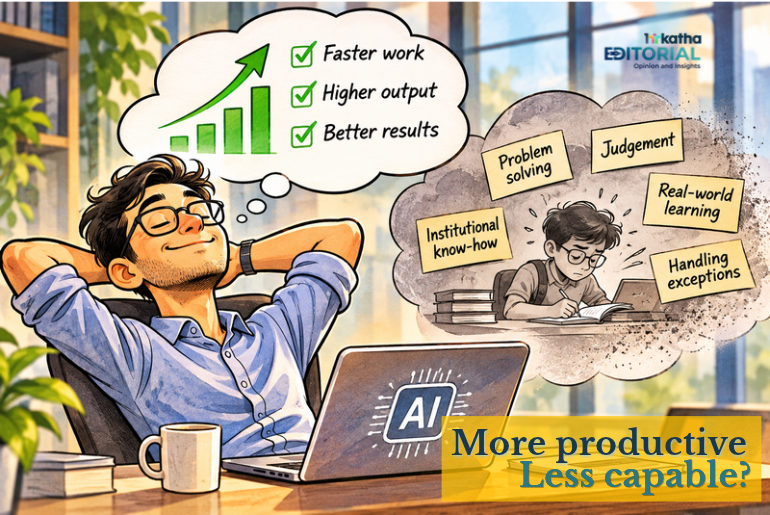
Consider an organisation that automates much of the work previously performed by its junior analysts. Its experienced managers, assisted by artificial intelligence, become considerably more productive. The business delivers more with fewer people. By almost every conventional measure, the transformation is a success.
But five years later, where does the organisation find its next generation of experienced managers?
The evidence on artificial intelligence and workplace productivity is increasingly difficult to dismiss. Studies of corporate executives find meaningful labour productivity gains, particularly in high-skill services and finance. Organisations report faster workflows, higher output and improved quality across a range of tasks.
Productivity measures what organisations produce relative to the resources they use. It is less effective at capturing what organisations may be quietly losing: the knowledge they retain, the judgement their employees develop and the capacity to function when the tools assisting them are unavailable or wrong.
Several recent studies raise an uncomfortable question: whether faster, more productive organisations are necessarily building the capabilities they will need in the future.
“Productivity measures what organisations produce relative to the resources they use. It is less effective at capturing what organisations may be quietly losing: the knowledge they retain, the judgement their employees develop and the capacity to function when the tools assisting them are unavailable or wrong.”
The exoskeleton problem
A study published in Nature Human Behaviour in October 2026 examined 487 management consultants undertaking data science tasks outside their existing expertise. Those given access to ChatGPT and trained in its use outperformed the control group across three tasks.
When subsequently tested without AI assistance, however, the AI-supported participants showed no measurable improvement on technical questions relative to where they had started.
The researchers describe AI, in this context, as a ‘capability-enhancing exoskeleton’. The metaphor is instructive. An exoskeleton enables its wearer to perform tasks beyond their physical capacity. Wearing one does not necessarily build the underlying strength.
The distinction between performance and capability matters enormously in the workplace. An employee who delivers exceptional results with AI assistance has not necessarily acquired the expertise required to produce those results independently. Yet conventional performance assessments may struggle to distinguish between the two.
There is also a difference between losing a capability and never developing it. An experienced professional who increasingly delegates intellectual work to AI may risk losing some of the expertise previously acquired. A younger professional who delegates the same work may never acquire that expertise in the first place.
The second problem may be harder to detect. The absence of capability might become apparent only when the employee is expected to exercise it independently.
The disappearing apprenticeship
The concern extends beyond individual learning to the way organisations are restructuring work.
Research published in Management Science in July 2026 examined job-posting data from 1,820 listed US companies following the launch of ChatGPT. Firms with greater exposure to generative AI posted significantly fewer vacancies requiring skills in monitoring, coordination, information provision and exception management, with declines ranging between 19 and 23 per cent.
Demand for more judgement-intensive activities, including conflict resolution, incentive design and staffing decisions, remained comparatively stable.
The distinction is significant because monitoring, coordination and exception management are not merely administrative activities. They are among the experiences through which professionals learn how information flows through a business, how competing priorities are reconciled and how decisions are made when circumstances do not match the plan.
Organisations may be reducing recruitment for the very activities through which their future decision-makers would have developed.
The experienced manager whose judgement is valuable today was once the junior professional who handled exceptions, investigated discrepancies and worked through operational problems. The apprenticeship was embedded in the work itself, even if organisations did not formally recognise it as such.
The Management Science researchers acknowledge that their findings reflect early organisational responses. Longer-term consequences, including the possible erosion of human expertise and weaker error detection, remain untested.
Nevertheless, the findings raise a question that conventional workforce planning rarely addresses. If organisations retain the positions requiring judgement while reducing opportunities to develop that judgement, how will they replenish their expertise?
“The experienced manager whose judgement is valuable today was once the junior professional who handled exceptions, investigated discrepancies and worked through operational problems. The apprenticeship was embedded in the work itself, even if organisations did not formally recognise it as such.”
Expertise changes the AI equation
A Microsoft Research survey of 319 knowledge workers, covering nearly a thousand examples of generative AI use, found that greater confidence in AI was associated with less self-reported critical thinking. Greater confidence in one’s own ability to perform a task was associated with more.
The finding does not establish that AI causes cognitive decline. It suggests that how critically people engage with AI may depend partly on how much they already know.
A theoretical framework published in the Academy of Management Review in February explores a related possibility. Under time pressure, managers who delegate thinking to AI may enter a reinforcing cycle of diminishing judgement. Conversely, where accountability is high and managers must engage with gaps in AI-generated explanations, the technology could help develop practical wisdom.
A separate experiment involving patent lawyers illustrates a similar asymmetry. AI assistance improved output quality, but lasting skill gains were concentrated among senior lawyers. Junior lawyers showed no average improvement in independent judgement.
Research on corporate executives from the National Bureau of Economic Research (NBER) adds another dimension. It identifies productivity gains concentrated in AI-skilled roles that build what economists call ‘organisation capital’, the durable, firm-specific knowledge that employees accumulate through experience and learning by doing.
Taken together, these findings suggest that AI’s contribution to performance and its contribution to learning need not be the same. Existing expertise may help professionals extract greater developmental value from AI. Those still acquiring that expertise may require a different kind of engagement with the technology.
“A role may become economically redundant while the learning it once provided remains strategically indispensable.”
Not all repetitive work is worth preserving
None of this means organisations must retain repetitive work simply because previous generations learnt through it. Much of the work traditionally assigned to junior employees was tedious without being particularly developmental.
AI could allow younger professionals to engage with more complex problems much earlier in their careers. It could accelerate learning, expose them to unfamiliar situations and give them access to expertise that was previously difficult to obtain.
But that requires organisations to distinguish between work that is merely repetitive and work through which expertise is developed.
An analyst need not spend hours manually compiling information that AI can assemble in seconds. Understanding why certain information matters, recognising inconsistencies and interpreting what the findings mean, however, remain important developmental experiences.
Eliminating unnecessary work creates efficiency. Eliminating developmental work without designing an alternative may create a capability deficit.
A specific concern for India
India’s services sector has built much of its global position through a particular model: large numbers of relatively junior professionals developing expertise through years of structured work and progressively more complex assignments.
The journey from analyst to manager to senior leader has historically been one in which practice produces capability.
The activities for which recruitment demand is declining in AI-exposed organisations, including coordination, monitoring, information provision and exception management, feature prominently in the early stages of that journey.
If AI substitutes for the work through which expertise is acquired, India’s talent pipeline could narrow even as the productivity of professionals already at the top of it improves.
For HR leaders, this presents a challenge that conventional workforce planning may not capture. Organisations can identify tasks that AI can automate, estimate the resulting productivity gains and redesign their workforce accordingly. They must also understand which of those tasks contribute to the development of future expertise.
A role may become economically redundant while the learning it once provided remains strategically indispensable.
What the productivity numbers cannot see
None of the research establishes that AI is making organisations less capable today. The productivity gains are real, and resisting technological adoption would be neither sensible nor sustainable.
The concern is that organisations are becoming increasingly sophisticated at measuring what AI helps their employees produce without necessarily becoming equally sophisticated at measuring what their employees are learning.
The judgement of experienced professionals, the institutional knowledge accumulated through practice and the ability to recognise when technology is wrong are capabilities built over time. Their development may be affected by decisions that appear, in the short term, to be straightforward efficiency gains.
Organisations are learning how to automate work that requires expertise. They must also learn how to replenish that expertise.
The exoskeleton performs well. The real test is whether the people inside it are becoming stronger.