


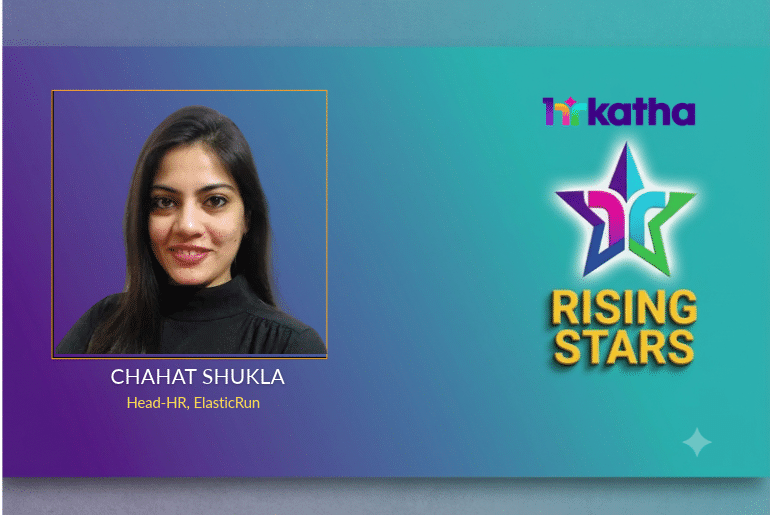
Had HR not claimed her, Chahat Shukla might well have ended up on a stage. A theatre enthusiast since college, she was fascinated by the complexity of human emotion. Playing a character meant understanding what motivated someone, what made them vulnerable and how they saw the world.
The same curiosity drew her to HR. Today, as head of HR at ElasticRun, her ability to see a situation from different perspectives comes in handy when dealing with founders, changing business priorities and a workforce spread across the country.
Earning the right to challenge
One of Shukla’s biggest professional challenges has been learning to work with founders in an entrepreneurial environment where priorities shift constantly and decisions are made quickly.
Influencing strong personalities, challenging perspectives constructively and building alignment without necessarily having formal authority have been important parts of her growth.
She has learnt that having the right answer is not always enough. It takes conviction to challenge the status quo, the ability to bring people along and the courage to make unpopular decisions.
Shukla has earned credibility by staying close to the business, understanding its operational realities and delivering consistently. Along the way, she has learnt when to push back and when to adapt.
What happens after automation?
What excites Shukla most about AI is not automation itself but the opportunity to redesign work and careers.
AI can give organisations greater speed, efficiency and capacity. What interests her is what leaders choose to do with that capacity. Do organisations simply do more with fewer people, or do they also use it to create more meaningful work and build new capabilities?
As job structures change, Shukla believes HR will need to create clearer pathways for employees to acquire skills, explore internal opportunities and prepare for roles that are still taking shape.
She wants HR teams themselves to become more comfortable experimenting with AI, questioning existing processes and upgrading their capabilities. That includes understanding issues such as data privacy, bias and fairness alongside the potential productivity gains.
“The objective is not to make HR more technology-driven at the cost of being human, but to make it more impactful through technology,” she says.
One experience across the country
At ElasticRun, technology is helping Shukla address a more immediate challenge: how to deliver a consistent employee experience across geographically dispersed frontline operations.
A key focus has been digitising the frontline employee lifecycle, from onboarding and attendance management to payroll information, grievance redressal and communication.
The idea is that an employee should receive the same quality of HR service regardless of where they work. Standardising these processes through technology is intended to improve transparency and reduce dependence on manual intervention and location-specific practices.
Shukla believes every such initiative should ultimately connect to a business outcome, whether it is productivity, profitability, retention or organisational effectiveness.
Opening doors to different careers
Some of Shukla’s most rewarding professional moments have come from seeing women take up operational roles, lead teams and become financially independent.
At ElasticRun, she has driven diversity and inclusion initiatives aimed at creating employment opportunities for women across frontline logistics operations, including women-led stations.
She finds similar satisfaction in creating internal career opportunities. An organisation, she believes, should be a place where people can reinvent themselves, take on unfamiliar responsibilities and grow into roles they may not have previously imagined.
For Shukla, seeing someone’s career take a different direction because the organisation chose to invest in their potential is among the most meaningful outcomes of working in HR.
Quick Takes
Conflict style: Mediation, with escalation when necessary.
Engagement driver: Recognition. People want their contribution to be seen and valued.
Feedback preference: Instant. Timely feedback creates opportunities to course-correct.
Retention tool: Career growth. Compensation gets people in the door, but growth gives them a reason to stay.
Team energy booster: Brainstorming. A good discussion can unlock ideas that no individual would have arrived at alone.
Moving beyond firefighting
Yoga is Shukla’s way of finding mental space and maintaining discipline amid the demands of her role. But when it comes to her team, she recognises that managing burnout requires more than individual coping mechanisms.
She sees burnout as a consequence of a sustained mismatch between expectations, resources and time to recover. She encourages team members to speak up when they feel stretched and wants ownership to mean taking responsibility, not being available all the time.
Nor does she consider constant firefighting a sign of high performance. Building sustainable systems, distributing responsibilities and empowering people to make decisions are equally important.
Her larger ambition is to build leadership teams and institutions that can sustain growth beyond any individual leader.
She also wants HR professionals to understand their organisation’s business model, customer priorities, financial drivers and operational challenges, with measurable accountability for people outcomes resting with both HR and business leaders.
Why she is a Rising Star
What makes Shukla worth watching is her willingness to look beyond immediate HR priorities. While AI promises efficiency, she is already thinking about what organisations could do with the capacity it creates. Her work on frontline digitisation and women-led logistics stations shows an interest in changing how people experience work. Her ability to earn credibility with founders and challenge their thinking constructively is another promising sign. As her responsibilities grow, it will be interesting to see how she translates her ideas about work and career redesign into practice.
Rising Stars is HRKatha’s editorial series profiling the next generation of HR leaders shaping the future of the profession. The series also features winners and finalists of the HRKatha Rising Star Leadership Awards, alongside emerging professionals whose work, ideas and leadership potential deserve wider recognition.
