



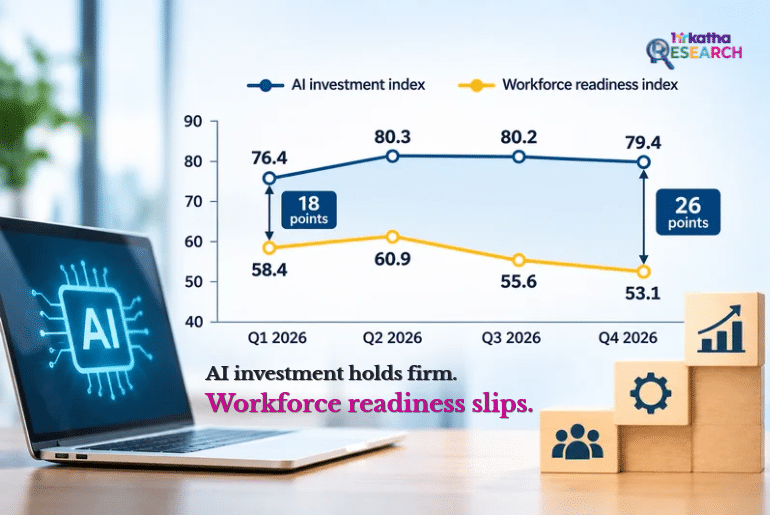
The AI investment index has barely moved since the second quarter. Workforce readiness, however, has fallen by almost eight index points. Between Q1 and Q4 2026, the gap between the two widened from 18 points to 26.
The figures come from the India findings of the AI Momentum Survey for Q4 2026, a quarterly study of 10,000 businesses across 32 countries by Dun & Bradstreet, the business data and analytics company. The survey tracks eight measures using a diffusion index, where 50 is neutral, readings above 50 signal expansion and readings below 50 signal contraction.
The AI investment index stood at 79.4 in Q4, against 80.3 in Q2. Workforce readiness stood at 53.1, against 60.9 in Q2, having declined in each of the last two quarters. It remains above neutral, but since Q2, no measure has lost more ground.
What the readiness numbers show
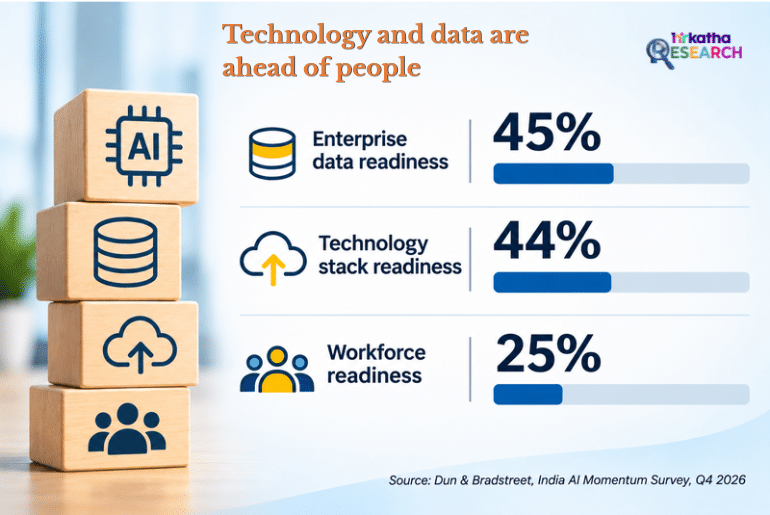
The distribution behind the index is more revealing. Only 25.2 per cent of organisations rate their workforce readiness as strong or very strong. Almost half, 49.7 per cent, describe it as mixed. Another 25.2 per cent report limited readiness or large gaps. As many organisations report weak workforce readiness as report strong.
Workforce readiness is the lowest of the three readiness indices at 53.1. Data readiness stands at 62.4 and technology stack readiness at 63.1, about nine and ten points higher, respectively. The response scales differ, but the distributions point in the same direction: 45 per cent say their enterprise data is mostly or fully ready and 44 per cent report third-party or cloud-native technology stacks, against 25.2 per cent who rate their workforce readiness as strong or very strong.
Risk confidence records the steepest quarterly fall
The AI risk mitigation index fell 5.9 points in Q4, from 62.3 to 56.4, the steepest quarterly decline recorded across the eight indices in 2026.
Only 29 per cent of respondents rate their ability to identify, monitor and mitigate AI risks as strong or high. Another 53 per cent describe it as moderate, while 17.5 per cent rate it as low or limited.
Scaling has outrun returns
Nearly 63 per cent of organisations report AI projects that are scaling, operationalised across core processes or running as agentic workflows. Around 35 per cent have pilots entering production, 26 per cent have embedded AI across multiple core processes and 1.3 per cent run agentic workflows. Another 35 per cent are still planning or piloting, while two per cent have no AI projects.
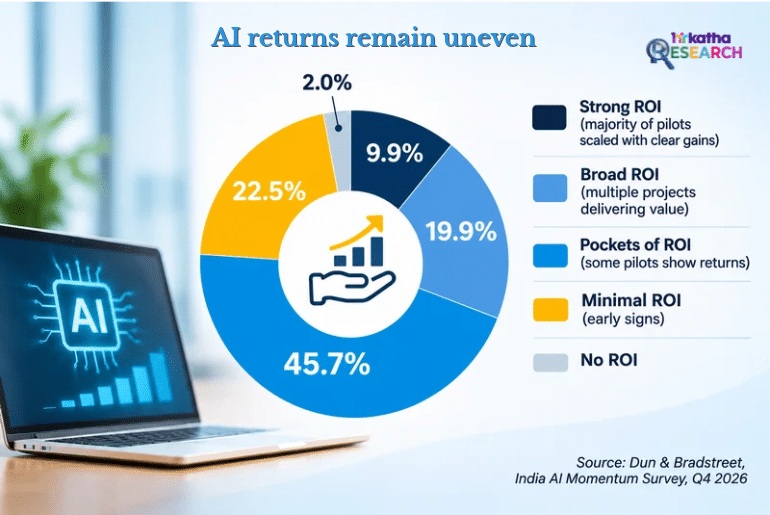
Reported returns are less widespread than reported progress in deployment. Only 29.8 per cent report broad or strong returns on investment (ROI). The largest group, 45.7 per cent, reports only pockets of ROI, while 22.5 per cent report minimal returns and two per cent report none.
Project maturity is the lowest of the eight indices at 45.4, while ROI sits at neutral, at 50.0. The three lowest indices are project maturity, ROI and workforce readiness. The survey does not test whether one explains the others.
Expectations run ahead
Despite uneven returns and declining workforce readiness, spending expectations remain strong. Nearly 69 per cent of respondents expect AI-related expenditure on R&D, infrastructure and talent to rise over the next 12 months. Of all respondents, 55.6 per cent anticipate a moderate increase and 13.2 per cent a significant one. Another 29 per cent expect spending to remain flat, while two per cent anticipate a decline.
Seventy per cent also say AI is likely or very likely to contribute to new products, services, business models or operational improvements in the next quarter.
The response categories behind that figure reveal how much of the optimism rests on early-stage initiatives. Only 13.9 per cent describe such outcomes as very likely, with launches scheduled or initiatives in advanced stages. Another 56 per cent describe them as likely, with defined initiatives and early development underway. Expectations of progress are considerably more widespread than advanced preparations.
Nearly seven in ten surveyed businesses expect to spend more on AI over the next 12 months. Yet,+ workforce readiness has declined for two consecutive quarters.
The investment index has held but workforce readiness has not.