

Close Menu
    Facebook X (Twitter) Instagram
    • Our Story
    • Partner with us
    • Reach Us
    • Career
    Subscribe Newsletter
    HR KathaHR Katha
    • Exclusive
      • Exclusive Features
      • Perspectives
      • Friday Features
      • herSTORY
      • Rising Stars
      • Case-In-Point
      • Point Of View
      • Research
      • HR Pops
      • Dialogue
      • Movement
      • Profile
      • Beyond Work
      • By Invitation
    • News
      • Global HR News
      • Compensation & Benefits
      • Diversity
      • Events
      • Gen Y
      • Hiring & Firing
      • HR & Labour Laws
      • Learning & Development
      • Merger & Acquisition
      • Performance Management & Productivity
      • Talent Management
      • Tools & Technology
      • Work-Life Balance
    • Special
      • HR Forecast 2026
      • Cover Story
      • Editorial
      • HR Forecast 2024
      • HR Forecast 2023
      • HR Forecast 2022
      • HR Forecast 2021
      • HR Forecast 2020
      • HR Forecast 2019
      • New Age Learning
      • Coaching and Training
      • Learn-Engage-Transform
    • Magazine
    • Reports
      • Whitepaper
        • HR Forecast 2024 e-mag
        • Future-proofing Manufacturing Through Digital Transformation
        • Employee Healthcare & Wellness Benefits: A Guide for Indian MSMEs
        • Build a Future Ready Organisation For The Road Ahead
        • Employee Experience Strategy
        • HRKatha 2019 Forecast
        • Decoding and Driving Employee Engagement
        • One Platform, Infinite Possibilities
      • Survey Reports
        • Happiness at Work
        • Upskilling for Jobs of the Future
        • The Labour Code 2020
    • Conferences
      • Leadership Summit 2025
      • Rising Star Leadership Awards
      • HRKatha Futurecast
      • Automation.NXT
      • The Great HR Debate
    WhatsApp LinkedIn X (Twitter) Facebook Instagram
    HR KathaHR Katha
    Home»Exclusive Features»Research»How to fight technological unemployment
    Research

    How to fight technological unemployment

    mmBy Dr. Prajjal Saha | HRKathaJuly 15, 20164 Mins Read10737 Views
    Share LinkedIn Twitter Facebook WhatsApp
    Share
    LinkedIn Twitter Facebook WhatsApp

    Technological disruptions demand that business and HR leaders stay abreast of technological advancements to avoid technological unemployment.

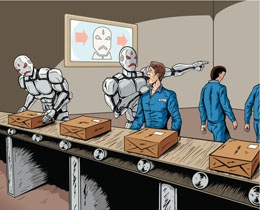
    Technological disruptions are here to stay, but whether they will replace humans or empower them to be more analytical and accurate, is an ongoing debate. While technology is making inroads into various jobs, studies have shown that it is already transforming the way businesses function. With intelligent technologies, such as chatbots, smart software and cloud computing, a lot of jobs either fear getting outdated or will have to re-innovate the way people function in certain roles, such that these technologies do not make the jobs obsolete but help people perform better.

    Boston Consulting Group predicts that by 2025, up to a quarter of jobs will be replaced by either smart software or robots. A study by Oxford University suggests that 35 per cent of existing UK jobs are at risk of automation in the next 20 years. The jobs that demand lower skill levels are the most vulnerable. This implies that professionals seeking job security in this disruptive world will have to continuously reskill and upskill themselves. This also means that organisations will have to regularly assess and develop people in terms of the knowledge of the desired technological tools.

    “While keeping up with technology is imperative in today’s business environment, corporates must ensure that this does not replace human interaction. The ideal scenario would be when we can bring both these together to a harmonious balance to achieve the organisational objectives.”

    According to the latest Randstad Workmonitor Survey, that interviewed over 600 employees in the age group of 18–65 in India, 95 per cent of the survey respondents agreed that today, technology and digitalisation have a major impact on their jobs. 96 per cent said that they see this trend as an opportunity—an almost equivalent number of male and female respondents mentioned this. Remarkably, 89 per cent indicated that they need more training to keep up with technological developments and make them work to their advantage.

    Moorthy K Uppaluri, MD & CEO, Randstad India says, “While keeping up with technology is imperative in today’s business environment, corporates must ensure that this does not replace human interaction. The ideal scenario would be when we can bring both these together to a harmonious balance to achieve the organisational objectives.”

    A few jobs that are already suspecting a perceptive risk of extinction—owing to technology and its smart machines—include taxi drivers, factory workers, journalists and teachers, and probably doctors.

    Examples of how artificial intelligence is becoming a reality in our work and personal lives are many— Google’s investment in driverless cars; IBM’s Watson partnership with Memorial Sloan Kettering and MD Anderson Cancer Centre to personalize cancer treatment; Skype’s launch of real time voice translation; Narrative Science’s software, Quill, that is capable of turning data into reports or articles.

    Moorthy K Uppaluri

    Does the advent and application of these technologies mean that the jobs of journalists, teachers, lawyers, doctors or many others are over? Well, not yet! Experts believe that these are the times when business and HR leaders need to stay abreast of the technology shifts in order to avoid technological unemployment or the loss of jobs caused by technological changes. This needs to be followed up by meticulous plannin
    g on how to help employees utilise these technologies to perform better, rather than getting ousted by them.

    “Just having the right technological tools will not transform an organisation. These tools are only effective when the right environment, the right culture and the right support are in place. When organisations can attain this, that is when the real transformation happens”, Uppaluri explained.

    Technology need to be seen as an addition to what humans are currently capable of, helping them move into more strategic roles. This is why, it is also being said that the jobs requiring lower-level skills will be completely overtaken by intelligent technologies. It’s time organisations focus on identifying and developing smarter employees, who can ride these smart technologies into a brighter future.

    Boston Consulting Group Chatbots Cloud computing HR Leaders Moorthy K Uppaluri Oxford University Randstad Workmonitor Survey Smart software Technological disruptions Technological unemployment
    Share. LinkedIn Twitter Facebook WhatsApp
    mm
    Dr. Prajjal Saha | HRKatha

    Dr. Prajjal Saha is a business journalist and the editor-publisher of HRKatha. He writes on the realities of work and organisations, offering a clear-eyed view of how companies translate intent into action—often revealing the gap between the two. With over 25 years of experience, he focuses on interpreting workplace trends and leadership decisions in a way that is both insightful and accessible. He founded HRKatha in 2015 to create a platform for credible, insight-driven analysis of the evolving workplace.

    Leave A Reply Cancel Reply

    Related Posts

    Work is no longer a reliable route out of poverty

    August 5, 2026

    Just 8% of Indian firms have actually institutionalised people analytics

    July 29, 2026

    AI is not replacing workers. It is replacing the youngest ones first

    July 22, 2026

    The $9.6 trillion shrug

    July 15, 2026
    zoha
    Editorial

    Why every organisation eventually becomes the company it rewards

    There is a test that every employee in every organisation applies, usually without naming it.…

    What Jantar Mantar told us about the generation now entering India’s workplaces

    A senior television journalist, who now runs his own YouTube channel, was speaking to a…

    EDITOR'S PICKS

    HR Perspectives by Deepali Bhardwaj: “Compensation certainly matters, but it rarely explains long-term commitment”

    August 5, 2026

    Work is no longer a reliable route out of poverty

    August 5, 2026

    The halo-horn effect: When one impression hijacks every judgement

    August 4, 2026

    Sanofi Consumer Healthcare asked employees what was wrong, then actually fixed it

    August 4, 2026
    Latest Post

    SpaceX insider share-lockup expiry opens trading access to 912 million shares

    News August 5, 2026

    SpaceX is set to face its first major test as a publicly-traded company this week,…

    HR Perspectives by Deepali Bhardwaj: “Compensation certainly matters, but it rarely explains long-term commitment”

    Perspectives August 5, 2026

    IHG Hotels and Resorts operates across multiple brand segments in India, from essential and premium…

    Work is no longer a reliable route out of poverty

    Research August 5, 2026

    In large parts of the world, employment is not an aspiration. It is a condition…

    Nutanix to cut 5% of global workforce

    Layoff August 5, 2026

    Nutanix has announced plans to cut about five per cent of its global workforce over…

    Asia's No.1 HR Platform

    Facebook X (Twitter) Instagram LinkedIn WhatsApp Bluesky
    • Our Story
    • Partner with us
    • Career
    • Reach Us
    • Exclusive Features
    • Cover Story
    • Editorial
    • Dive into the Future of Work: Download HRForecast 2024 Now!
    © 2026 HRKatha.com
    • Disclaimer
    • Refunds & Cancellation Policy
    • Terms of Service

    Type above and press Enter to search. Press Esc to cancel.