


The need for developing an internal talent marketplace was felt more than ever before during the pandemic. Companies faced a major issue in redeploying employees to different businesses or departments, and change became unavoidable. During such times of crisis, an organisation requires agility for quick deployment and internal mobility of resources.
A fine example of this is Unilever, During the COVID-19 pandemic, which managed to redeploy more than 8000 employees and 300,000 hours of employee work using an internal talent marketplace, amidst the pandemic. An iterative design is require in the talent market place to derive such innovation.
“We have also seen a small success by using the internal talent marketplace design, where we had to re-deploy our workforce from the stores, which were closed during the lockdown, but the demand in ecommerce business was rising. We reskilled our internal talent within three weeks to tackle the needs of the Company.”
Sachin Agrawal, head-HR, B2B ecommerce business, Reliance Retail
For an organisation, creating an internal talent marketplace helps fulfil the skill and talent demands, as and when they arise, from within. On the other hand, for the employees, it opens up doors to explore new and better opportunities, which align with their interests. To do that, one has to identify one’s internal talent and their skills, and map the same with the needs of the organisation, enabling technology.
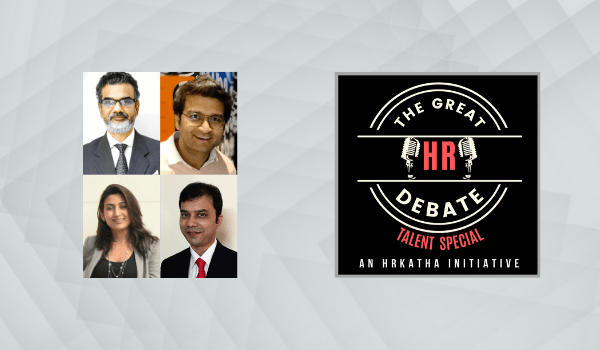
In the third session of The Great HR Debate, Talent Special, the topic of discussion was ‘What does the iterative talent marketplace design look like?’
The debaters who were part of this session were, Gautam Srivastava, VP-HR, The Leela Hotels & Resorts; Mona Thangaraj, head of talent acquisition, GroupM India and Shailesh Saumya Singh, head of talent acquisition, Max Life Insurance. The session was moderated by Sachin Agrawal, head-HR, B2B ecommerce business, Reliance Retail.
Srivastava was of the opinion that the need for an internal talent marketplace has grown in the past few years as many industries have been struggling to meet the challenge of talent demand and supply.
“The purpose of the design needs to be clearly defined as per the organisational needs and goals. Then these need to be aligned with the programmes and policies created with the help of technology. Such designs are driven like a project. I have even seen organisations forming a task force to run these projects.”
Gautam Srivastava, VP-HR, The Leela Hotels & Resorts
According to Srivastava, some key factors, while designing an internal marketplace are, purpose, programme, policies and enabling technology. “The purpose of the design needs to be clearly defined as per the organisational needs and goals. Then these need to be aligned with the programmes and policies created with the help of technology. Such designs are driven like a project. I have even seen organisations forming a task force to run these projects,” shared Srivastava.
Adding to this, Singh said that it is very important to understand the organisational structure, employment model and skills the company requires around which the workforce management strategy of the company is built.
He pointed out the need for organisations to invest time, while designing such programmes and policies to build an internal marketplace, which can sustain for a long term, because the requirement of the business keeps changing every five years.
“It is important to identify unique skills internally and give opportunities to people within the organisations to move into different roles. That way, it will allow one to hold on to one’s best talent.”
Mona Thangaraj, head of talent acquisition, GroupM India
Citing an example from his own company, Max Life Insurance, Singh shared that the Company does not do much campus hiring. It hires around 70 people from campuses under its leadership development programme, to prepare a pipeline of future leaders in the company.
Thangaraj also shares an example from her company, GroupM, which allows its employees to move internally within the organisation within 12 months of being hired. “It is important to identify unique skills internally and give opportunities to people within the organisations to move into different roles. That way, it will allow one to hold on to one’s best talent,” explained Thangaraj.
Sharing a recent example from Reliance Retail, Agrawal shared, “We have also seen a small success by using the internal talent marketplace design, where we had to re-deploy our workforce from the stores, which were closed during the lockdown, but the demand in ecommerce business was rising. We reskilled our internal talent within three weeks to tackle the needs of the Company.”
“It is very important to understand the organisational structure, employment model and skills the company requires around which the workforce management strategy of the company is built.”
Shailesh Saumya Singh, head of talent acquisition, Max Life Insurance
Singh also cited an example from Uber, which used a very innovative idea to meet the talent-demand needs. The Company asked some of the working professionals in the US, who travel to work daily by their own car, whether they would give a ride to passengers whose destination lay on the same route, while they travelled back home from work. “When I was in the US, one of my Uber cab drivers was a VP of a tech company and I was impressed by the way Uber was using innovative ways to build its talent strategy. That made me realise that talent exists everywhere. We just need to identify it with an open mind,” enunciated Singh.
Thangaraj cited the example of Google, which used its internal talent pool as gig workers to work on small projects, which kept the workforce engaged. This is the kind of design that has given birth to products, such as Google Maps, Youtube and many more.
Knowledge and awareness of the skills and potential of one’s internal talent and matching it with the needs of the organisation can play a big role in meeting the immediate talent demand needs within the establishment.
