


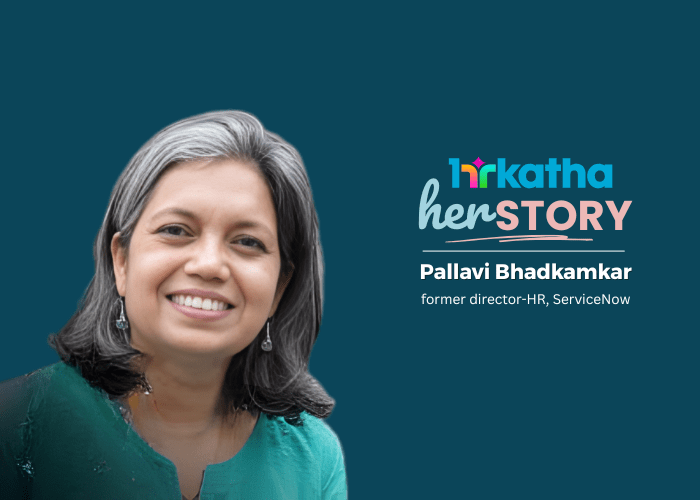
Not just an HR professional
Back when she was an undergraduate, Pallavi Bhadkamkar happened to converse with a few senior HR leaders to understand what HR was really about and felt it was something she would like to do. She was also clear that she wanted to complete a postgraduation in Psychology as it was a must for pursuing PhD or further studies in any branch of the subject.
Aware that a specialisation in Organisational Psychology was important in the US and the UK for HR professionals and consultants, she went on to complete an advanced certification in Organisational Development (OD) and Management from Fielding University, US which increased the depth of her knowledge in OD, Design and Change.
Today, as a senior HR leader and former director-HR at ServiceNow, Bhadkamkar approaches her work through the lens of OD and Design while also drawing upon her interest in and understanding of Psychology. Having also invested in understanding and growing her business acumen, she readied herself to play a business partner and not just an HR professional.
“The starting point for defining strategic HR is always the context — organisational, business and environmental”
Walking away from the gender lens
For an assertive and resilient person such as Bhadkamkar, it didn’t take long to learn not to be entrenched in her gender identity but to establish rapport and credibility as an individual. Subtle biases were handled with resilience, by being authentic to her own self and by staying non-reactive.
She does recall two instances from two different organisations when she was given to understand that for some reason a male leader was taken more seriously than a female. She was told that leaders were unlikely to “listen” to a female facilitator! What surprised her was that the feedbacks came from senior HR leaders (one of whom was a woman). Smart enough not to take this first brush with gender bias as a personal rejection, Bhadkamkar attributed this feedback to the overall culture of the organisation and an example of the world we live in. She has always focussed on organisations and teams that valued her expertise without looking through a gender lens.
Quick Fire Round
If not HR, what career path would you have pursued?
Marketing, Psychotherapy.
Your mantra for difficult days?
Stay empathetic, authentic and respectful—especially when making difficult decisions.
One thing you wish people understood about being a woman in HR leadership?
That our expertise should be valued without looking through a gender lens.
What energises you most about your work?
Playing a business partner role and solving real organisational problems—not just being an HR professional.
Morning ritual that sets you up for success?
Some “me” time with a cup of tea to start the day with clarity on the business context and the problems we’re trying to solve.
Best investment you’ve made in yourself?
Increasing my knowledge and competencies in areas such as OD, coaching, facilitation; continuing to invest in passions such as French and music, which help me destress and live a full life.
Empathy, authenticity and respect
According to Bhadkamkar, she always strove to be empathetic and authentic whilst still garnering the respect that her role demands. While making difficult decisions, such as downsizing and terminations, she tried to take into account diverse perspectives, facts, and data, looking at both short-term and long-term impact. Once the decision was taken, never did she lose sight of the fact that the person sitting across from her was a human with feelings and concerns and not just data on a spreadsheet. This kept her empathetic, authentic and respectful.
“An HR leader should be able to do both: sit in the boardroom to advise on talent strategies and start from the business problem, to design strategy and tactics around it.”
Defining ‘strategic’ HR
“The starting point for defining strategic HR is always the context — organisational, business and environmental,” says Bhadkamkar. Pivoting rapidly to virtual teams and collaboration was strategic during the pandemic, and that could have included transactional and administrative elements. During change and transformation, walking the floors and talking to the foot soldiers to ensure communication and alignment is also strategic.
It is not only about sitting in the boardroom and advising on talent strategies or coaching and other esoteric elements that can come to mind. The key element in strategic HR is to start from the business problem that we are trying to solve and then design a strategy and tactics around it. Sometimes, the strategy could be to get transactional elements out of the way in the short term and at other times a long-term approach may be required. An HR leader should be able to do both.
Advice to women
While she admits that women are a minority in leadership positions, and biases exist, the key is, to build resilience within oneself. Her advice to young women in HR? Say ‘yes’ to opportunities as a professional without approaching career from a gender perspective; be open to diverse viewpoints, work on building and nurturing strong networks.