


A supply disruption hits a key ingredient market.
A regulatory shift alters sourcing requirements. A digital marketplace launches a competing private label. Cross-border staffing delays slow expansion into a critical geography.
For consumer goods companies, these are no longer hypothetical scenarios. They are simultaneous realities. Volatility is no longer episodic. It is structural.
Geopolitical uncertainty, fragile supply chains, regulatory shifts and tightening global talent mobility are compressing decision cycles and forcing organisations to rethink how quickly their workforce can adapt.
In this environment, the traditional advantage of scale is being replaced by something more dynamic: the ability to redeploy skills and leadership rapidly across the value chain.
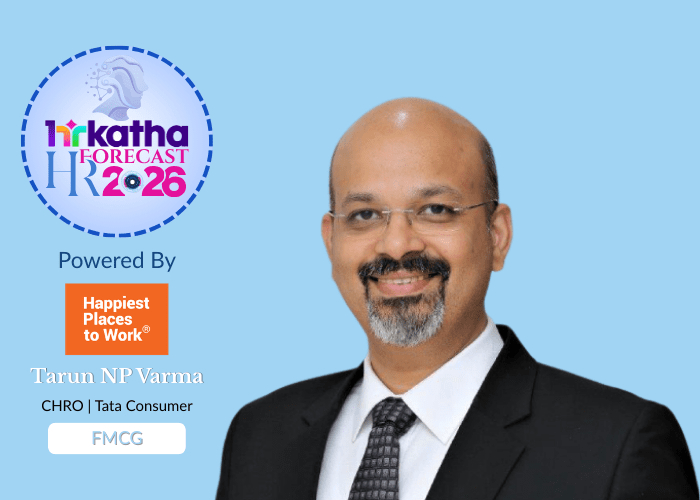
Tarun N.P. Varma, CHRO at Tata Consumer Products—who also oversees sustainability and ethics—believes that in 2026 the defining capability for FMCG will not be hiring talent, but moving talent internally at the speed the business demands.
“The FMCG industry is navigating geopolitical flux, changing employment regulations, supply chain fragility and constraints in cross-border talent mobility,” he says. “This offers the sector an opportunity to turn volatility into an engine for capability—reskilling at scale, accelerating digital adoption and orchestrating agile careers across plants, sales and multi-channel businesses.”
Three signals point to how this transformation may unfold.
Signal 1: Internal talent mobility will become strategic infrastructure
In volatile operating environments, the speed at which companies redeploy talent matters more than the ability to hire externally.
Consumer goods organisations operate across complex ecosystems: manufacturing plants, multi-channel distribution networks, digital platforms and international supply chains.
When a supply disruption forces production shifts, when regulatory changes require new compliance expertise, when digital channels scale faster than anticipated—organisations need to move capability to critical nodes immediately.
External hiring cannot deliver that speed. Internal mobility can.
“Practically, this means an integrated people agenda tied closely to strategy, talent marketplaces that redeploy scarce skills to critical nodes in the value chain, and AI-enabled learning that personalises growth while protecting trust,” Varma explains.
At Tata Consumer Products, HR transformation was designed to run alongside business transformation—not follow it.
“We chose to build HR infrastructure alongside business transformation, not after it—knitting eleven core people processes into six strategic pillars so capability keeps pace with ambition.”
The result: HR systems designed not for stability but for speed.
When the business needs manufacturing expertise shifted to a new geography, commercial talent redeployed to emerging channels, or digital capabilities scaled across teams, the infrastructure exists to execute quickly.
In 2026, organisations that build talent marketplaces enabling real-time skill redeployment will gain resilience competitors relying on external hiring cannot match.
Those treating internal mobility as a retention perk rather than operational capability will struggle when volatility accelerates.
Signal 2: AI will accelerate HR—if deployed as coach, not cop
Artificial intelligence is reshaping how organisations measure performance, track productivity and allocate work.
But the technology creates a fork in the road.
Deployed well, AI enables better decisions, reduces bias and accelerates feedback. Deployed poorly, it creates cultures of surveillance and erodes trust.
Varma believes the difference lies in intent and governance.
“I believe in the AIxHR phenomenon—AI accelerating HR. But leaders must see AI as an enabler of decision-making, not as a control mechanism.”
Real-time analytics can surface performance patterns, identify skill gaps and enable faster coaching. For organisations navigating constant operational shifts—supply disruptions, rapid team restructuring, emergency redeployments—data helps allocate scarce talent more effectively.
But the same systems, without guardrails, can undermine employee confidence.
“AI will make performance more transparent and timely—but only if we deploy it as a coach, not a cop.”
At Tata Consumer Products, AI deployment follows clear principles: strong data governance, transparent communication about what systems measure and why, and human judgment remaining central to evaluation and rewards.
“Our stance is to set guardrails on data use, communicate the ‘what, why and how’, and ensure human judgment remains central to evaluation and rewards.”
Used responsibly, AI strengthens the organisational social contract—fairer decisions, faster coaching, clearer standards.
“Fairer decisions, faster coaching and clearer standards—while keeping dignity at the centre of work.”
Through 2026, the divide will be visible. Some organisations will use AI to enable development and informed decision-making. Others will deploy it for surveillance, triggering trust erosion and engagement decline.
The technology is neutral. The intent behind its use determines the outcome.
Signal 3: ESG leadership will increasingly run through HR
Environmental, social and governance priorities are moving from corporate responsibility initiatives to core business strategy.
For consumer goods companies, ESG pressures come from multiple directions: regulators demanding transparency, investors requiring sustainability metrics, consumers choosing brands based on values, and communities expecting ethical supply chains.
As these demands intensify, HR’s role is expanding beyond traditional boundaries.
At Tata Consumer Products, Varma oversees not only HR but also sustainability and ethics—positioning the function at the intersection of people, planet and purpose.
“Human Resources is the natural custodian of ESG—from embedding ethics and transparency to enabling workforce inclusion and community impact.”
This integration extends across the value chain—from internal governance to partner ecosystems and community programmes.
“Our sustainability agenda—For Better Planet, Sourcing, Nutrition and Communities—is inseparable from people practices, governance rhythms and leadership scorecards.”
Practical execution includes leadership accountability for sustainability metrics, programmes expanding employment access across communities, ethical sourcing practices with partners, and governance frameworks ensuring transparency across operations.
As climate change and geopolitics reshape supply chains, companies increasingly depend on trust—across partners, communities and employees.
“HR’s integration of ethics, skills and culture is what sustains that trust.”
By 2026, HR functions integrating ESG deeply into talent strategy will operate as strategic business partners.
Those treating sustainability as separate compliance function will face mounting pressure to integrate or risk losing stakeholder confidence.
The pay transparency question: Structured clarity over absolute disclosure
Across global markets, pay transparency is becoming increasingly common—driven by regulation, competitive pressure and employee expectations.
Whether India will follow the same trajectory remains uncertain.
Varma believes structural realities—labour market imbalances, societal inequities and intense competition for frontline talent—may slow widespread adoption of full disclosure.
However, organisations are likely to move gradually toward greater clarity.
“Rather than absolute transparency, the pragmatic path is structured transparency—consistent job architectures, auditable pay bands and periodic equity reviews.”
For consumer goods companies operating across diverse markets and distribution networks, compensation clarity also enables internal mobility.
“Especially in frontline talent markets where competition is intense, clarity around pay and incentives builds trust and reduces friction in role movement across operations.”
Employees more readily accept lateral moves, temporary deployments or geographic shifts when compensation frameworks are clear and equitable.
In 2026, leading organisations may not publish all salaries publicly—but they will operate with internal clarity that enables mobility and builds trust.
The entrepreneurial leadership imperative
These forces—internal mobility, AI acceleration, ESG integration, compensation clarity—converge on a leadership requirement.
Traditional FMCG leadership was built for execution within stable structures. The emerging requirement is entrepreneurial enterprise leadership—capable of navigating supply chain volatility, regulatory shifts, multi-channel consumer markets and rapid organisational reconfiguration.
“Developing entrepreneurial enterprise leaders capable of navigating this complexity is essential,” Varma says.
This leadership model combines commercial acumen with people capability: understanding when to pivot supply chains, how to redeploy talent rapidly, which ESG commitments strengthen competitive position, and how to use AI responsibly.
Organisations investing in this leadership capability will navigate volatility more effectively. Those maintaining traditional hierarchical models will struggle as decision cycles compress and operational complexity intensifies.
Three Strategic Imperatives
Talent Mobility Infrastructure: Build internal talent marketplaces and AI-enabled learning ecosystems that redeploy skills rapidly across manufacturing, commercial and digital functions—making mobility operational capability, not HR programme.
Trust-Centric AI: Deploy AI in HR with strong governance and transparent communication—ensuring analytics enable development and informed decisions rather than surveillance.
Integrated ESG Leadership: Embed sustainability, ethics and inclusion into HR strategy and leadership accountability—treating ESG as business capability, not compliance function.
The Adaptability Advantage
The FMCG industry is entering a period of structural volatility.
Supply chains are being reconfigured by geopolitics and climate. Consumer behaviour is evolving through digital channels. Competition is intensifying from agile new entrants.
In this environment, organisational advantage depends less on stability and more on adaptability.
Companies investing in internal talent mobility, entrepreneurial leadership and trust-centric technology will navigate uncertainty more effectively than competitors relying on traditional hiring and hierarchical structures.
By 2026, the divide will be clear.
Some organisations will move talent, capability and leadership at business speed—redeploying skills across the value chain as conditions shift, integrating ESG into core strategy, and using AI to enable rather than control.
Others will maintain traditional talent systems designed for stability—struggling when volatility demands rapid reconfiguration.
As Varma observes, the goal is not simply to manage volatility but to convert it into organisational strength.
The sector has the opportunity. The question is whether organisations will build the people infrastructure to seize it.
In 2026, competitive advantage in FMCG may no longer be determined by the strongest product portfolio or the widest distribution.
It may belong to the organisation that can move capability fastest across its enterprise.