



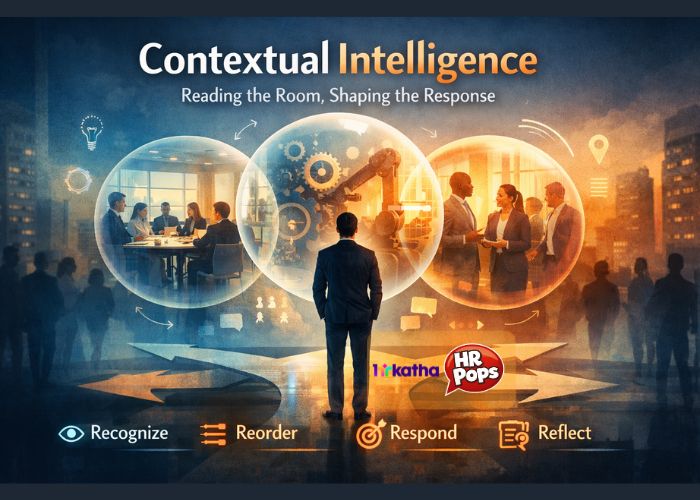
What does ‘contextual intelligence’ mean?
Contextual intelligence is the ability to understand the environment around you, interpret its dynamics, and adapt your actions accordingly.
It goes beyond technical knowledge or emotional awareness. It is about reading the room, recognising what truly matters in a given situation, and responding in a way that fits the context.

Unlike technical intelligence, which is knowing what to do, or emotional intelligence, which is understanding how people feel, contextual intelligence is about knowing what will work, where, and why.
It is often explained through a simple framework of four steps: recognise the situation and its complexities, reorder priorities based on context, respond with appropriate action, and reflect to improve future decisions. Together, these form the “4R” model of contextual decision-making.
Where did the idea come from?
The concept emerged from leadership studies in the late 20th century, as scholars began to observe that effective leaders did more than apply standard frameworks.
They adapted.
Early thinking linked contextual intelligence to ideas such as tacit knowledge, timing, and non-linear thinking. Over time, it became clear that leaders who could interpret context and adjust their approach consistently outperformed those who relied on rigid models.
As organisations became more global, complex, and technology-driven, contextual intelligence evolved into a distinct leadership capability. It is particularly valuable in uncertain and rapidly changing environments.
Why is it relevant for HR?
HR operates at the intersection of people, culture, and business strategy. In all these areas, context matters.
Contextual intelligence shapes several core HR functions:
- Employee engagement: What works in one team or geography may fail in another. Context-aware strategies outperform standardised programmes
- Talent decisions: Hiring and development require understanding not just skills, but cultural fit, market conditions, and organisational needs
- Change management: Timing, communication style, and stakeholder alignment often determine success more than the change itself
- Leadership development: Future leaders must be equipped to adapt, not just execute predefined competencies
- Global workforce management: Balancing global consistency with local relevance requires constant contextual judgement
In an era shaped by AI, hybrid work, and diverse workforces, the ability to interpret context has become central to effective HR leadership.
The gap between knowing and applying
Here lies the challenge. Contextual intelligence is widely claimed, but rarely demonstrated.
Many HR professionals believe they “read the room”. Yet engagement initiatives fail, change programmes face resistance, and inclusion efforts feel disconnected from reality.
The problem is often a misunderstanding of what contextual intelligence requires.
It is not instinct alone. Intuition can be biased.
It is not experience alone. Experience can become outdated.
True contextual intelligence demands deliberate effort. It requires seeking diverse perspectives, questioning assumptions, and adjusting based on feedback.
The final step, reflection, is often overlooked. Without assessing what worked and what did not, learning remains incomplete.
At the same time, over-adapting carries its own risk. When policies shift too frequently or messages change across audiences, organisations lose consistency and trust.
Contextual intelligence is therefore not about reacting to everything. It is about adapting with coherence.
The takeaway
Contextual intelligence is less about rules and more about judgement.
For HR, it ensures that policies, practices and decisions are not one-size-fits-all, but aligned with the realities of the organisation and its people.
As workplaces become more complex and less predictable, this capability is emerging as a key differentiator. It separates those who manage processes from those who shape outcomes.
The question is not whether context matters.
It is whether you are interpreting it well enough to act on it.