

Close Menu
    Facebook X (Twitter) Instagram
    • Our Story
    • Partner with us
    • Reach Us
    • Career
    Subscribe Newsletter
    HR KathaHR Katha
    • Exclusive
      • Exclusive Features
      • Perspectives
      • Friday Features
      • herSTORY
      • Case-In-Point
      • Point Of View
      • Research
      • HR Pops
      • Dialogue
      • Movement
      • Profile
      • Beyond Work
      • Rising Star
      • By Invitation
    • News
      • Global HR News
      • Compensation & Benefits
      • Diversity
      • Events
      • Gen Y
      • Hiring & Firing
      • HR & Labour Laws
      • Learning & Development
      • Merger & Acquisition
      • Performance Management & Productivity
      • Talent Management
      • Tools & Technology
      • Work-Life Balance
    • Special
      • HR Forecast 2026
      • Cover Story
      • Editorial
      • HR Forecast 2024
      • HR Forecast 2023
      • HR Forecast 2022
      • HR Forecast 2021
      • HR Forecast 2020
      • HR Forecast 2019
      • New Age Learning
      • Coaching and Training
      • Learn-Engage-Transform
    • Magazine
    • Reports
      • Whitepaper
        • HR Forecast 2024 e-mag
        • Future-proofing Manufacturing Through Digital Transformation
        • Employee Healthcare & Wellness Benefits: A Guide for Indian MSMEs
        • Build a Future Ready Organisation For The Road Ahead
        • Employee Experience Strategy
        • HRKatha 2019 Forecast
        • Decoding and Driving Employee Engagement
        • One Platform, Infinite Possibilities
      • Survey Reports
        • Happiness at Work
        • Upskilling for Jobs of the Future
        • The Labour Code 2020
    • Conferences
      • Leadership Summit 2025
      • Rising Star Leadership Awards
      • HRKatha Futurecast
      • Automation.NXT
      • The Great HR Debate
    • HR Jobs
    WhatsApp LinkedIn X (Twitter) Facebook Instagram
    HR KathaHR Katha
    zoha
    Home»Exclusive Features»HR Pops»Sensemaking: Turning confusion into clarity
    HR Pops

    Sensemaking: Turning confusion into clarity

    How the skill of interpreting complex signals became essential in HR, yet remains one of the least understood practices in the modern workplace
    mmBy Liji Narayan | HRKathaJune 23, 20264 Mins Read213 Views
    Share LinkedIn Twitter Facebook WhatsApp
    HR Pops: Sensemaking
    Share
    LinkedIn Twitter Facebook WhatsApp

    What does sensemaking mean?

    In modern complex workplaces that are not just fast changing but also filled with competing priorities, leaders and employees often face situations where information is incomplete, ambiguous, or even contradictory. That is when sensemaking or the process of interpreting and giving meaning to events, data, and experiences becomes critical. As the term itself suggests, it is the process that helps individuals and organisations act with clarity. For HR professionals, sensemaking is not just a skill but a necessity for guiding people through uncertainty, change and conflict.

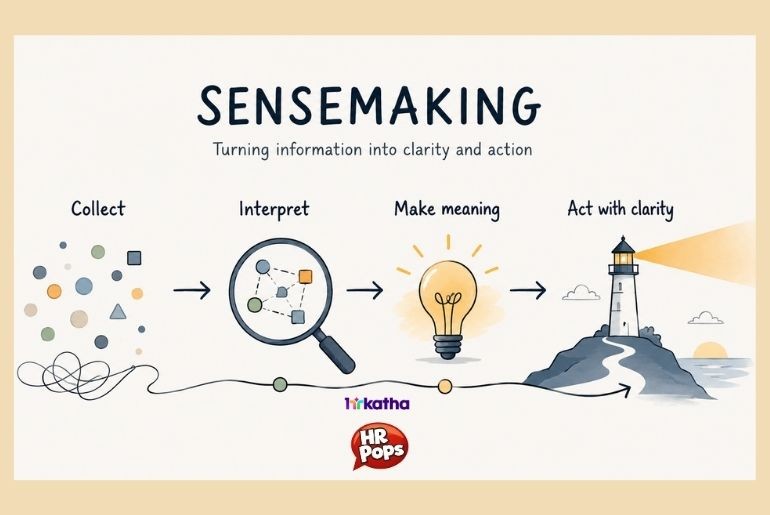
    It is all about creating shared understanding. It involves collecting information, interpreting it, and framing it in a way that helps people decide what to do next. Unlike problem solving, which assumes clear definitions and solutions, sensemaking acknowledges that many workplace issues are messy and require context driven judgement. In HR, this could mean understanding why employee morale is low, why a new policy is resisted, or how cultural differences affect collaboration.

    zoha

    How did the term emerge?

    The term ‘sensemaking’ gained prominence in organisational studies through the work of Karl Weick in the 1970s and 1980s. He argued that organisations are not machines but living systems where people constantly interpret and re interpret events. Over time, sensemaking became a central idea in leadership, crisis management and organisational behaviour. It was especially highlighted after major corporate crises, where leaders had to quickly interpret unfolding events and guide responses without perfect information.

    How is it relevant to HR today?

    Human resource professionals operate at the intersection of business strategy and human experience. Sensemaking is vital when it comes to change management, that is, when companies restructure, merge, or adopt new technologies. That is the time employees often feel uncertain and HR must help them make sense of what is happening and why. Additionally, sensemaking helps HR uncover underlying dynamics and frame fair solutions as conflicts, grievances and performance issues rarely have simple causes.

    Navigating cultural differences and unconscious bias also requires HR to interpret complex social signals and create shared meaning across diverse groups.

    Again, sensemaking helps just as it does when employees are trying to understand how automation will reshape their jobs. It is up to the HR to help employees make sense of the new, understand the impact, retrain for new roles, and see opportunities rather than only threats. Even when it comes to well-being and mental health, it is the HR’s responsibility to remain alert and interpret signals. Employees are not always able to articulate their distress.

    The task of interpreting signals, normalising conversations, and connecting people to support has to be done by the HR.

    What are the skills required for effective sensemaking ?

    To practice sensemaking well, HR professionals need to listen actively so that they can capture multiple perspectives. They need to think contextually, that is, look beyond what is visible on the surface. The skill of storytelling is also a must to be able to frame complex realities in simple, relatable ways. To understand emotional undercurrents, empathy is a must. Additionally, analytical ability is required to connect data with human experience.

    zoha

    What can go wrong without sensemaking?

    If HR fails to practise sensemaking, decisions can become mechanical and disconnected from reality. For instance, imagine a company rolling out a strict attendance policy without interpreting why employees are struggling with punctuality. If the real issue is inadequate transport options or caregiving responsibilities, the policy will only worsen frustration. Employees may feel unheard, morale may drop and attrition could rise.

    The takeaway

    Clearly, HR cannot rely on rules and data alone. Without sensemaking, organisations risk misjudging problems, alienating employees and undermining trust. With it, HR can bridge gaps between business needs and human realities, ensuring workplaces remain both productive and humane.

    clarity amidst uncertainty and ambiguity HR Pop HR Pops HRPops interpreting complex signals Karl Weick making sense amongst chaos and confusion making sense out of ambiguity messy workplace issues process that helps individuals and organisations act with clarity sensemaking Sensemaking vital to change management skills required for effective sensemaking
    Share. LinkedIn Twitter Facebook WhatsApp
    mm
    Liji Narayan | HRKatha

    HRKatha prides itself in being a good journalistic product and Liji deserves all the credit for it. Thanks to her, our readers get clean copies to read every morning while our writers are kept on their toes.

    Leave A Reply Cancel Reply

    Related Posts

    Navigating the grey: When the rulebook runs out

    June 16, 2026

    Rage Applying: How a TikTok trend became shorthand for employees mentally checking out

    June 9, 2026

    How a structure borrowed from airlines became a blueprint for HR

    June 2, 2026

    Cultural intelligence: Beyond diversity workshops and global buzzwords

    May 26, 2026
    Editorial

    The two cultures inside the same multinational

    Someone I know works with one of the world’s largest technology and consulting firms. Based…

    Why HR becomes conservative when hiring HR

    Hire for potential, not just pedigree. Look beyond industry boundaries. Avoid groupthink. Value transferable capability.…

    EDITOR'S PICKS

    Sensemaking: Turning confusion into clarity

    June 23, 2026

    POV: Does rapid hiring during growth phases create long-term cultural risks?

    June 22, 2026

    Lessons from the youngest person in the room

    June 19, 2026

    Case-in-Point: Exit interview truth vs managerial reputation

    June 18, 2026
    Latest Post

    Rahul Dabi elevated to DGM-HR & people services, Skoda Auto Volkswagen India

    Movement June 23, 2026

    Skoda Auto Volkswagen India has promoted Rahul Dabi to deputy general manager – human resources…

    Sensemaking: Turning confusion into clarity

    HR Pops June 23, 2026

    What does sensemaking mean? In modern complex workplaces that are not just fast changing but…

    91trucks restructures operations, cuts workforce and shuts stores

    News June 22, 2026

    Commercial vehicle marketplace startup 91trucks has undertaken a significant restructuring exercise that has led to…

    X targets disgruntled meta employees after layoffs

    News June 22, 2026

    The competition for technology talent has intensified after X moved quickly to attract engineers affected…

    Asia's No.1 HR Platform

    Facebook X (Twitter) Instagram LinkedIn WhatsApp Bluesky
    • Our Story
    • Partner with us
    • Career
    • Reach Us
    • Exclusive Features
    • Cover Story
    • Editorial
    • Dive into the Future of Work: Download HRForecast 2024 Now!
    © 2026 HRKatha.com
    • Disclaimer
    • Refunds & Cancellation Policy
    • Terms of Service

    Type above and press Enter to search. Press Esc to cancel.