



Organisations are built on a simple premise: experience matters.
That premise is largely correct. Experience teaches judgement, context and the ability to distinguish a genuine crisis from an email marked urgent. It explains why companies pay senior executives more than interns.

Yet experience has a blind spot. The longer people work within a system, the more likely they are to accept parts of it without noticing. What begins as expertise can, over time, harden into assumption.
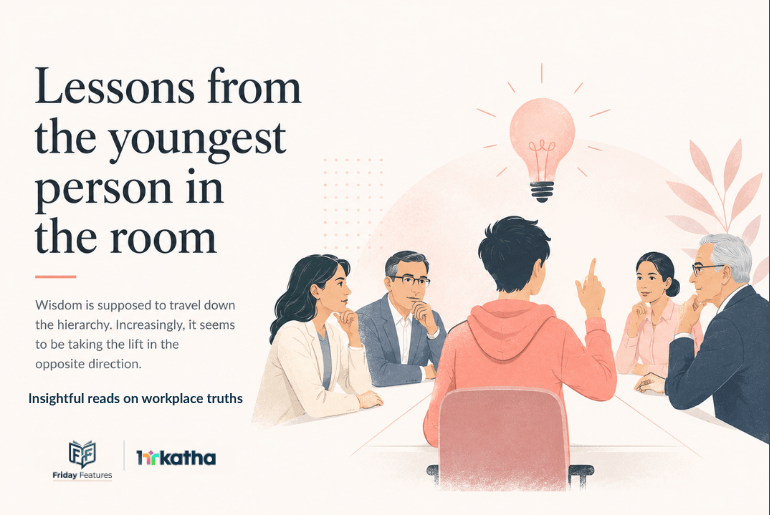
That is where the youngest person in the room occasionally becomes useful.
A fresh graduate asks why a process exists. A young colleague adopts a tool that everyone else dismissed. An intern questions a practice that has survived mostly because nobody remembers who introduced it.
Such moments rarely appear in leadership-development programmes. Yet they often produce the most interesting lessons.
Three HR leaders share insights they learned from colleagues young enough to be their children.
The visibility lesson most veterans never learned
Manish Majumdar, Head HR, Centum Electronics
Professionals of Manish Majumdar’s generation were raised on a reassuring belief: good work speaks for itself.
The theory sounds noble. It also turns out to be incomplete.

What younger employees understand instinctively is that good work and visible work are not necessarily the same thing. An excellent idea that remains hidden is organisationally indistinguishable from no idea at all.
Majumdar noticed how naturally younger colleagues communicate what they are doing. They document progress, showcase achievements and build narratives around their work. Older generations sometimes dismiss this behaviour as self-promotion.
Younger employees tend to see it differently. If nobody knows what value has been created, the value may as well not exist.
The lesson was uncomfortable but useful. Visibility is not vanity. It is communication. And communication, in modern organisations, is part of the job.
The question that reframed the conversation
Samir Bhiwapurkar, Senior General Manager-HR & Admin, Indo Count Industries
After more than three decades in HR, Samir Bhiwapurkar had become familiar with a professional hazard: systems have a habit of becoming more important than the people they were designed to serve.
The reminder came from a young colleague.

During a discussion about a new HR initiative, Bhiwapurkar was explaining a process that had delivered results for years. The colleague listened patiently before asking a deceptively simple question:
He asked why the process was being designed around the system rather than around the employee experience.
The room fell silent.
Not because the question was revolutionary. Quite the opposite. It was obvious.
Which is precisely why nobody had asked it.
Experience teaches professionals how to navigate complexity. It can also encourage them to view problems through the lens of compliance, governance and operational necessity. Younger employees arrive carrying less institutional baggage. They are more likely to ask whether a process makes sense in the first place.
Bhiwapurkar says the question altered his thinking. The most effective innovations are often not grand reinventions. They are simple challenges to assumptions everyone else has stopped examining.
The generation building skills, not collecting titles
Nihar Ghosh, Senior HR Leader
For much of corporate history, career progression was relatively easy to explain.

One acquired experience, earned promotions and accumulated increasingly impressive titles.
Younger professionals appear to be following a different formula.
Nihar Ghosh observed that many early-career employees are less obsessed with the next designation than previous generations were. Their focus is often on acquiring capabilities that remain useful regardless of employer, industry or job title.
This is not a rejection of ambition. It is an adaptation to uncertainty.
Titles depend on organisational structures. Skills travel.
In a world where industries transform faster than they once did, younger employees have concluded that the safest investment is not a position but a capability. The question is no longer, “What role comes next?” but “What can I do next that I couldn’t do before?”
Ghosh found the mindset instructive. Careers are becoming less like ladders and more like portfolios. The people who adapt fastest may not be those climbing quickest, but those learning continuously.
The youngest person in the room may be carrying the newest map
None of these lessons emerged from a leadership programme, a mentoring framework or an expensive organisational intervention.
They emerged from ordinary conversations.
That is the most interesting part.
Companies devote considerable effort to transferring knowledge from older employees to younger ones. Far less attention is paid to the reverse flow. Yet younger workers arrive with instincts shaped by technologies, expectations and economic realities that many organisations are still trying to understand.
Experience remains invaluable.
But when experience meets a changing world, curiosity may matter just as much.
The smartest organisations are not those that assume wisdom sits at the top of the hierarchy.
They are the ones that recognise it can appear anywhere in the room.
Even in the seat furthest from the head of the table.