


From engineering to enabling people
For years, Girija Kolagada led engineering and product teams. Yet, as she did, she found herself increasingly drawn to the people side of leadership: building teams, shaping culture, and enabling leaders to succeed.
Over time, she came to a quiet realisation. The most complex and meaningful challenges she encountered were not technical. They were human.

The more she led teams, the more she realised that technology problems were usually solvable. The harder questions involved motivation, trust, leadership and culture.
Moving into HR business partnering felt like a natural extension of that journey, where she could operate at the intersection of business and people with greater intent. She did not see it as a jump. She saw it as an expansion of her leadership lens.
What still surprises her is the gap between the potential impact HR can have and how it is sometimes positioned. When HR is deeply embedded in business decisions, it can shape outcomes in powerful ways. However, that requires moving beyond process ownership to true partnership.
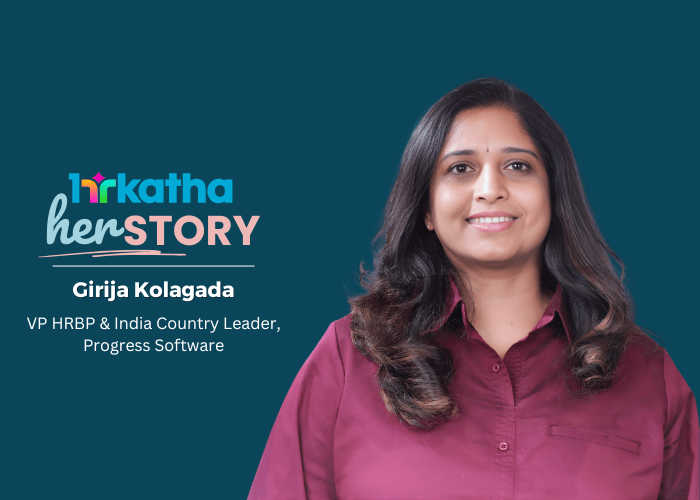
Today, as VP HRBP & India country leader at Progress Software, Kolagada leads with a simple conviction: HR’s greatest contribution lies not in administering processes, but in shaping decisions.
From perception to credibility
One subtle barrier Kolagada encountered was how assertiveness was sometimes perceived differently for women.
Early in her career, she realised that being clear and direct could occasionally be interpreted differently when it came from a woman. Rather than changing her style, she focused on being consistent, fact-based and intentional in her communication.
“While you may not control the biases in the room, you do control the consistency and credibility with which you show up,” she says.
Over time, outcomes spoke louder than perceptions and credibility replaced assumptions.
“Consistency turns perception into credibility.”
From execution to enablement
Kolagada’s leadership style has evolved from being execution-focused to being more enabling and context-driven.
Earlier, she believed leadership was about driving outcomes directly. Today, she sees it as creating the conditions where others can succeed through clarity, trust and thoughtful decision-making.
She still values results. But she places equal importance on how those results are achieved.
As organisations become more complex and interconnected, she believes leaders must spend less time directing and more time enabling others to make sound decisions.
From rushing in to building depth
Looking back, Kolagada believes many of the opportunities that shaped her career were not part of a carefully constructed plan. Moving from engineering into HR itself was proof of that.
That experience has shaped the advice she offers younger professionals today.
“Don’t rush to define your career too narrowly. Focus on building depth, curiosity and resilience,” she advises.
She encourages professionals to remain open to opportunities that may not fit neatly into a predefined plan. Careers are rarely linear, and some of the most meaningful experiences often emerge from unexpected directions.
From her own journey, she has learnt that capabilities and perspective matter more than carefully plotting every step. The path often reveals itself along the way.
Quick fire round
One book that changed your perspective on leadership?
Multipliers by Liz Wiseman.
What’s the best career advice you’ve ever received?
Focus on impact, not titles.
One thing you wish people understood about being a woman in a senior leadership role?
You don’t have to fit a predefined leadership mould to be effective. Authenticity is a strength, not a limitation.
Best investment you’ve made in yourself?
Continuously stepping into roles that stretched me beyond my comfort zone.
One skill you’re currently working on developing?
Listening more deeply, especially in complex, high-stakes conversations.
From service function to strategic partner
The mindset that HR is primarily a support or service function needs to retire, feels Kolagada.
The conversations that matter today are no longer about policies and processes alone. They are about leadership effectiveness, organisation design, capability building and preparing businesses for AI-driven transformation.
What deserves greater attention is HR as a strategic partner that brings data, insight and perspective to business decisions.
Areas such as talent strategy, workforce planning and long-term capability building require HR leaders to be deeply embedded in business discussions rather than operating at the margins.
This shift, she believes, requires both a mindset change and significant capability building within HR itself.
“Leadership starts with asking the right questions.”
From having answers to asking questions
A senior leader Kolagada worked with early in her career had a lasting influence on her.
One lesson has stayed with her across every role since: leadership is not about having all the answers. It is about creating the conditions for others to succeed.
She learnt that thoughtful questions often create more value than quick answers.
“Leadership is not about having all the answers. It’s about asking the right questions and creating the right environment for others to succeed,” she says.
That perspective continues to guide her approach to leadership and talent development today.
From being liked to being respected
There have been times when Kolagada has had to choose between being liked and being respected.
Over time, she came to realise that it is often a false trade-off.
“There are moments when you have to make decisions that may not be immediately popular. But if they are grounded in fairness, transparency and consistency, respect follows,” she observes.
Leadership sometimes requires difficult decisions. What matters is ensuring those decisions are principled, clearly communicated and consistently applied.
In her experience, respect creates stronger and more enduring relationships than popularity alone.