


Close Menu
    Facebook X (Twitter) Instagram
    • Our Story
    • Partner with us
    • Reach Us
    • Career
    Subscribe Newsletter
    HR KathaHR Katha
    • Exclusive
      • Exclusive Features
      • Perspectives
      • Friday Features
      • herSTORY
      • Rising Stars
      • Case-In-Point
      • Point Of View
      • Research
      • HR Pops
      • Dialogue
      • Movement
      • Profile
      • Beyond Work
      • By Invitation
    • News
      • Global HR News
      • Compensation & Benefits
      • Diversity
      • Events
      • Gen Y
      • Hiring & Firing
      • HR & Labour Laws
      • Learning & Development
      • Merger & Acquisition
      • Performance Management & Productivity
      • Talent Management
      • Tools & Technology
      • Work-Life Balance
    • Special
      • HR Forecast 2026
      • Cover Story
      • Editorial
      • HR Forecast 2024
      • HR Forecast 2023
      • HR Forecast 2022
      • HR Forecast 2021
      • HR Forecast 2020
      • HR Forecast 2019
      • New Age Learning
      • Coaching and Training
      • Learn-Engage-Transform
    • Magazine
    • Reports
      • Whitepaper
        • HR Forecast 2024 e-mag
        • Future-proofing Manufacturing Through Digital Transformation
        • Employee Healthcare & Wellness Benefits: A Guide for Indian MSMEs
        • Build a Future Ready Organisation For The Road Ahead
        • Employee Experience Strategy
        • HRKatha 2019 Forecast
        • Decoding and Driving Employee Engagement
        • One Platform, Infinite Possibilities
      • Survey Reports
        • Happiness at Work
        • Upskilling for Jobs of the Future
        • The Labour Code 2020
    • Conferences
      • Leadership Summit 2025
      • Rising Star Leadership Awards
      • HRKatha Futurecast
      • Automation.NXT
      • The Great HR Debate
    WhatsApp LinkedIn X (Twitter) Facebook Instagram
    HR KathaHR Katha
    Home»Exclusive Features»Research»6 ways companies can adapt to the new normal: Deloitte Report
    Research

    6 ways companies can adapt to the new normal: Deloitte Report

    HRK News BureauBy HRK News BureauJune 8, 2020Updated:June 9, 20204 Mins Read13875 Views
    Share LinkedIn Twitter Facebook WhatsApp
    Share
    LinkedIn Twitter Facebook WhatsApp

    With the COVID-19 outbreak, there has been a complete shift in the market and customer requirements, pushing organisations to transform their work processes. It is time companies realised that they need to be agile and adaptive on the work front.

    As per the report by Deloitte, only the adaptable organisation model will be able to successfully taken organisations forward into the future. With the changes in customer requirements and the disruptions in the market and economy, organisations that fail to be agile will eventually cease to exist.

    While most companies were aware that organisational agility is essential, only a few of them took initiatives to implement the same in the past.

    Maturity level of organisations

    The study reveals that organisations are at different maturity levels in terms of implementing adaptability.

    Ninety six per cent companies believed that enhancing organisation agility was important to grow in the disruptive and evolving business environment that existed earlier. But, a very small percentage, 27 per cent are changing their way of working or scaling up adaptability in their organisations. They are trying to achieve this through agile, result-oriented network of teams fostering business and customer-driven missions.

    Depending on the maturity levels in implementing adaptability, Deloitte segregated the organisations into four different categories,

    Transforming

    Around 27 per cent of companies fell into this category. These companies have adopted agile-at-scale through an outcome-based network of teams fostering business and customer- driven missions.

    Experimenting

    Only about 30 per cent of the companies are ‘experimenting’ with disrupting the edges of the organisation that are focussed on the future, employing an agile structure, even while preserving the organisational core.

    Understanding

    About 34 per cent of the organisations are at the ‘understanding’ level of maturity. That is, they are gathering knowledge on agile models, outlining their approach, and assessing how the business will be impacted by the same.

    Yet to begin

    A very small percentage of organisations (9 per cent) are yet to start working on making their organisations agile and adaptable. They still believe that the traditional approach with hierarchies is the most effective model.
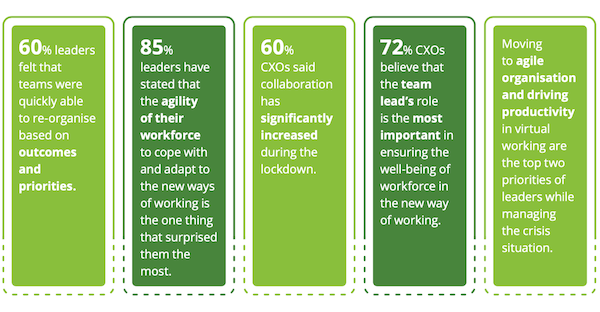
    Clearly, the lockdown has redefined the operating conditions for businesses in a short time, and has thrown up unexpected organisational challenges.

    Firstly, companies are having to juggle ideas to ensure employees’ health and safety, and also business continuity. The second challenge is to align the organisation to continuously- changing business priorities in the context of COVID-19. Thirdly, there is a need to navigate resources often and quickly respond to emerging market requirements.

    Yet another challenge involves exploring external collaborations to come up with innovative solutions to resolve issues at hand and also fill the gaps so that operational effectiveness is ensured within the organisation, post lifting of lockdown. Knowingly or unknowingly, most organisations seem to have become adaptable and are considering approaches to bring about agility and respond to the crises as the present one.

    Six lessons for organisations post-lockdown

    The new and altered organisational world has learned six important lessons  in how to respond to an emergency, such as a coronavirus outbreak.

    1. Purpose-driven organisations aim to inspire employees and external stakeholders to contribute and overcome the crisis situation.

    2. Unlike in the past, organisations have now learned to create small, diverse and flexible teams with varied capabilities to promote innovativeness and launch new products, services or approaches to serve customers.

    3. Companies are now realising the importance of empowering employees so that they function as owners and work to produce the desired outcomes. In other words, standard roles and boundaries are becoming redundant.

    4. Instead of hierarchical leaders, there will be leaders guiding teams across levels, encouraging everyone to take timely action, and leading the staff through challenging and uncertain times.

    5. Organisations will now use the open talent market to address skill shortage and acquire new skills to focus on the business priorities.

    6. More organisations will go beyond the traditional value chain to identify key stakeholders in the business ecosystem and engage with them to resolve issues collaboratively, share resources, and adopt innovative techniques.


    Deloitte new normal
    Share. LinkedIn Twitter Facebook WhatsApp
    HRK News Bureau

    Leave A Reply Cancel Reply

    Related Posts

    The workforce has stopped moving. That may not be good news for employers

    August 12, 2026

    Work is no longer a reliable route out of poverty

    August 5, 2026

    Just 8% of Indian firms have actually institutionalised people analytics

    July 29, 2026

    AI is not replacing workers. It is replacing the youngest ones first

    July 22, 2026
    zoha
    Editorial

    The certification that nobody questioned

    Every year, organisations spend considerable money and management time pursuing workplace certifications. Employees are surveyed,…

    Why every organisation eventually becomes the company it rewards

    There is a test that every employee in every organisation applies, usually without naming it.…

    EDITOR'S PICKS

    The one thing that helps employees settle into a new workplace

    August 14, 2026

    Rising Star: Sujata Phukan

    August 14, 2026

    Case-in-Point: The return to office exception

    August 13, 2026

    herSTORY: Manika Awasthi, Chief People Officer, Compass Group

    August 13, 2026
    Latest Post

    Vertex Group announces ‘Mega Hiring Month’ with 2,000 jobs in Delhi NCR & Bengaluru

    News August 14, 2026

    Marking India’s 80th Independence Day, Vertex Group has announced ‘Vertex Mega Hiring Month’ with plans…

    Air India to resume annual salary increments from October

    News August 14, 2026

    Air India will resume its annual salary revision cycle from October 1, after deferring increments…

    Dubai govt launches initiatives focused on employee wellbeing and flexible work

    News August 14, 2026

    Dubai’s Department of Government Human Resources (DGHR) has launched three initiatives aimed at strengthening employee…

    Vedanta taps young professionals to power India’s next-gen industries

    News August 14, 2026

    On International Youth Day, Vedanta Group underscored how India’s young workforce is reshaping resource-intensive industries…

    Asia's No.1 HR Platform

    Facebook X (Twitter) Instagram LinkedIn WhatsApp Bluesky
    • Our Story
    • Partner with us
    • Career
    • Reach Us
    • Exclusive Features
    • Cover Story
    • Editorial
    • Dive into the Future of Work: Download HRForecast 2024 Now!
    © 2026 HRKatha.com
    • Disclaimer
    • Refunds & Cancellation Policy
    • Terms of Service

    Type above and press Enter to search. Press Esc to cancel.