




Work from home’ or WFH may be the latest buzzword, but not every sector, or every company is prepared to manage this efficiently.
Overall preparedness

As per a report by KPMG, over 80 per cent of companies in IT/ITES, advisory, BFSI, are well prepared to manage work from home – companies from these sectors have rated their practices as highly mature or mature enough. Ninety per cent of the Global Capability Centres (GCC) are also well prepared for remote working, which implies that these organisations have the necessary infrastructure and practices to support work from home for their employees.
In sectors, such as media and education, the preparedness is between 70-80 per cent, and among PSUs, only 50 per cent of companies were prepared enough.
However, sectors such as hospitality, retail and consumer goods companies are least prepared for a WFH arrangement. About 80-50 per cent of companies in these sectors, are either still developing the WFH infrastructure or the same is totally non-existent.
Facilitating remote working
So how do these companies facilitate remote working for their employees? Most organisations have extended multifaceted support system to their employees to operationalise remote working. However, five per cent of the organisations still report no remote working practices or infrastructure.
Almost 89 per cent of companies claim to have provided laptops and desktops to their employees – 48 per cent with VPN and 41 per cent without VPN. The top three sectors that issued laptops, with secured internet connections, are BFSI, IT/ITES and GCC.
Usage of personal laptop with adequate security was found prevalent in PSUs as well as infrastructure and retail companies.
Almost 83 per cent companies claim to have provided either internet reimbursement or internet data card (mostly in consumer goods companies) to their employees for smooth remote functioning.
Onsite employees
It’s true that due to the nature of business, many companies or sectors, cannot work from home. They have to be on site for business continuity. In such cases, precautionary measures are quite important.
Unfortunately, 28 per cent of companies across sectors are not even providing the minimum precautionary measures, such as use of sanitisers. What is heartening is that a majority of the organisations are conducting temperature checks and frequent fumigations of office premises. A select few organisations are also conducting daily fumigation of company transport buses and providing dietary supplements, such as fruits, and vitamin C to employees to boost their immunity. They are also avoiding the usage of disposable cutlery in canteens to keep contamination at bay.
The KPMG report suggests that 37 per cent of companies are providing food and medical support to their onsite employees, and 33 per cent are providing transportation.
Engagement woes
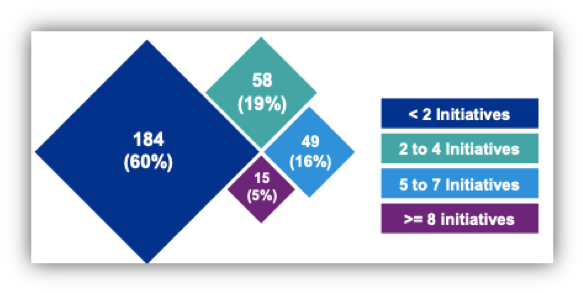
Irrespective of employees being onsite or remote, well-being is high on the agenda for most companies. As per the report, 90 per cent of the companies have at least one initiative around the well-being of their employees. About 21 per cent are quite proactive and have five or more initiatives to support employee well-being.
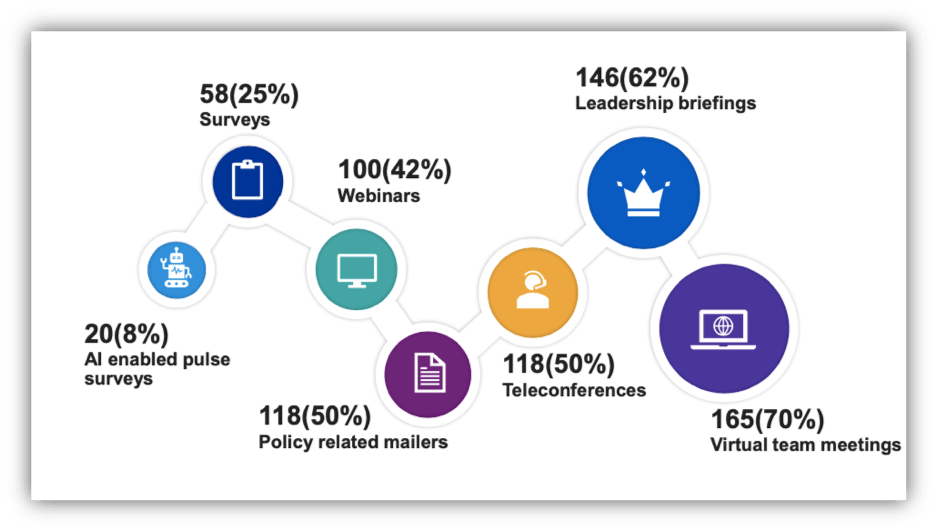
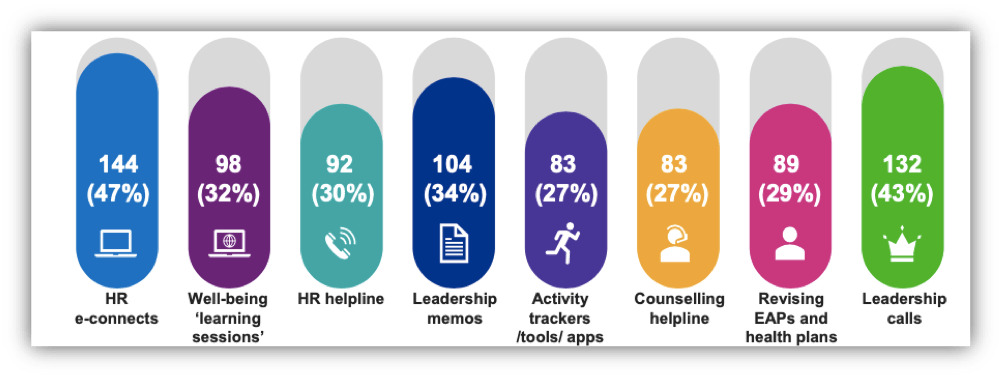
Among the several activities to engage employees, HR e-connects and leadership calls seem to be quite popular, and are being widely used by companies. About 47 per cent and 43 per cent of companies, respectively, claim to be following these practises.
Amongst the well-being learning sessions, virtual yoga or light exercise sessions for employees and their families seem to the latest chartbusters. About 13 per cent of the firms have even gone ahead to organise ‘Virtual 5K Runs’ for their overseas workforce. Wellness radio talk shows, another innovative practice, has been adopted by 16 per cent of the organisations.
Compensation & Benefits
As per the report, 50 per cent of the companies have deferred or suspended their planned increment cycle across levels and more than 40 per cent organisations in advisory, automobile, education, energy, oil and gas sectors have opted to defer the increment cycle. However, senior management-level employees are impacted the most vis-à-vis other levels, with maximum incentive cuts being seen at executive and senior-leadership level.
Most organisations in IT/ITES, life sciences/pharma and retail sector have refrained from any downwards trend in the overall promotion cycle.
While 50 per cent organisations across industries are keeping their salary increment budgets unchanged, around 36 per cent organisations have opted to decrease the salary increment budgets. Proportion of organisations reporting a downward revision of increment budget is higher at middle and senior management levels vis-à-vis junior and non-management levels
Around 80 per cent of the respondent organisations across industries have not changed the health insurance benefits offered to employees. With the health of employees being the focus for all organisations, a positive trend has been observed in some sectors, such as advisory (29 per cent), consumer goods (30 per cent), and so on, who have reported an upward revision of health insurance entitlements across management and non-management level.
Around 70 per cent of the organisations across levels have reported no change in the planned impact on fixed pay at the non-management and junior-management level. Approx. 50 per cent of the organisations are either looking at keeping the sales incentives unchanged or considering a downward revision across levels.
A large proportion of organisations, around 80 per cent, have not changed the leave policies offered to the employees.
If the COVID-19 situation persists, around 22 per cent of the organisations may defer, freeze or suspend incentive payouts to support their overall finances.
