



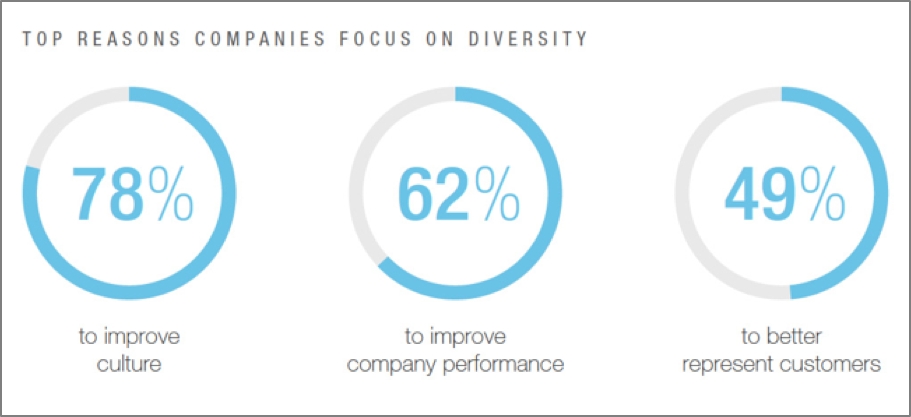
Across the globe, 78 per cent companies prioritise diversity to improve company culture, 62 per cent do so to boost financial performance and 49 per cent to better represent customers.
Four mega trends are expected to shape the future of hiring and recruitment in 2018—diversity, new interviewing tools, data, and artificial intelligence—in order of importance. These factors will play an important role in shaping the way job seekers find jobs, get hired, and stay engaged at work this year.

Globally, around 78 per cent of respondents of Global Recruiting Trends 2018 by LinkedIn, have voted for diversity as the top trend that will affect how they hire in 2018. In India, the share is even higher—81 per cent of talent acquisition leaders and hiring managers in the country are of the opinion that diversity will top their recruitment agenda this year.
There is growing evidence that diversity, along with inclusion and belonging, enhances productivity and also promotes innovation and higher engagement.
So what makes diversity so important?
Across the globe, 78 per cent companies prioritise diversity to improve company culture, while 62 per cent do so to boost financial performance and 49 per cent to better represent customers.
Companies also agree that diversity is a biggest pain point for them when it comes to hiring. Despite all the buzz around a diverse team, most companies still fall short of their goals and the public’s expectations and there are reasons for the same.
Hiring managers (around 38 per cent) accept that they are unable to find diverse candidates for interview, while 27 per cent opined that retaining diverse employees is a challenge. Around 14 per cent admit their inability to take diverse candidates beyond the interview stage and even if they manage to cross this level, eight per cent of the respondents feel they do not get enough diverse talent to accept the offer.

Citi, for example, has implemented such assessments for its campus recruitment programme, leading to more diverse candidates and a better understanding of their talents.
The report suggests that organisations are putting an end to the transactional and tedious traditional recruitment processes. Instead, they are focussing on using strategic methods with a human touch to find high-potential talent.
According to the study, 61 per cent Indian respondents—as compared to the global average of 56 per cent—believe that interviewing innovations are extremely important to the future of hiring.
Talent leaders find interviewer bias and limited ability to assess soft skills and weaknesses as the biggest drawbacks of traditional interviews.
Hiring managers are nowadays focussing more on smarter interview models. Soft skills assessments, job auditions, meeting in casual settings, virtual reality assessments and video interviews are considered the most useful interview innovations.
Online soft-skills assessments have the ability to measure traits, such as teamwork and curiosity, and give a more holistic picture of candidates earlier in the process. Citi, for example, has implemented such assessments for its campus recruitment programme, leading to more diverse candidates and a better understanding of their talents.

The CEO of Charles Schwab takes candidates to lunch and asks for the restaurant to mess up their orders on purpose. He is able to judge the candidates’ character depending on their reactions to the situation.
Similarly, job auditions are another upcoming trend wherein companies pay candidates to do real work so that they can observe skills in action. Citadel designed day-long job auditions in which about 100 students competed for cash by solving real business problems with data.
Casual interviews typically take place over a meal and can offer a unique look into a candidate’s character. The CEO of Charles Schwab takes candidates to lunch and asks for the restaurant to mess up their orders on purpose. He is able to judge the candidates’ character depending on their reactions to the situation.
In the virtual reality (VR) method, companies immerse candidates in simulated 3-D environments to test their skills in a standardised way. Lloyds Banking Group has been a front runner in this aspect and has seen great results in terms of reducing bias and engaging candidates.
KPMG Australia has been organising video interviews for its entry-level hires and seen increased efficiency.
Again, the study suggests that 64 per cent of the talent acquisition professionals use data now, and 79 per cent are even more likely to use it in the next two years. In the present scenario, data is mostly used in talent acquisition to increase retention, evaluate skills gap, build better offers, understand candidate wants, and perform workforce planning. However, what is hindering the usage of data in talent acquisition is poor data quality and figuring out where to find the data.
KPMG Australia has been organising video interviews for its entry-level hires and seen increased efficiency.
Artificial Intelligence (AI) emerged strong with 76 per cent respondents saying that its impact on recruitment will be significant and will help them work faster—by automating administrative tasks— and smarter by generating insights they wouldn’t otherwise receive on their own. The areas where AI will impact recruitment processes the most include sourcing, screening candidates and nurturing of candidates.
“Workplaces are evolving faster than ever before, and we are seeing new jobs and skill sets emerging in India. Therefore, the Indian recruiter too will undergo a transformation and use new tools to assess high-potential talent. Diversity will be the key to how people hire this year, and a strong assessment of soft skills, such as leadership and communication, along with digital skills will be imperative. To arrive at the right choice, companies in India are now using data, analytics and insights to make better decisions,” said Irfan Abdulla, director of talent and learning solutions, LinkedIn India & South Asia, in an official communiqué.
For the Global Recruiting Trends 2018 report, LinkedIn reached out to around 9000 recruiters and hiring managers, from 39 countries. It also interviewed industry experts to analyse the state of recruitment across the world.
1 Comment
Behaviourally trained process interviews can get a direct feel of the candidate and the judgment, rather than mechanised processes like psychometrics etc again not fully reliable ownig to the relevance of the constructs, cultural bias, focus on elimination before meeting the person, focus on weaknesses and d-efocus on harnessing the talent of the individual, while answers to psychometrics could be faked and there are lots of coaching centres giving psychometric training to candidates who could be at an advantage compared to candidates without opportunity of such coaching.
While psychometrics could be harnessed usefully keeping above biases in view, not derailing talent selection, while there is talent crunch.
best regards,
kshantaram