



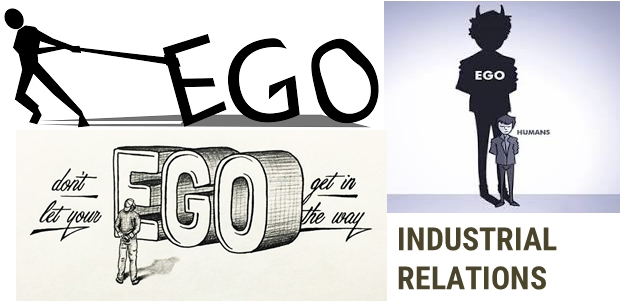
The personal ego state of the stakeholder individuals can make or mar the desired industrial relations.
When Sigmund Freud was scratching his head on ‘id, ego and super-ego’, we were allowing our baby ‘egos’ to inflate, adventurous and abused left and right. There are very few people who consciously venture to tame their egos around standard deviations. A majority go unbridled towards provocations and depressions for high mindedness to lowness.

Industrial relation is, broadly, a game of ‘ego’ puzzle between the opinion makers and managers. Eric Berne hypothesised three ego states as Parent, Adult and Child. The Child, as source of emotions, creation, recreation, spontaneity and intimacy, is a state in which people prefer to feel, think and behave like they did in childhood. The Parent ego is a dominating state in which people feel, think and behave the way they experienced and interpreted their parent’s actions. However, a person in the Adult ego state is focused towards an objective appraisal of reality.
Though these ego states do not correspond directly to Sigmund Freud’s ‘ego, superego, and id’, there may be obvious parallels: Superego=Parent; Ego=Adult; Id=Child. Ego states are more observable and consistent for each person, because the ego state from which someone is communicating, is evident in his behaviour, manner and expression.
At any given time, a person experiences and manifests his or her personality through a mixture of behaviours, thoughts and feelings. There are four psychological positions that a person can hold, that have profound implications for how an individual operationalises his life. These are:
1. Feel good. ‘I am OK and you are OK’. Positive relationship orientation.
2. Superiority complex. ‘I am OK and you are not OK’. Bullishness.
3. Inferiority complex. ‘I am not OK and you are OK’. Accepts abuse.
4. Hopelessness. ‘I am not OK and you are not OK’. Pessimism.
Susan Forward, a psychotherapist, coined the term ‘Emotional blackmail’, about controlling people in relationships through fear, obligation and guilt (FOG), to do things that are uncomfortable, undesirable, burdensome or self-sacrificing for others. She, along with Frazier, identified four blackmail or mental manipulation types.
Punisher: Do it or I will hurt you.
Self-Punisher: Do it or I will hurt myself.
Sufferer: Do it otherwise I will suffer.
Tantalizer: Do it, you will enjoy.
Let us assimilate the above coexisting concepts in an IR perspective. When a worker or union and the manager or IR manager negotiate with each other on an issue, the instant personal hypotheses of these individuals drive and define the level of discussion. One can make out whether it is a win-win negotiation, a win-lose, a lose-win or a lose-lose one. This situation has another inclusive dimension — whether it is a short term or a long term solution, considering the duration of impact.
As I have experienced, there is no ‘short term’ impact for any solution to an issue, whether of short term or long term. Every solution to a problem creates a history to be quoted by the beneficiaries in future. Moreover, an overlooked concern can flare-up at any appropriate time to come. When Gandhiji was thrown out of the first class compartment of that train in South Africa, nobody, including the ticket collector or Mr. Gandhi himself, could have visualised the impact of this episode on the history of the British Empire.
Similarly, the personal ego states of the manager and the leader are responsible to make or mar the desired industrial relations.
If both are ‘feel good’ and ‘child’ the FOG may not be evident, because both will understand and genuinely consider the needs and limitations of each other. They will handle their industrial relations with natural spontaneity. They may be cool managers, but not preventive. Eventually they may ignore ‘punishers’ and ‘sufferers’ living in the system who may collaborate and conspire with cynic ‘tantalizers’ in due course of time to upset the IR situation.
When TISCO was being built at Jamshedpur, the Tatas had executed unparalleled welfare plans for the employees. They created a lot of good work practices, some of which became the foundation for labour laws in India. After the World War when the market suffered and TISCO was not able to pay wages to the employees, Mr. Tata staked his personal property including household jewellery to pay the wages. However, TISCO still had to face several labour unrests in its IR history.
With their ‘parental’ superiority complex the ‘punishers’ at both ends drive the IR towards a point of no-return. If these individuals are not sacrificed or replaced in the process, organisational collapse will engulf all inspirations. A similar fate is destined if both are ‘hopeless’ ‘self-punishers’ through their ‘inferiority complexes’. ‘Sufferers’ at least are comparatively better for managing an immediate situation. But, this ungraceful mind becomes futile in the long run.
Thus, the preventive solution for better IR is to have a corroborative allocation between rights and responsibilities with an alive, introspecting mechanism. The ‘adult’ ‘tantalizers’ can give progressive environment with ‘feel good’ approach.
Better IR is not only a product of better negotiation, meticulous administration, or caring schemes. It needs better intensions and unbiased behavioural skills. Around the mid-90s I worked for a company in Greater NOIDA. From an IR point of view this factory was so turbulent that even during my selection interview at an outside location, the president of the company told me that if needed, I could close the plant for some time to correct the IR situation. I told him, ‘Sir, if I join, I will come to run the plant, not to close it’. Then he suggested I visit the plant before accepting the appointment letter.
The IR of this plant was a nightmare. For years, no HR head had stayed there, and those who did were mostly beaten up. There were two unions, protected by external political leaders and local goons, who took to regular fist fighting. All contracts were given to their people. Abusive language was a part of their usual communication, even during scheduled meetings. Staff and executives often begged them for peace. It took almost one year of struggle to bring the IR to a comfortable level.
We generally fail in IR administration because we fail in defining and executing the rule of games in a fair manner. Once you deviate from the rule, the deviation becomes the rule, because the ego of a defiant person finds its way to satisfy its inflation. Since there cannot be sacrosanct rules, there must be rules to define and settle the deviations before new executions.
My single approach that got the neck of the problem was to fix the rule mutually and uphold it firmly. To do this, sometimes I had to single out an opinion maker from the other side, make him understand the situation, take his silent consent to go ahead. I never practiced or allowed decisions to be taken ad hoc. Once people are looped in to define the rule of game, they can be brought to follow it. Sometimes I had to take a risk and hold the decision till a guiding principle for future course of action was concluded. We brought systemic order and peace in the plant within a year just because we never allowed deviation from the concluded rules, unless it was amended with the same process.
As IR administrators, we must be genuine, logical and assertive, and accept responsibility. Avoidance and compromises are rolling snow-balls that keep increasing mass to create and cause destructions. Our own egos should not come into play while dealing with people and deciding the issues. Most of us miss out on opportunities, or fail to handle a situation, or cause the situation to aggravate, just because of our own egocentric tempers.
Finally, we need to take a call on suitable ego states to manage success in IR. Managing IR is nothing but managing the self through all weathers; everything else ends up coordinated at its natural pace.
(The author is plant HR head, Hero Motocorp)

6 Comments
Dear Mr Singh
Very intense and thought provoking article. The personal ego state can not only make or mar the relationship in IR scenario but every relation in life is touched by it. It may influence the beautiful relationship between two colleagues and friends where position and status start playing more important role than the real bonding they shared in the past.
In fact every relation in every walk of life can be affected by the personal ego.
Thanks and Warm regards
Capt MCS Bhakuni (Mob 9350578051)
Head Employee Relations L&T
Mumbai
Very nice article with adeep insight…thought provoking one…
Thanks & regards,
Bhavansingh Chavda
Human Resources
OPaL, Gujarat
Dear Sir,
Thank you for sharing your experiences and Knowledge. Article has practical solutions for IR problems.
Interesting Artical
Very much thanking you sir for your insightful explanation of psychological aspects impact on industrial relations
Dear Sir,
Very Insightful article.. Food for my thoughts pertaining to personal & professional life… very well blended the psychological concepts to our professional life…