


Close Menu
    Facebook X (Twitter) Instagram
    • Our Story
    • Partner with us
    • Reach Us
    • Career
    Subscribe Newsletter
    HR KathaHR Katha
    • Exclusive
      • Exclusive Features
      • Perspectives
      • Friday Features
      • herSTORY
      • Case-In-Point
      • Point Of View
      • Research
      • HR Pops
      • Dialogue
      • Movement
      • Profile
      • Beyond Work
      • Rising Star
      • By Invitation
    • News
      • Global HR News
      • Compensation & Benefits
      • Diversity
      • Events
      • Gen Y
      • Hiring & Firing
      • HR & Labour Laws
      • Learning & Development
      • Merger & Acquisition
      • Performance Management & Productivity
      • Talent Management
      • Tools & Technology
      • Work-Life Balance
    • Special
      • HR Forecast 2026
      • Cover Story
      • Editorial
      • HR Forecast 2024
      • HR Forecast 2023
      • HR Forecast 2022
      • HR Forecast 2021
      • HR Forecast 2020
      • HR Forecast 2019
      • New Age Learning
      • Coaching and Training
      • Learn-Engage-Transform
    • Magazine
    • Reports
      • Whitepaper
        • HR Forecast 2024 e-mag
        • Future-proofing Manufacturing Through Digital Transformation
        • Employee Healthcare & Wellness Benefits: A Guide for Indian MSMEs
        • Build a Future Ready Organisation For The Road Ahead
        • Employee Experience Strategy
        • HRKatha 2019 Forecast
        • Decoding and Driving Employee Engagement
        • One Platform, Infinite Possibilities
      • Survey Reports
        • Happiness at Work
        • Upskilling for Jobs of the Future
        • The Labour Code 2020
    • Conferences
      • Leadership Summit 2025
      • Rising Star Leadership Awards
      • HRKatha Futurecast
      • Automation.NXT
      • The Great HR Debate
    • HR Jobs
    WhatsApp LinkedIn X (Twitter) Facebook Instagram
    HR KathaHR Katha
    Home»Special»Editorial»The early morning email
    Editorial

    The early morning email

    When 30,000 exits are communicated at scale, the method says more about corporate integrity than the decision itself
    mmBy Dr. Prajjal Saha | HRKathaApril 6, 20264 Mins Read267 Views
    Share LinkedIn Twitter Facebook WhatsApp
    Share
    LinkedIn Twitter Facebook WhatsApp

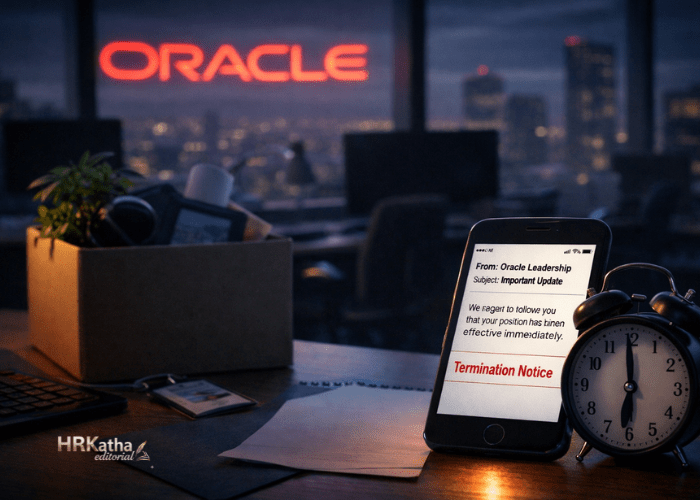
    On Tuesday morning, March 31st, 2026, approximately 30,000 employees of Oracle across the United States, India, Canada and Mexico woke up to an email from “Oracle Leadership”.

    The message was brief.

    zoha

    “After careful consideration of Oracle’s current business needs, we have made the decision to eliminate your role as part of a broader organisational change. As a result, today is your last working day.”

    No advance notice. No conversation with managers. No call from HR. Just an email that arrived at 6 a.m., followed almost immediately by system lockouts that prevented employees from accessing their files, emails or colleagues.

    The reaction, across employee forums and professional networks, was not just about job loss. It was about how it happened.

    This is not, at its core, a story about whether layoffs are justified. Companies restructure, priorities shift and technologies evolve. Even profitable organisations make deliberate choices about capital allocation and workforce composition. Oracle is not a company under existential strain. In fiscal year 2025, it reported net income of $12.4 billion, and in the quarter ending February 2026, roughly $4.6 billion. The decision to rebalance its workforce may therefore be strategic, even necessary.

    What merits closer scrutiny is not the decision itself, but the manner in which it is executed.

    There is a way to conduct large-scale workforce reductions that acknowledges contribution and treats exit with the seriousness it deserves. It requires managers to speak directly with the people they are letting go. It requires severance that reflects tenure, transition support that is real, and the time to leave with some sense of closure. It requires treating people on the way out with the same care organisations display when they are trying to attract them.

    zoha

    None of this is costless. But for a company generating billions in profit, it is clearly affordable.

    The decision to communicate termination to 30,000 people through a mass email sent before sunrise is therefore not a constraint. It is a choice.

    That choice reflects a broader pattern that has become normalised across corporate environments. Large-scale layoffs are now routinely executed through impersonal mechanisms—emails, automated notifications, immediate system lockouts—designed for efficiency and legal clarity rather than human consideration.

    The logic is easy to understand. Speed reduces uncertainty. Standardisation reduces risk. Minimal interaction limits liability. From an operational standpoint, the process is efficient.

    From a human standpoint, it is dehumanising.

    Corporate language continues to insist that people are an organisation’s greatest asset. The claim appears in annual reports, recruitment campaigns and leadership speeches. But such assertions are tested not in moments of growth, but in moments of separation.

    How an organisation treats people when it no longer needs them reveals more about its values than how it treats them when it does.

    An employee may have spent decades contributing to a company—building systems, managing teams, delivering results, often at personal cost. The end of that relationship cannot always be avoided. But the manner of its ending remains within the organisation’s control.

    A 6 a.m. email followed by immediate disconnection communicates something very specific. It suggests that the relationship was purely transactional. That contribution was conditional. That once the condition no longer holds, the exit requires no more than notification.

    It is difficult to reconcile that message with the idea of people as assets of enduring value.

    The uncomfortable reality is that such practices persist not because they are necessary, but because they are accepted. Markets reward decisiveness. Organisations optimise for efficiency. Legal considerations shape process design. Over time, these factors combine to create a standard that prioritises execution over experience.

    And because it is widespread, it no longer surprises.

    That may be the more significant issue. Not that one company chose this approach, but that it no longer stands out.

    Corporate integrity is not defined by whether difficult decisions are made. It is defined by how those decisions are carried out. The choice is not between restructuring and compassion. It is between executing necessity with care, or without it.

    Thirty thousand people woke up to an email that ended their employment.

    That was not inevitable. It was designed.

    And design, in organisations, is always a reflection of priority.

    AI layoffs corporate ethics corporate governance corporate layoffs employee exits Employee Experience Future of work HR leadership HR strategy LEAD Leadership Accountability Oracle layoffs Organisational Culture People management workforce restructuring workplace dignity
    Share. LinkedIn Twitter Facebook WhatsApp
    mm
    Dr. Prajjal Saha | HRKatha

    Dr. Prajjal Saha is a business journalist and the editor-publisher of HRKatha. He writes on the realities of work and organisations, offering a clear-eyed view of how companies translate intent into action—often revealing the gap between the two. With over 25 years of experience, he focuses on interpreting workplace trends and leadership decisions in a way that is both insightful and accessible. He founded HRKatha in 2015 to create a platform for credible, insight-driven analysis of the evolving workplace.

    Leave A Reply Cancel Reply

    Related Posts

    SEGULA Technologies elevates Praveen Ambrose to CHRO

    April 6, 2026

    POV: Should DEI strategies be standardised globally or tailored to local contexts?

    April 6, 2026

    Krishna Kumar Singh takes additional charge as CMD of SAIL

    April 3, 2026

    The unspoken office hierarchy everyone understands but nobody admits

    April 3, 2026
    Editorial

    The early morning email

    On Tuesday morning, March 31st, 2026, approximately 30,000 employees of Oracle across the United States,…

    The certainty tax: Why uncertainty makes bad decisions inevitable

    The conflict in West Asia has introduced real uncertainty into global markets. Oil supply routes…

    EDITOR'S PICKS

    The early morning email

    April 6, 2026

    POV: Should DEI strategies be standardised globally or tailored to local contexts?

    April 6, 2026

    The unspoken office hierarchy everyone understands but nobody admits

    April 3, 2026

    HRForecast 2026: Wisdom, not knowledge, will define the workforce – Ruhie Pande, Group CHRO & CMO, Serentica, Resonia and Sterlite Electric

    April 2, 2026
    Latest Post

    SEGULA Technologies elevates Praveen Ambrose to CHRO

    Movement April 6, 2026

    SEGULA Technologies has elevated Praveen Ambrose to chief human resources officer (CHRO). Ambrose has been…

    The early morning email

    Editorial April 6, 2026

    On Tuesday morning, March 31st, 2026, approximately 30,000 employees of Oracle across the United States,…

    Fairness outweighs compassion in public jobs: SC

    IR & Labour Laws April 6, 2026

    The Supreme Court has made it clear that public employment cannot allow exceptions based on…

    POV: Should DEI strategies be standardised globally or tailored to local contexts?

    Point Of View April 6, 2026

    In the race to build truly inclusive workplaces, global organisations often face a quiet but…

    Asia's No.1 HR Platform

    Facebook X (Twitter) Instagram LinkedIn WhatsApp Bluesky
    • Our Story
    • Partner with us
    • Career
    • Reach Us
    • Exclusive Features
    • Cover Story
    • Editorial
    • Dive into the Future of Work: Download HRForecast 2024 Now!
    © 2026 HRKatha.com
    • Disclaimer
    • Refunds & Cancellation Policy
    • Terms of Service

    Type above and press Enter to search. Press Esc to cancel.