


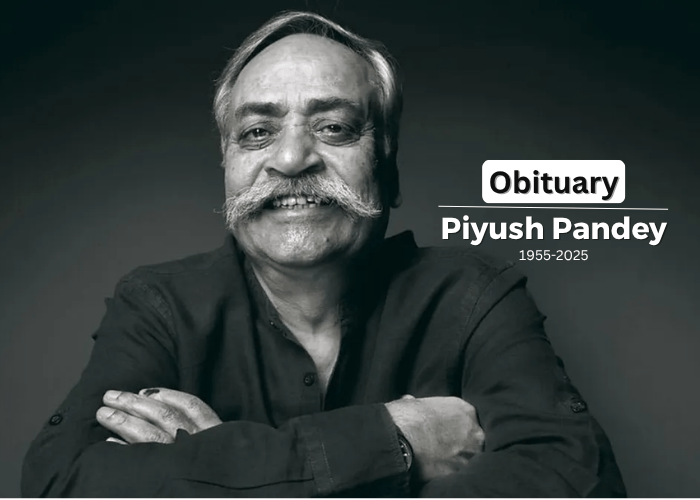
As a journalist covering the advertising industry, I knew Piyush Pandey’s reputation long before I met him. Everyone did. His name carried an unseen aura—the man who transformed Indian advertising, whose campaigns became cultural phenomena. When you’re about to interview someone of that stature, you brace for ego, distance, the carefully managed persona that usually accompanies industry legends.
Then you’d meet him, and the aura would dissolve into something far more interesting: a man genuinely surprised by his own legend, who spoke about work as though he were still figuring it out, who was closer to people than his reputation suggested possible. This wasn’t practiced humility—it was something rarer in creative industries, where brilliance often breeds remoteness.
When Piyush Pandey left for a better world on October 23, 2025, at 70, tributes poured in celebrating his advertising genius—the Fevicol ads, Cadbury commercials, Asian Paints campaigns that defined Indian advertising. Yet amidst the nostalgia for memorable campaigns, a more profound legacy risked being overlooked.
That disconnect between aura and accessibility wasn’t a personality quirk. It was a leadership philosophy that systematically created other leaders without the insecurity that typically afflicts creative fields.
The approachability strategy
Creative industries face a peculiar challenge: success depends on individual brilliance, creating powerful incentives for distance and mystique. When a single person’s vision drives value, maintaining aura becomes strategic—it justifies outsized compensation and discourages challenges from subordinates.
Pandey rejected this entirely. Despite being one of India’s most celebrated advertising minds, he remained remarkably accessible. That accessibility had profound consequences. When leaders maintain distance, mentorship becomes transactional—formal programmes, scheduled reviews, measured interactions. When leaders are genuinely approachable, development becomes organic. Young creatives could test ideas, challenge thinking, and learn through proximity.
More importantly, accessibility signals confidence. Leaders who maintain aura suggest they have something to protect. Leaders who remain grounded signal they believe their value lies not in scarcity but in multiplication. Pandey’s approachability announced that what he knew wasn’t a secret to be guarded but knowledge to be shared.
For organisations, this matters enormously. Most leadership development programmes fail not because of poor curriculum but because senior leaders remain fundamentally inaccessible—protected by hierarchy, consumed by “strategic” work, available only through formal channels. Development requires proximity, which requires leaders secure enough to provide it.
The ecosystem builder
Under Pandey’s leadership, Ogilvy India became what industry insiders recognised as a “talent factory”—developing creative leaders who went on to lead rival agencies. When talented juniors left for competing firms, Pandey’s response wasn’t resentment but continued support. He maintained relationships, celebrated their successes, and remained genuinely invested in their careers—even as they competed against him.
The strategic logic becomes clear over time. By developing talent that improved the entire advertising ecosystem rather than just Ogilvy, Pandey created something more valuable than retention—reputation as the industry’s premier training ground. Rivals might poach individuals, but they couldn’t replicate the development infrastructure.
During my interactions with advertising professionals over the years, a pattern emerged. Pandey’s name surfaced repeatedly—not as a distant figurehead but as someone who fundamentally shaped how they approached work. Remarkably, this included people who’d never worked directly at Ogilvy but had learned from those who had.
This multiplication effect distinguishes transformational leaders from merely successful ones. Pandey didn’t just develop talented individuals—he developed people who developed others. Today’s Indian advertising landscape is populated by professionals who trace their creative lineage to Pandey, many now leading firms that compete with Ogilvy. This wasn’t failure—it was the entire point.
Pandey understood something most organisations miss: talent insecurity is self-fulfilling. Organisations that hoard capabilities announce their irrelevance. Those that develop leaders systematically—even knowing some will leave—build sustainable advantages that transcend individual retention.
The authenticity imperative
The gap between Pandey’s industry reputation and his personal groundedness reflected genuine values rather than calculated positioning. He famously described himself as part of a team: “A Brian Lara can’t win for the West Indies alone. Then who am I?” This wasn’t false modesty but actual belief that collective capability matters more than individual brilliance.
When leaders truly believe this—not merely profess it—their talent development becomes transformational rather than transactional. Modern organisations struggle because incentive structures reward individual achievement over collective capability building. Leaders get promoted for personal results, not subordinate development. Performance reviews assess what you accomplished, not whom you developed.
Pandey’s career demonstrates that developing others need not conflict with personal success—but only when organisational cultures genuinely support this alignment. His apparent discomfort with his own legend—despite Padma Shri, Cannes Lions, every industry award—wasn’t practiced humility but genuine disinterest in personal mythology.
This matters because leader worship undermines leadership development. When organisations venerate individual brilliance, they discourage distributed capability. Success becomes attributed to special individuals rather than replicable approaches. By maintaining groundedness despite his reputation, Pandey demonstrated that excellence needn’t require distance—that great work comes from dedication and craft rather than innate genius accessible only to the chosen few.
The confidence question
The advertising industry’s reaction to Pandey’s passing revealed his ultimate impact. Competitors, former colleagues, and professionals who never worked directly with him expressed genuine loss—not perfunctory tributes but authentic grief for someone who shaped their careers. This response reflected what he had built over decades—not a personal empire but a professional community where his juniors joined rival agencies not as defectors but as ambassadors carrying forward a shared philosophy.
This approach requires confidence most organisations lack. It demands believing that developing remarkable people creates sustainable advantages even when those people leave. It requires trusting that reputation as a talent factory attracts more value than retention creates. Most fundamentally, it needs leaders secure enough to celebrate others’ success without feeling diminished.
The test of leadership isn’t whether talented people surround you—it’s whether they thrive after leaving you. Do they credit your influence? Do they replicate your development approach? Do they build ecosystems or empires?
For organisations genuinely committed to leadership development, Pandey’s career offers uncomfortable challenges. Are you developing people who could lead rival firms? Do you celebrate subordinates’ external opportunities? Can you build reputation as an industry’s talent engine?
These questions provoke anxiety because honest answers reveal how far current practices deviate from genuine development. It’s easier to establish formal programmes than embrace the fundamental confidence required to develop people who might leave. But the alternative isn’t security—it’s irrelevance.
As someone who observed Pandey from the journalist’s vantage point—watching the gap between legendary status and grounded reality—the lesson seems clear. During my interactions with various advertising professionals over the years, a pattern emerged. When people discussed their careers, Pandey’s name surfaced repeatedly—not as a distant figurehead but as someone who fundamentally shaped how they approached their work.
Leadership that creates leaders doesn’t require aura or distance. It requires confidence, authenticity, and genuine belief that developing others creates value that transcends organisational boundaries.
India’s advertising community won’t replace Piyush Pandey. But the leaders he developed will develop others, who will develop still more. That’s what leadership development looks like when taken seriously rather than merely processed through corporate programmes.
The question for every organisation is whether it possesses the confidence and commitment to build similar legacies—or whether talent development remains comfortable rhetoric disconnected from uncomfortable practice.