

Close Menu
    Facebook X (Twitter) Instagram
    • Our Story
    • Partner with us
    • Reach Us
    • Career
    Subscribe Newsletter
    HR KathaHR Katha
    • Exclusive
      • Exclusive Features
      • Perspectives
      • Friday Features
      • herSTORY
      • Rising Stars
      • Case-In-Point
      • Point Of View
      • Research
      • HR Pops
      • Dialogue
      • Movement
      • Profile
      • Beyond Work
      • By Invitation
    • News
      • Global HR News
      • Compensation & Benefits
      • Diversity
      • Events
      • Gen Y
      • Hiring & Firing
      • HR & Labour Laws
      • Learning & Development
      • Merger & Acquisition
      • Performance Management & Productivity
      • Talent Management
      • Tools & Technology
      • Work-Life Balance
    • Special
      • HR Forecast 2026
      • Cover Story
      • Editorial
      • HR Forecast 2024
      • HR Forecast 2023
      • HR Forecast 2022
      • HR Forecast 2021
      • HR Forecast 2020
      • HR Forecast 2019
      • New Age Learning
      • Coaching and Training
      • Learn-Engage-Transform
    • Magazine
    • Reports
      • Whitepaper
        • HR Forecast 2024 e-mag
        • Future-proofing Manufacturing Through Digital Transformation
        • Employee Healthcare & Wellness Benefits: A Guide for Indian MSMEs
        • Build a Future Ready Organisation For The Road Ahead
        • Employee Experience Strategy
        • HRKatha 2019 Forecast
        • Decoding and Driving Employee Engagement
        • One Platform, Infinite Possibilities
      • Survey Reports
        • Happiness at Work
        • Upskilling for Jobs of the Future
        • The Labour Code 2020
    • Conferences
      • Leadership Summit 2025
      • Rising Star Leadership Awards
      • HRKatha Futurecast
      • Automation.NXT
      • The Great HR Debate
    WhatsApp LinkedIn X (Twitter) Facebook Instagram
    HR KathaHR Katha
    Home»Exclusive Features»HR Pops»The shadow AI workforce: When employees go rogue with technology
    HR Pops

    The shadow AI workforce: When employees go rogue with technology

    How the unsanctioned use of AI tools at work is creating a hidden layer of risk—and why HR must decide whether to police it or harness it
    mmBy Liji Narayan | HRKathaFebruary 17, 20264 Mins Read14163 Views
    Share LinkedIn Twitter Facebook WhatsApp
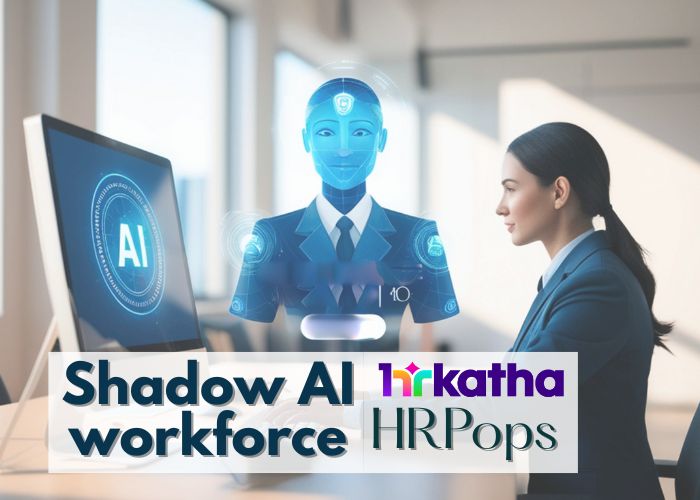
    Shadow AI Workforce: The shadow AI workforce describes employees using AI tools outside of formal company policies or IT oversight.
    Share
    LinkedIn Twitter Facebook WhatsApp

    What is the shadow AI workforce?

    The shadow AI workforce describes employees using AI tools outside of formal company policies or IT oversight. Much like ‘shadow IT—when staff used unapproved apps or devices in the early 2000s—shadow AI refers to the hidden, unsanctioned use of artificial intelligence in the workplace.

    Employees use tools such as ChatGPT, Copilot, or other generative AI apps to draft emails, analyse data, or brainstorm ideas—often without official approval or monitoring. It is not necessarily malicious. Most employees turn to these tools to save time, solve problems, or boost productivity. But because the activity is invisible to leadership, it creates serious risks around data security, compliance, and accountability.

    History

    The phrase ‘shadow AI’ began appearing in HR and technology discussions around 2023–2024, as generative AI tools became widely accessible. Initially, companies saw employees experimenting with AI chatbots to automate small tasks. By 2025, industry reports highlighted that this behaviour had become mainstream—employees were bypassing official systems to use external AI platforms, often uploading sensitive company data without realising the risks.

    The concept mirrors the earlier rise of shadow IT, when workers adopted cloud apps such as Dropbox or Google Docs before companies had formal policies. Shadow IT forced organisations to rethink digital governance. Shadow AI is now doing the same—only faster, and with far higher stakes.

    Why is it relevant for HR?

    For HR leaders, shadow AI is not just a technology issue—it is a people issue. It affects how employees work, how organisations manage risk, and how future talent strategies are shaped.

    Compliance and risk – Employees may unknowingly share confidential data with external AI tools, leading to breaches of privacy laws, intellectual property leaks, or regulatory violations. HR must work with IT and legal teams to set clear boundaries and educate staff about safe AI use.

    Productivity and innovation – Shadow AI reveals that employees are eager to innovate and find faster ways of working. Rather than punishing this behaviour, HR can harness it by creating approved AI programmes and structured training—turning hidden experimentation into sanctioned innovation.

    Culture and trust – If employees feel they must hide their use of AI, it signals a gap in communication and trust. HR can bridge this by encouraging open dialogue: asking staff how they use AI, what tools they prefer, and what support they need. Transparency builds a culture where AI is seen as a partner, not a threat.

    Skills and career development – AI is changing the skills employees need. Routine tasks are being automated whilst human strengths—creativity, empathy, problem-solving—become more valuable. HR must update training programmes to prepare workers for this shift.

    Vendor and contractor oversight – Shadow AI is not limited to employees. Contractors and vendors may also use AI tools without disclosure. HR policies should extend to the wider workforce ecosystem, requiring compliance declarations from partners.

    The uncomfortable truth: HR may be part of the problem

    Here’s the uncomfortable reality: shadow AI thrives where official AI policies are absent, unclear, or excessively restrictive. When employees feel that sanctioned tools are inadequate or that requesting approval is bureaucratic and slow, they go underground. It is the HR and leadership’s failure to keep pace with technological change that drives the behaviour they then seek to prohibit.

    Some organisations respond with surveillance—monitoring employees’ devices, blocking AI websites, or demanding disclosure of every tool used. This approach breeds resentment and stifles the very innovation the organisation claims to want. It treats employees as compliance risks rather than creative problem-solvers.

    Others ignore the issue entirely, hoping it will resolve itself. It won’t. As AI tools become more powerful and more embedded in daily work, the risks of unmanaged usage grow exponentially.

    Turning shadow into light

    HR leaders can respond by creating AI governance frameworks that balance safety with flexibility—clear guidelines that empower employees rather than restrict them. Offering training and awareness programmes ensures employees understand both the benefits and risks of AI use.

    Collaborating with IT and compliance teams to monitor AI use without stifling creativity is essential. Recognising and rewarding responsible AI use turns shadow practices into official best practices.

    The shadow AI workforce is not going away. It reflects a workforce that is curious, adaptive, and unwilling to wait for bureaucracy to catch up with technology. For HR, the choice is stark: police the shadows, or step into the light. The organisations that thrive will be those that choose the latter—guiding AI adoption rather than fighting it, and transforming a hidden risk into a strategic advantage.

    accountability AI adoption AI policies AI tools approved AI programmes boost productivity bypassing official systems ChatGPT clear boundaries compliance compliance declarations Copilot creativity Data security digital governance empathy external AI platforms generative AI apps generative AI tools how employees work HR Pops HRPops intellectual property leaks monitoring devices monitoring employee devices privacy laws problem solving regulatory violations rogue tech rogue with technology save time sensitive company data Shadow AI solve problems stifling creativity surveillance Transparency unapproved AI unapproved apps unsanctioned used of AI tools
    Share. LinkedIn Twitter Facebook WhatsApp
    mm
    Liji Narayan | HRKatha

    HRKatha prides itself in being a good journalistic product and Liji deserves all the credit for it. Thanks to her, our readers get clean copies to read every morning while our writers are kept on their toes.

    1 Comment

    1. AnalogueItSolutions on April 7, 2026 4:13 pm

      This is a very insightful article on the concept of the “shadow artificial intelligence workforce.” I found it particularly interesting how you connected it with the earlier idea of shadow IT and explained how employees are increasingly using AI tools without official approval to improve productivity. It clearly shows that most employees are not acting maliciously, but are simply trying to work faster and smarter.

      Reply
    Leave A Reply Cancel Reply

    Related Posts

    Just 8% of Indian firms have actually institutionalised people analytics

    July 29, 2026

    Visa to cut 2,600 jobs in efficiency drive

    July 29, 2026

    Downshifting: Why slowing down is becoming a career strategy

    July 28, 2026

    Gen Z employee flags toxic work culture

    July 27, 2026
    zoha
    Editorial

    What Jantar Mantar told us about the generation now entering India’s workplaces

    A senior television journalist, who now runs his own YouTube channel, was speaking to a…

    India’s IT services industry built the talent. Its biggest clients are now hiring it directly through GCCs

    Something significant is happening to India’s technology workforce in 2026. Most people are describing the…

    EDITOR'S PICKS

    The five-minute rituals that make the workday better

    July 31, 2026

    HR leadership lessons from the military

    July 30, 2026

    herSTORY: Beena Dixit, Country Head, People & Organisation, Siemens Energy India

    July 30, 2026

    Case-in-Point: The internal informant

    July 30, 2026
    Latest Post

    Manish Dwivede joins Allana Group as group CHRO

    Movement July 31, 2026

    Manish Dwivede has been appointed as group chief human resources officer at Allana Group, a…

    BP proposes 700 job cuts in non-frontline roles amid restructuring push

    Global HR News July 31, 2026

    British Petroleum (BP), a multinational oil and gas company headquartered in London is planning to…

    SELLABILITY appoints Sneha Sahasrabudhe as CHRO

    Movement July 31, 2026

    SELLABILITY, an Indian real estate sales and marketing mandate consultancy has named Sneha Sahasrabudhe as…

    Government to bring gig workers under social security net through new labour codes

    News July 31, 2026

    Millions of delivery agents, cab drivers and other platform workers could soon have access to…

    Asia's No.1 HR Platform

    Facebook X (Twitter) Instagram LinkedIn WhatsApp Bluesky
    • Our Story
    • Partner with us
    • Career
    • Reach Us
    • Exclusive Features
    • Cover Story
    • Editorial
    • Dive into the Future of Work: Download HRForecast 2024 Now!
    © 2026 HRKatha.com
    • Disclaimer
    • Refunds & Cancellation Policy
    • Terms of Service

    Type above and press Enter to search. Press Esc to cancel.