


What is the shadow AI workforce?
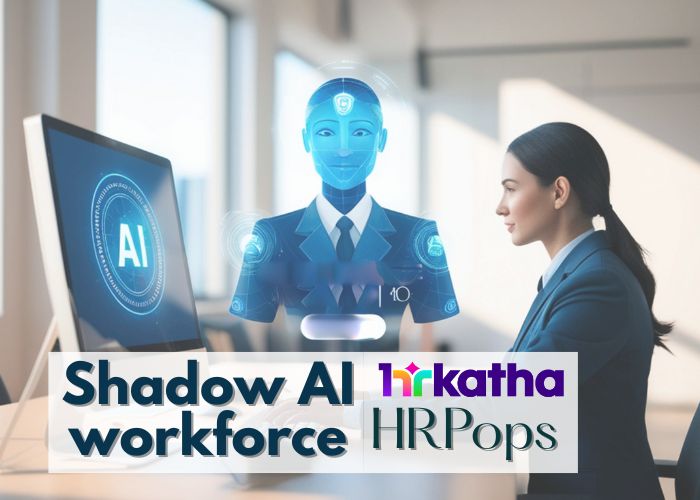
The shadow AI workforce describes employees using AI tools outside of formal company policies or IT oversight. Much like ‘shadow IT—when staff used unapproved apps or devices in the early 2000s—shadow AI refers to the hidden, unsanctioned use of artificial intelligence in the workplace.

Employees use tools such as ChatGPT, Copilot, or other generative AI apps to draft emails, analyse data, or brainstorm ideas—often without official approval or monitoring. It is not necessarily malicious. Most employees turn to these tools to save time, solve problems, or boost productivity. But because the activity is invisible to leadership, it creates serious risks around data security, compliance, and accountability.
History
The phrase ‘shadow AI’ began appearing in HR and technology discussions around 2023–2024, as generative AI tools became widely accessible. Initially, companies saw employees experimenting with AI chatbots to automate small tasks. By 2025, industry reports highlighted that this behaviour had become mainstream—employees were bypassing official systems to use external AI platforms, often uploading sensitive company data without realising the risks.
The concept mirrors the earlier rise of shadow IT, when workers adopted cloud apps such as Dropbox or Google Docs before companies had formal policies. Shadow IT forced organisations to rethink digital governance. Shadow AI is now doing the same—only faster, and with far higher stakes.
Why is it relevant for HR?
For HR leaders, shadow AI is not just a technology issue—it is a people issue. It affects how employees work, how organisations manage risk, and how future talent strategies are shaped.
Compliance and risk – Employees may unknowingly share confidential data with external AI tools, leading to breaches of privacy laws, intellectual property leaks, or regulatory violations. HR must work with IT and legal teams to set clear boundaries and educate staff about safe AI use.
Productivity and innovation – Shadow AI reveals that employees are eager to innovate and find faster ways of working. Rather than punishing this behaviour, HR can harness it by creating approved AI programmes and structured training—turning hidden experimentation into sanctioned innovation.
Culture and trust – If employees feel they must hide their use of AI, it signals a gap in communication and trust. HR can bridge this by encouraging open dialogue: asking staff how they use AI, what tools they prefer, and what support they need. Transparency builds a culture where AI is seen as a partner, not a threat.
Skills and career development – AI is changing the skills employees need. Routine tasks are being automated whilst human strengths—creativity, empathy, problem-solving—become more valuable. HR must update training programmes to prepare workers for this shift.
Vendor and contractor oversight – Shadow AI is not limited to employees. Contractors and vendors may also use AI tools without disclosure. HR policies should extend to the wider workforce ecosystem, requiring compliance declarations from partners.
The uncomfortable truth: HR may be part of the problem
Here’s the uncomfortable reality: shadow AI thrives where official AI policies are absent, unclear, or excessively restrictive. When employees feel that sanctioned tools are inadequate or that requesting approval is bureaucratic and slow, they go underground. It is the HR and leadership’s failure to keep pace with technological change that drives the behaviour they then seek to prohibit.
Some organisations respond with surveillance—monitoring employees’ devices, blocking AI websites, or demanding disclosure of every tool used. This approach breeds resentment and stifles the very innovation the organisation claims to want. It treats employees as compliance risks rather than creative problem-solvers.
Others ignore the issue entirely, hoping it will resolve itself. It won’t. As AI tools become more powerful and more embedded in daily work, the risks of unmanaged usage grow exponentially.
Turning shadow into light
HR leaders can respond by creating AI governance frameworks that balance safety with flexibility—clear guidelines that empower employees rather than restrict them. Offering training and awareness programmes ensures employees understand both the benefits and risks of AI use.
Collaborating with IT and compliance teams to monitor AI use without stifling creativity is essential. Recognising and rewarding responsible AI use turns shadow practices into official best practices.
The shadow AI workforce is not going away. It reflects a workforce that is curious, adaptive, and unwilling to wait for bureaucracy to catch up with technology. For HR, the choice is stark: police the shadows, or step into the light. The organisations that thrive will be those that choose the latter—guiding AI adoption rather than fighting it, and transforming a hidden risk into a strategic advantage.
1 Comment
This is a very insightful article on the concept of the “shadow artificial intelligence workforce.” I found it particularly interesting how you connected it with the earlier idea of shadow IT and explained how employees are increasingly using AI tools without official approval to improve productivity. It clearly shows that most employees are not acting maliciously, but are simply trying to work faster and smarter.