


Something is keeping the world awake at night—and it is not merely anxiety about the morning commute. Resmed’s sixth annual Global Sleep Survey, drawing on responses from 30,000 people across 13 countries, lands with the force of a midnight alarm: fewer than one in three people sleep well every night, and more than half manage restorative rest on only four nights a week or fewer. Awareness of sleep’s importance has never been higher. The quality of sleep has rarely been lower. Welcome to the great awareness–action gap.
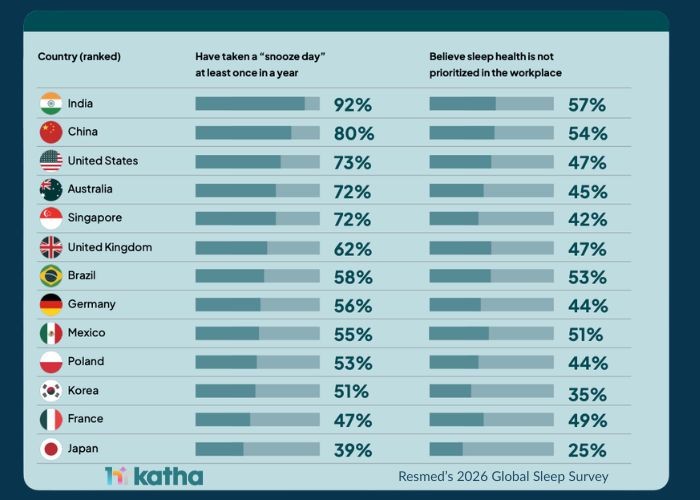
The numbers are striking enough on their own. But buried within the data is a figure that ought to unsettle every boardroom from Mumbai to Manchester: 92 per cent of Indian workers admit to having taken at least one “snooze day”—a sick day claimed not from illness but from sheer sleep deprivation—in the past year. That is not a rounding error. It is a structural problem wearing the disguise of a personal failing.
The geography of exhaustion
India does not merely top the snooze-day league table; it laps the field. Half of Indian employees take such days off four or more times annually, compared with 32 per cent of Americans, 30 per cent of Chinese workers, and 24 per cent each in Australia and Germany! Wait, there’s more—An alarming 30 per cent Indians are depressed due to poor sleep, needless to say most belong to Gen Z.
This is not simply a function of long hours or a young workforce, though both matter. It reflects something more systemic: a work culture where sleep is treated as optional, and the consequences of that assumption are now impossible to ignore.
Globally, 67 per cent of respondents say inadequate sleep directly impairs their focus and performance at work. Some 58 per cent blame high workloads for disrupting their sleep, while nearly half say their employer takes no meaningful interest in sleep health. The arithmetic is straightforward: tired workers underperform, and underperformance carries a cost.
Young, wired, and wide awake
The age dimension of the crisis is particularly revealing. Those aged 25 to 29—early-career professionals navigating deadlines, performance pressure and job insecurity—are both the most enthusiastic adopters of sleep-tracking technology and among the most frequent takers of snooze days.
This is not a contradiction. It is a portrait of a generation that is acutely aware of what it is losing, but structurally unable to reclaim it.
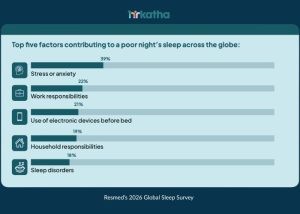
The scale of that adoption is itself striking. Wearable use for sleep tracking surged globally from 16 per cent to 53 per cent in a single year. India leads the way, with 51 per cent of respondents monitoring their sleep via smartwatch, ring or fitness band. The data is abundant; behaviour change is not. Awareness, it turns out, does not automatically translate into action when the underlying drivers—workload, stress and constant connectivity—remain unchanged.
A woman’s problem, writ large
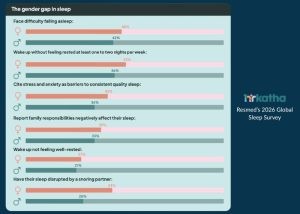
The gender dimension of the crisis demands equal attention. Nearly half of women report difficulty falling asleep, and more than half wake up without feeling rested at least once or twice a week.
Women are significantly more likely than men to cite stress, anxiety and family responsibilities as sleep disruptors. Many also report interrupted sleep due to partners’ snoring, adding yet another layer to an already fragmented rest cycle.
This is not merely a health statistic. It is an equity issue. Women continue to shoulder a disproportionate share of unpaid cognitive and emotional labour—the kind that does not end when the workday does. Any workplace intervention that ignores this reality risks addressing symptoms rather than causes.
The clinical gap
Perhaps the most telling finding is the gap between intent and action. Some 66 per cent of respondents say they would consult a doctor for persistent sleep problems. Only 23 per cent have actually done so.
Many do not consider their sleep issues serious enough. Others have normalised chronic exhaustion as an inevitable feature of modern life. Meanwhile, fewer than half say a healthcare provider has never raised sleep during a routine consultation.
The result is predictable: a widespread, underdiagnosed problem with significant health implications. Poor sleep is linked to cardiovascular disease, diabetes, depression and cognitive decline. In India, nearly a third of respondents report feelings of depression linked to inadequate sleep—an outcome with consequences that extend well beyond the office.
Sleep and the structure of work
If there is a single thread connecting these findings, it is this: sleep deprivation is not merely an individual failing. It is, increasingly, a by-product of how work is designed.
Long hours, blurred boundaries and the expectation of constant availability have turned rest into a residual activity—something to be fitted in after work has taken its share. In such a system, sleep becomes negotiable. Biology, unfortunately, does not.
Flexible working arrangements offer one of the few structural levers available to employers. A majority of respondents say flexibility would improve their sleep. Yet flexibility often remains unevenly applied or culturally constrained, limiting its real impact.
What is to be done
The solutions themselves are not complex. Consistent sleep schedules, better sleep environments and reduced screen exposure are well understood. But individual interventions will have limited effect unless organisational practices evolve alongside them.
For employers, this means recognising sleep as a legitimate component of workforce wellbeing—and, by extension, productivity. It may also mean confronting uncomfortable truths about workload, expectations and the implicit rewards attached to overwork.
The price of sleeplessness
India’s 92 per cent figure should be the number that concentrates minds. It represents not just lost productivity, but a cumulative toll on the health and effectiveness of a workforce the country can ill afford to exhaust.
The world, it seems, has finally woken up to the importance of sleep.
The next step is far more difficult: designing work in a way that allows people to actually get some.